


Most homes don't fall apart during normal weeks. They fall apart during transitions. A new roommate moves in. A partner joins the household. A live-in nanny leaves. A parent moves into the spare room. Suddenly routines that ran fine for two people are absorbing a third set of habits, a new set of keys, a new set of logins, and a pile of unwritten expectations nobody thought to say out loud.
Transitions hurt because a household is a system, and change hits every part of it at once — who does what, who has access to what, who owns which decision, and what physically belongs to whom. Try to handle all of that in one panicked weekend and you'll be cleaning up the mess for months.
A phased approach fixes this. You don't onboard a new household member in a day. You stage it across 30, 60, and 90 days so the load spreads out and friction points surface while they're still small enough to deal with. This is a household onboarding checklist built like an operational playbook, not a moving-day to-do list.
Why transitions break households that otherwise run fine
The average household has no real "add a person" or "remove a person" process. There are routines for the steady state, but nothing for the change itself. So when change comes, everyone improvises — and improvisation under time pressure produces the same predictable failures every time.
Three things break, almost always in this order.
Access breaks first. Keys, garage codes, streaming logins, the shared calendar, the Wi-Fi password, the Amazon account, the thermostat app. When someone moves in, access gets handed out reactively — a login here, a spare key there — with no record of what was shared. When someone moves out, nobody remembers what to revoke. Months later you realize an ex-roommate still has the door code and access to the shared grocery account.
Role ownership breaks second. Two people had an unspoken division of labor. Add a third and the boundaries blur. Now nobody's sure who's on trash, who handles the dog's vet appointments, who pays the internet bill. Tasks get double-done or dropped entirely. This is the "I thought you were handling that" era, and it can drag on longer than anyone expects.
Inventory and money break last, but hurt longest. Whose furniture is in the living room? Who paid for the shared groceries this month? What's a joint expense versus a personal one? When the household eventually changes again — someone leaves, a relationship ends — these unresolved questions turn into real conflict because there's no record of who contributed what.
The core problem: transitions expose whatever your household never bothered to document. A phased playbook forces that documentation to happen before it becomes an argument.
The three transition types (they're not the same)
People lump all household changes together, but they behave very differently operationally. A quick comparison:
Stop losing track of household duties.
Famioly helps you organize, assign & complete family tasks efficiently.
- Centralized task management
- Shared family calendar
- Budget & expense tracking
No credit card required
| Transition | Main risk | Speed to full integration | Reversal likelihood |
|---|---|---|---|
| Moving in (roommate/family) | Access sprawl, unclear cost splits | Medium (60–90 days) | Moderate |
| New partner joining | Emotional friction over role and money boundaries | Slow, intentional (90+ days) | Low but high-stakes |
| Offboarding (someone leaving) | Forgotten access, unresolved shared assets | Should be fast (30 days) | N/A |
The mistake that comes up constantly: households treat a new partner move-in like a roommate move-in, granting full financial and decision access on day one because it feels cold not to. Then, if things don't work out, they're untangling joint accounts and shared purchases with no record of who owned what. Speed isn't kindness here. Structure is.
Offboarding is the opposite problem — people go too slow, letting access and loose ends linger for months out of politeness or avoidance. Offboarding should be the fastest and most mechanical of the three.
The 30/60/90 structure, and why it maps to how people actually adjust
The phases aren't arbitrary. They roughly match how real integration happens.
-
Days 0–30 — Stabilize. Get the essentials working so daily life doesn't grind. Access to what's needed, basic role clarity, physical setup.
-
Days 31–60 — Distribute. Hand over real ownership of tasks and start folding the new person into decisions and cost-sharing.
-
Days 61–90 — Normalize. Full integration, review what's working, adjust the split, lock in the long-term arrangement.
If you've already built out a household operating system, this playbook slots right on top of it — the phases are just the on-ramp that gets a new person into your existing roles, triggers, and cadence matrix without breaking it.
Below is a rough map of how the three phases connect to each other:
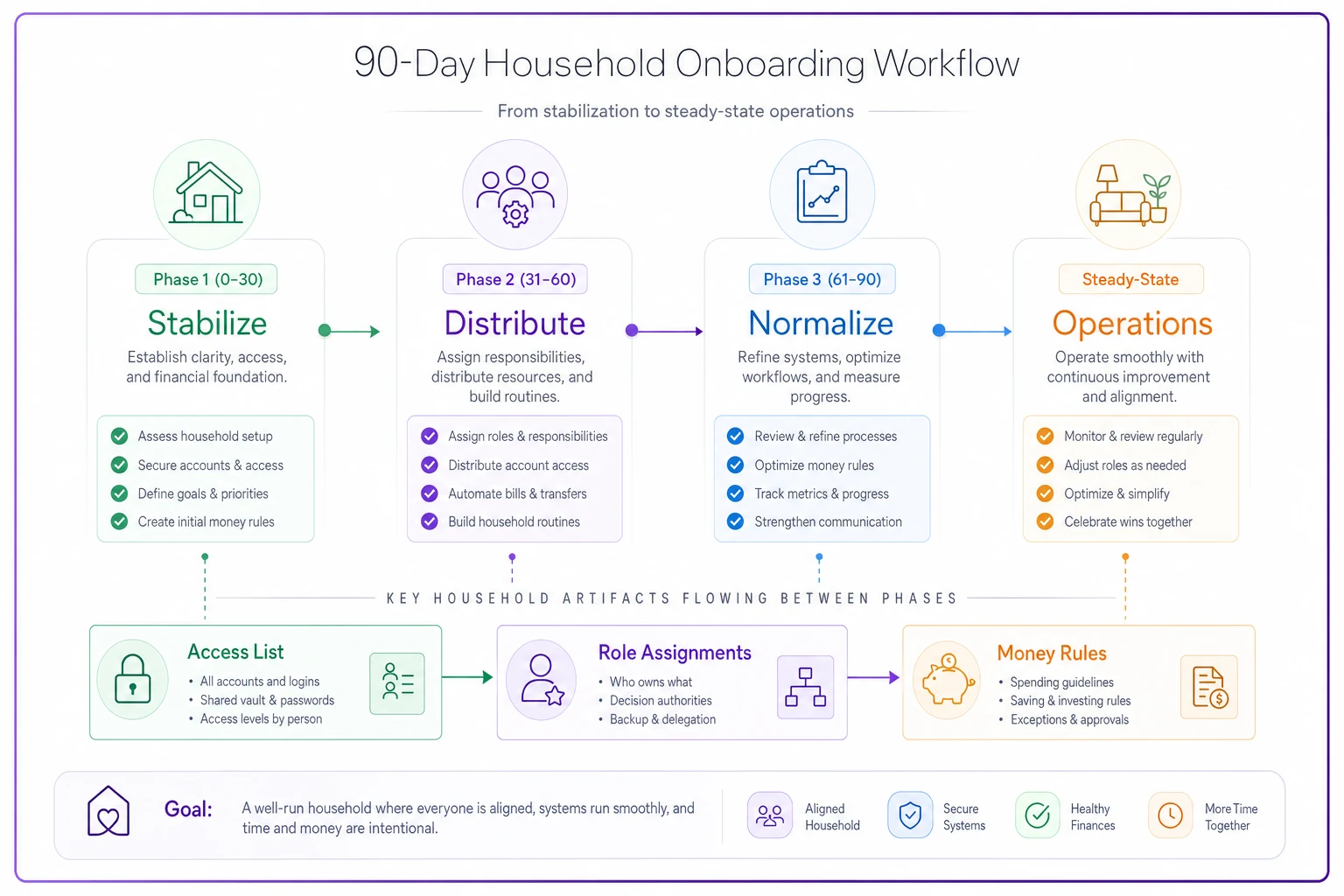
Each phase feeds directly into the next, and the outputs of each — the access list, the role assignments, the money rules — carry forward rather than being rebuilt from scratch.
[Phase 1: Stabilize (0–30)] | v [Phase 2: Distribute (31–60)] | v [Phase 3: Normalize (61–90)] | v [Steady-State Operations]
Phase 1 (0–30): Stabilize
The goal here is functional, not optimal. You're getting the person able to live and contribute without stepping on anyone.
-
Grant minimum-viable access only. Wi-Fi, door and garage entry, the shared calendar, and any app they genuinely need in week one — the grocery list, say. Nothing financial yet. Write down every single thing you share in one place. That list becomes your offboarding checklist later, whether you realize it now or not.
-
Do a rough inventory pass. Photograph and note what belongs to whom in shared spaces. Feels awkward with a partner; do it anyway, framed as "so we never have to guess later." Takes twenty minutes and saves real grief.
-
Assign three or four core tasks, clearly owned. Not the whole household. Just enough that the new person is contributing and knows exactly what's theirs.
-
Set the first negotiation checkpoint for day 30. Put it on the calendar now. That's the moment you revisit cost splits and add responsibilities.
The pattern to avoid: dumping everything at once. New person gets every login, every task, every expectation on day one, gets overwhelmed, and quietly drops half of it. Slow the access, and actual adoption goes up.
Phase 2 (31–60): Distribute
Now you hand over real ownership and start sharing money.
-
Expand access to what the person now needs — a shared expense app, the thermostat, the vet portal. Log each addition on the same access list.
-
Move from "here are your tasks" to "here's your domain." Instead of individual chores, give them ownership of an area — kitchen supplies, pet care, whatever fits. Ownership sticks better than task lists because the person decides how, not just what.
-
Have the first real money conversation. What's shared, what's personal, how does the split work? Decide the rule, not just this month's number, so you're not renegotiating every four weeks.
-
Run a short check-in. Doesn't need to be a whole production — the format from a tight 20-minute family meeting works well for a transition review. Ten minutes, three questions: what's working, what's unclear, what do we adjust.
Role ownership fails when it's assigned but never verified. Saying "you handle groceries" means nothing if nobody notices when the household runs out of coffee for a week. The day-60 checkpoint is where you check whether ownership is actually being exercised, not just labeled.
Phase 3 (61–90): Normalize
By now the person should be a full participant. This phase is about locking things in and doing an honest review.
-
Finalize access at the long-term level. Full member gets full access; a temporary roommate stays on a limited set. Update the master list.
-
Reconcile the inventory and money. Confirm the shared/personal split, settle any imbalances from the first two months, agree on how future shared purchases are logged.
-
Fold them fully into the routine cadence. New people often reveal that the household's default routines never actually fit everyone — a good moment to think about why standard routines fail across different household types and adjust rather than force the newcomer into a system built for two.
-
Run the final negotiation checkpoint. Everything's on the table: split, roles, expectations. After this, you drop out of transition mode and back into steady-state operations.
This phase often feels anticlimactic, which is actually the point. If you've run the first two phases properly, there shouldn't be much to argue about at day 90 — just a few adjustments and an agreement that the arrangement is settled.
The offboarding playbook (the one everyone skips)
Offboarding is where households leak money and security, because emotionally it's the hardest moment to be systematic. Someone's leaving — a roommate, a live-in helper, a relationship ending — and the last thing anyone wants is a checklist. But that's exactly when a checklist saves you.
Run this within 30 days of departure, ideally within the first week:
-
Revoke every access on the master list. This is why you kept that list from day one. Door codes, garage, Wi-Fi (change it), streaming logins (change passwords, not just remove the profile), shared financial apps, the calendar, cloud photo accounts, the front-door camera app. People forget the camera app constantly.
-
Reconcile the inventory. Walk the shared spaces against the photos you took. Sort what leaves, what stays, what gets reimbursed.
-
Settle shared money. Final split of joint expenses, close or split shared accounts, remove authorized users.
-
Redistribute the orphaned roles. Whatever domains the leaving person owned now need new owners — and this is effectively a re-onboarding for the remaining household, so give it real attention rather than assuming it'll sort itself out.
-
Update the standing documentation. Remove them from emergency contacts, medical authorizations, school pickup lists, anywhere their name still lingers.
Change passwords for streaming logins rather than just removing the profile.
The single most common offboarding failure: revoking the obvious access (they hand back the key) and forgetting the digital access (they still get every shared calendar invite and can log into the grocery account). Digital access is invisible, so it's what lingers for months.
When a full 30/60/90 playbook makes sense — and when it doesn't
When it's worth it: any transition meant to be long-term or shared financially. A partner moving in, a family member joining, a live-in caregiver, a roommate on a real lease. Anything where money, access, or roles genuinely intertwine deserves the full staged approach.
When it's overkill: a two-week houseguest, a college kid home for summer, a short-term situation with no financial entanglement. Forcing a 90-day playbook on something temporary is just bureaucracy. A light version works fine — an access list and a couple of agreed responsibilities, nothing more.
Who should genuinely slow down: anyone tempted to skip the negotiation checkpoints because "we're all adults, we'll figure it out." Those are the households that end up in the worst untangling situations. The checkpoints exist so the awkward conversation happens on a scheduled Tuesday instead of during a blowup.
A real scenario
A three-person household — two long-term partners plus an aging parent moving into a converted downstairs room. They'd never run a transition deliberately before, so the parent's first month was chaos: no calendar access meant appointments got double-booked, no defined role left the parent either doing nothing or over-inserting into everything, and a fuzzy money arrangement had the parent quietly paying for groceries with no reconciliation.
They restarted with a phased playbook. Month one: calendar access, one owned domain (the parent took over managing the pantry and weekly shopping list, which gave a real sense of contribution), and a day-30 checkpoint. Month two: a clear money rule — parent contributes a fixed amount monthly toward shared costs, no more ad-hoc grocery payments — and expanded calendar and appointment access. Month three: full integration and a final review.
The measurable change was modest but real. Double-booked appointments dropped from a near-weekly headache to almost none, and somewhere around $200–$300 in untracked monthly contributions disappeared as a source of confusion because there was now a rule instead of a guess. The bigger win was harder to quantify: the parent felt like a contributing member of the household within a month instead of a guest who never quite landed.
Bringing it together
Household transitions aren't emotional events with some logistics attached — they're operational events with emotions attached. Treat them like operations and the emotions get easier, because nobody's stressed about forgotten door codes or unspoken money assumptions when there's a clear playbook running underneath.
Keep three artifacts and you're most of the way there: a master access list that grows during onboarding and drives offboarding, a shared inventory record so you never argue about who owns what, and scheduled negotiation checkpoints at 30, 60, and 90 days so the hard conversations happen on a calendar instead of in a crisis.
Do that, and the next time your household absorbs a change — a move-in, a new partner, a goodbye — it won't cost you a chaotic month. It'll cost you three short check-ins and a list you already had.
Keep three artifacts and you're most of the way there: a master access list that grows during onboarding and drives offboarding, a shared inventory record so you never argue about who owns what, and scheduled negotiation checkpoints at 30, 60, and 90 days so the hard conversations happen on a calendar instead of in a crisis.
Do that, and the next time your household absorbs a change — a move-in, a new partner, a goodbye — it won't cost you a chaotic month. It'll cost you three short check-ins and a list you already had.
Ready to simplify your household management?
Join thousands of families using Famioly to save time, reduce home management stress, and keep the household running smoothly.