



Every family routine eventually hits the same breaking point. Not because someone forgot to set an alarm or because the kids moved too slowly. The routine breaks because it was built for a household structure that doesn't exist anymore.
Think about morning routines. A single parent with two kids needs completely different timing buffers than a blended family juggling three drop-off locations. A multigenerational home where grandma handles breakfast while parents prep for work operates nothing like a nuclear family where one person manages everything before 7:30am.
The problem gets worse when household structures shift. Your perfectly calibrated routine from last year falls apart when your teenager starts zero-period band practice. Or when your mother-in-law moves in and suddenly you're coordinating three generations' schedules. Or when joint custody means your routine needs to work with half the people every other week.
Most families try fixing broken routines by adding more reminders or waking up earlier. That misses the actual problem — you're using the wrong routine template for your household type.
Why cookie-cutter routines fail specific household structures
Standard routine advice assumes a two-parent household with predictable schedules and no external complications. That's maybe 20% of actual families today.
Single-parent households face time compression that standard routines simply can't handle. When one person manages morning prep, school runs, work, pickups, homework help, dinner, and bedtime, there's zero margin for routine failures. A delayed school bus doesn't just mean running late — it cascades into missed work meetings, scrambled childcare backup, and evening activities getting canceled.
Blended families deal with coordination complexity that doubles or triples normal household operations. Different rules at different houses. Multiple sets of school supplies. Varying weekend schedules. Kids arriving Sunday night without homework done, then leaving Wednesday with half their stuff at the wrong house. Standard routines assume everyone starts from the same baseline each morning. Blended families never have that luxury.
Multigenerational homes navigate authority overlaps and cultural routine differences that nobody really prepares you for. Grandparents who believe kids should eat hot breakfast clash with parents rushing to get everyone out by 7:15am. Different generational approaches to homework, bedtime, screen time, and chores create routine conflicts constantly. Add elderly care needs on top of children's schedules and you've got something genuinely complex.
Each structure needs fundamentally different routine architecture. Not just tweaked timing or adjusted responsibilities — completely different operational frameworks.
The hidden routine failures nobody talks about
Beyond the obvious morning chaos, certain routine failures show up consistently for specific household types.
Stop losing track of household duties.
Famioly helps you organize, assign & complete family tasks efficiently.
- Centralized task management
- Shared family calendar
- Budget & expense tracking
No credit card required
Information handoffs break constantly in blended families. The orthodontist appointment scheduled during mom's week that dad doesn't know about. The science project due Monday that nobody mentioned during Sunday's transition. Permission slips signed at one house but needed at school from the other. These aren't communication problems — they're systematic routine gaps.
Role confusion undermines multigenerational households daily. Who's actually in charge of homework help when three adults are home? Does grandma's "just one cookie before dinner" override mom's nutrition rules? When dad works late, does teenage sister or grandmother handle bedtime for younger kids? Without explicit role definitions, routines become suggestions that nobody consistently follows.
Single parents hit capacity walls that standard routines never account for. When you're the only adult, there's no handoff option during routine execution. Can't be in two places at once when soccer practice and piano lessons overlap. Can't maintain evening routine when you're sick. Can't enforce consequences consistently when you're also the only source of comfort and support.
The worst part: these failures compound. Information gaps lead to missed activities, which create trust issues, which undermine routine compliance, which increases household stress, which makes information sharing even worse. The spiral accelerates until families abandon routines entirely.
Building routines that match your household reality
Single-parent routine framework
Single-parent households need routines built on parallel processing and hard boundaries. Since you can't add more adults, you add more simultaneous activities and stricter cutoffs.
Morning routine example:
-
6
00am: Parent shower while kids eat pre-set breakfast
-
6
20am: Kids dress while parent preps lunches
-
6
40am: Bathroom rotation (strictly timed 5-minute slots)
-
7
00am: Final check and load car
-
7
10am: Hard departure (no exceptions)
The key difference from standard routines: everything happens in parallel, nothing depends on sequential completion, and timing boundaries are absolute. Missing the 7:10 departure means calling school about tardiness, not rushing to make up time.
Evening routine framework:
-
Single dinner time (no separate kid/adult meals)
-
Homework happens during dinner prep
-
All screens off at 7
30pm (parent included)
-
Bathing every other night (not daily)
-
15-minute bedroom reset while kids brush teeth
-
One story/talk time, then lights out
Notice the trade-offs. Less individual attention, more rigid timing, fewer choices. But the routine actually works with one adult managing everything.
Set a visible hard departure alarm (like 7:10) and treat it as non-negotiable to protect time buffers.
Blended family routine architecture
Blended families need redundancy, documentation, and transition protocols that standard families never consider.
Weekly transition routine:
-
Sunday 5pm
Receiving parent checks shared calendar for week ahead
-
Sunday 6pm
Kids unpack and sort items (school bag stays packed)
-
Sunday 7pm
Week-ahead briefing (appointments, tests, activities)
-
Monday 6am
Normal morning routine begins with verification checklist
The architecture assumes information loss between houses. Everything important gets verified, documented, or duplicated. School supplies exist at both houses. Permission slips get photographed and shared. Medication counts get logged at every transition.
Blended family morning routines need buffers that single-household routines don't:
-
Extra 10 minutes for "I forgot my project at mom's house"
-
Backup supplies for items left at the other house
-
Digital homework submission as default
-
Clothes at both houses (no packing between transitions)
Multigenerational routine structure
Multigenerational households need explicit role ownership and cultural negotiation built directly into routine design.
Role assignment matrix:
| Routine Component | Primary Owner | Backup Owner | Observer Only |
|---|---|---|---|
| Morning wake-up | Parent | Teen sibling | Grandparent |
| Breakfast prep | Grandparent | Parent | Kids |
| Homework check | Parent | Grandparent | Teen sibling |
| Bedtime enforcement | Parent | Grandparent | Nobody |
| Weekend activities | Parent | Grandparent (input) | Kids (requests) |
Notice the "observer only" column. This prevents authority conflicts by explicitly stating who doesn't make decisions for specific routines.
Conflict resolution protocol:
-
Cultural preferences get discussed Sunday evenings
-
Parent decisions override for health/safety
-
Grandparent preferences prioritized for meals
-
Kids get choice within predetermined options
-
Disagreements get noted for next Sunday's discussion
This isn't about winning arguments — it's about preventing routine breakdown from predictable conflicts.
Visual workflow for designing routines:
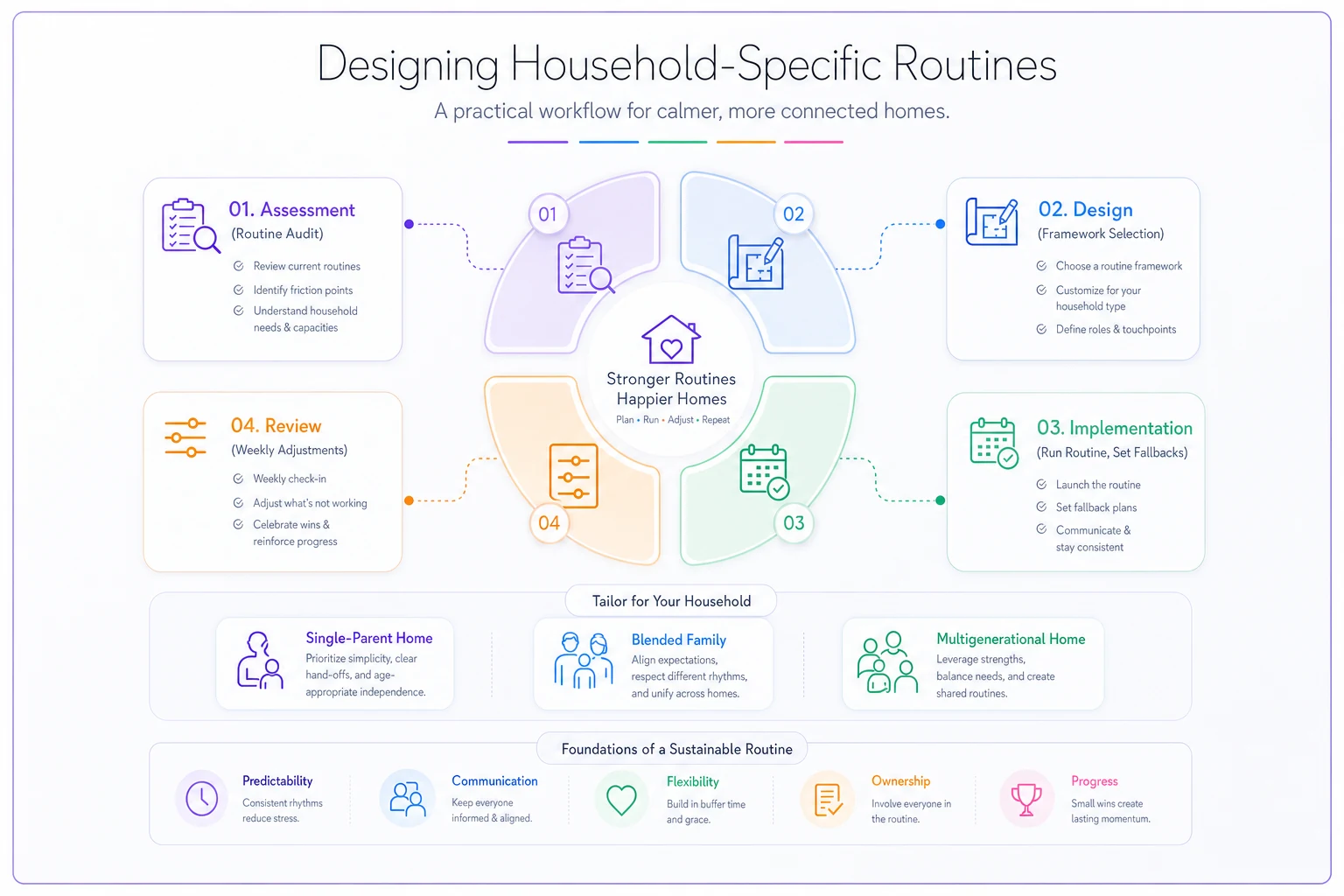
A simple workflow to follow when you're redesigning a routine.
Critical timing differences per household type
Timing makes or breaks routines, but optimal timing varies drastically by household structure.
Single-parent households need front-loaded routines. Everything critical happens early when energy is highest. By evening, both parent and kids are depleted. Trying to maintain complex evening routines guarantees failure. Better to accept simple dinners and basic bedtime than pretend you'll sustain elaborate evening structure after a full day.
Blended families need transition buffers that seem excessive to intact families. Sunday night isn't just bedtime — it's integration time. Monday morning needs an extra 20 minutes versus Tuesday through Friday. Friday afternoon requires pack-up protocols. These aren't inefficiencies — they're necessary operational buffers.
Multigenerational homes need staggered timing that prevents bathroom bottlenecks and kitchen conflicts. If grandparents wake at 5:30am, parents shower at 6:00am, and kids get ready at 6:30am, everyone gets necessary time without collision. Put everyone on the same 6:30am schedule and watch the routine implode.
Timing flexibility also differs by structure. Single parents need rigid timing because there's no backup. Blended families need flexible timing to accommodate two-household variables. Multigenerational homes need mixed timing — rigid for shared resources, flexible for individual activities.
Fallback rules that prevent routine collapse
Every routine needs failure protocols. But the fallback rules change based on household structure.
Single-parent fallback rules focus on minimum viable completion:
-
Breakfast becomes granola bars in the car
-
Homework help becomes 15-minute check instead of full review
-
Bedtime story becomes 5-minute talk
-
Evening activities get canceled if morning ran late
-
Weekend catches up what weekdays couldn't complete
The principle: maintain routine skeleton even when the full routine fails. Kids still eat breakfast, do homework, and have some bedtime connection — just in degraded form.
Blended family fallbacks address information and logistics gaps:
-
Missing items trigger same-day delivery
-
Forgotten events get makeup coordination between houses
-
Homework gaps get teacher emails with both parents copied
-
Transition delays get documented for custody records
-
Emergency handoffs happen at neutral locations
These aren't punishments — they're operational protocols that prevent small failures from breaking co-parenting relationships.
Multigenerational fallbacks manage role confusion and capacity issues:
-
When parent unavailable, grandparent follows written routine card
-
When grandparent overwhelmed, teen takes specific responsibilities
-
When cultural conflict arises, default to pre-agreed rules
-
When nobody available, neighbors or paid help activate
-
When routine breaks completely, reset happens next Sunday
The key: fallback rules get decided during calm moments, not during routine failure. Everyone knows what happens when the standard routine breaks.
Technology that holds routines together
The right operational tools transform routine management from constant negotiation to automatic execution.
Shared calendaring goes beyond basic calendar apps for complex households. Blended families need custody calendars that auto-adjust activities based on placement. Multigenerational homes need multiple permission levels — grandparents see medical appointments but not parent date nights. Single parents need calendars that auto-notify emergency contacts when coverage gaps appear.
Task management for households differs from work productivity systems. Kids need visual task boards they can update themselves. Parents need verification workflows — did homework actually get completed or just claimed complete? Grandparents need simplified interfaces that don't require smartphone expertise.
Information persistence prevents routine failure from information loss. Storing medication schedules, allergy lists, emergency contacts, school schedules, activity details, and preference notes where everyone can access them means that when routines break, anyone can step in with full context.
Communication protocols embedded in technology reduce friction. Automated handoff reports for custody transitions. Scheduled check-ins for single parents. Rule reminders for multigenerational conflicts. Not more communication — structured communication that prevents routine breakdown.
Operational software designed for household management handles these requirements without turning everyone into project managers. The platform maintains routine integrity while family members just execute their parts. AI automation can trigger reminders, escalate uncompleted tasks, and adjust routines when calendar conflicts arise.
When to break your own routine rules
Rigid routines fail just as often as no routines. Knowing when to break your own rules prevents routine rebellion.
Single parents should break routine for:
-
Kid achievements that deserve real celebration
-
Mental health days when everyone's genuinely depleted
-
Unexpected opportunities for joy
-
When routine enforcement is damaging the relationship
-
Emergency support for friends or family
The broken routine becomes a positive memory, not a system failure. Kids learn routines serve the family, not the reverse.
Blended families should suspend routine for:
-
First week after major transitions
-
Holidays involving travel between houses
-
When loyalty conflicts arise
-
During custody modification periods
-
Family emergencies at either house
These aren't failures — they're strategic routine pauses that preserve long-term stability.
Multigenerational homes should flex routine for:
-
Cultural celebrations that don't fit standard schedules
-
Grandparent health changes
-
Visiting relatives
-
Seasonal schedule shifts
-
Generational bonding opportunities
The flexibility demonstrates respect across generations while keeping core routine structure intact.
The compound effect of routine-household alignment
When routines match household structure, the effects compound beyond simple schedule management.
Single parents report that proper routine architecture reduces daily decision fatigue significantly. Not having to negotiate every transition saves mental energy for actual parenting. Kids develop independence faster because routines have no backup adult to rely on.
Blended families with structured routines see co-parenting conflicts drop noticeably. One family tracked a drop from around twelve monthly co-parenting arguments to two after implementing proper transition protocols. Kids stopped playing houses against each other because expectations were consistent.
Multigenerational households with clear role definition report relationship improvements across all generations. Grandparents feel valued but not exploited. Parents maintain authority while respecting elders. Kids understand who to approach for different needs.
The operational improvements are measurable. Morning departure delays drop from 15-20 minutes to under 5. Homework completion rates improve substantially. Bedtime resistance decreases when routines become predictable patterns rather than nightly negotiations.
The real value shows up in reduced household stress. Parents stop feeling like they're constantly failing. Kids stop resisting because routines make sense for their reality. Extended family stops creating conflict through well-meaning interference.
Making the shift to structure-specific routines
Transitioning from broken standard routines to household-specific routines takes deliberate phases.
Start with a routine audit. Document current routine attempts for one week. Note every failure point, every conflict, every time someone says "this isn't working." Don't try fixing anything yet — just observe and document.
Next, identify structural mismatches. Which routine assumptions don't match your household reality? Where are you force-fitting standard advice into a non-standard structure? What routine elements require resources you don't actually have?
Design new routine architecture based on your actual household type. Use the frameworks above as starting points, but modify for your specific situation. If you're a single parent managing chronic illness, add extra fallback protocols. If you're a blended family with a special needs child, build in therapy and medication management. If you're multigenerational with language barriers, add translation tools.
Implement gradually. Don't revamp everything at once. Start with the most painful routine failure — usually mornings. Run the new routine for two weeks before adding another component. Let each piece stabilize before expanding.
Build in review cycles. Every Sunday, spend 10 minutes reviewing what worked and what didn't. Adjust timing, modify responsibilities, or activate fallback rules as needed. Routines are living systems that need constant minor adjustments.
Your routine architecture becomes your family's operational foundation
The right routine structure doesn't just organize your days — it fundamentally changes how your household operates. Single parents stop apologizing for not being two people. Blended families stop pretending they're traditional nuclear families. Multigenerational homes stop fighting the same cultural battles every week.
When routines match household reality, energy goes toward growth instead of constant crisis management. Kids develop skills appropriate for their household structure. Parents maintain sanity while managing complexity. Extended family contributes without creating chaos.
This isn't about perfection. Even well-designed routines fail sometimes. The difference is that structure-specific routines fail gracefully with clear recovery protocols. A missed morning doesn't cascade into a ruined week. A transition hiccup doesn't trigger custody warfare. A generational disagreement doesn't undermine parental authority.
Most importantly, everyone stops pretending. Single parents stop pretending they have partner support. Blended families stop pretending both houses operate identically. Multigenerational homes stop pretending everyone agrees on everything. The honesty embedded in proper routine design creates relief that no amount of trying harder ever could.
Your household structure isn't a limitation to work around. It's the reality to build from. When routines embrace that reality instead of fighting it, daily operations transform from exhausting battles into sustainable systems. The same challenges exist, but now you have architecture designed to handle them.
Stop using routine templates built for someone else's family. Build routines that match your actual household structure, with all its complexity and constraints. That's when routines stop being aspirational fiction and become operational reality.
Ready to simplify your household management?
Join thousands of families using Famioly to save time, reduce home management stress, and keep the household running smoothly.