


Sunday night rolls around. You gather everyone for the "weekly family meeting" you swore would fix the chaos. Twenty minutes later, Dad's checking fantasy football scores, your teenager is half-listening while texting, and somehow you've spent fifteen minutes debating whether pizza counts as a vegetable for Tuesday's dinner.
Nothing gets decided. The same issues pop up next week. The laundry situation remains a mystery, nobody knows who's picking up groceries, and that permission slip still isn't signed.
The families who actually close their action items don't have more discipline or better kids. They have a better format.
Why family meetings fail (and it's not because your kids hate structure)
Most families treat their weekly meeting like a casual check-in. No agenda, no clear roles, no tracking system. Someone mentions the broken dishwasher, another person brings up soccer practice conflicts, and before you know it, you're having three parallel conversations about completely different timeframes.
The meeting becomes a venting session disguised as planning. Everyone talks, nobody writes anything down, and by Wednesday you're arguing about who was supposed to call the repair guy.
The operational breakdown happens in three places:
Without assigned roles, one parent ends up playing referee, note-taker, and timekeeper simultaneously. Usually while also trying to contribute to the actual discussion. It's like trying to coach a basketball game while also playing point guard.
Action items get mentioned but never captured. "Someone should check if we need more detergent" becomes a floating task that nobody owns. Two weeks later, you're washing clothes with dish soap because everyone thought someone else handled it.
There's no follow-up mechanism. Even when tasks get assigned, they disappear into the void between meetings. No reminders, no check-ins, no accountability. Just a vague hope that everyone remembers their part.
The 20-minute framework that changes everything
Here's what actually works: a tight structure with three distinct phases, assigned roles that rotate weekly, and a simple visual tracking system everyone can see.
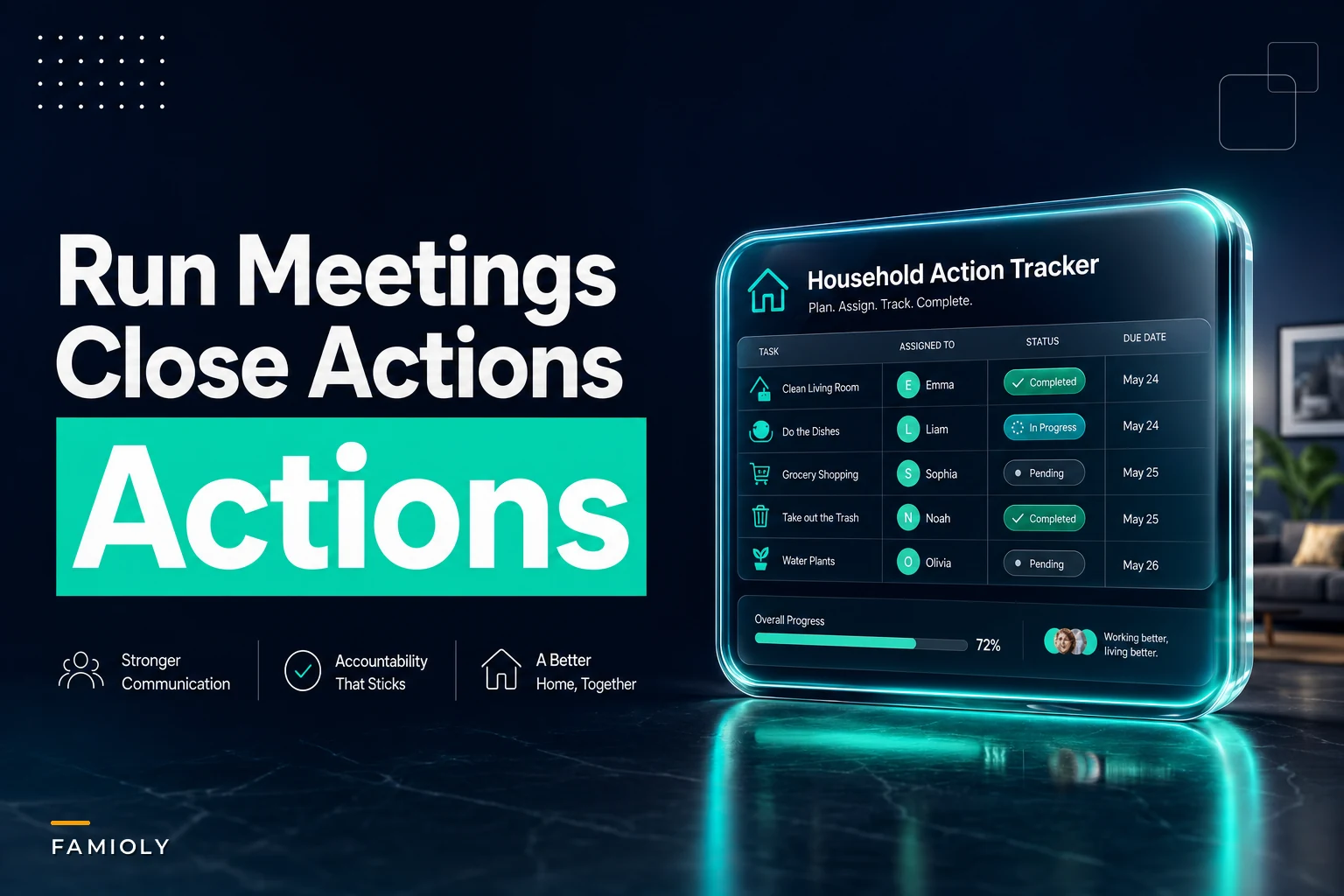
Stop losing track of household duties.
Famioly helps you organize, assign & complete family tasks efficiently.
- Centralized task management
- Shared family calendar
- Budget & expense tracking
No credit card required
Phase 1: Status Check (5 minutes)
Start with last week's action items. Not new problems, not future planning—just a rapid check on what was supposed to happen. Did Tommy's science project materials get bought? Did the garage actually get cleaned out? Binary answers only: done or not done.
This phase needs a timekeeper who cuts off explanations. You're not solving problems yet, just getting the lay of the land. If something didn't happen, mark it and move on.
Phase 2: This Week's Operations (10 minutes)
Now you tackle the upcoming week. But here's the critical difference—you're only discussing operational items with clear deadlines in the next seven days. Not summer vacation planning, not college discussions, just this week.
The note-taker captures everything on a simple tracking board (physical whiteboard or shared digital doc). Each item gets:
-
What needs to happen
-
Who owns it
-
When it's due
-
Any dependencies
Your 12-year-old needs a ride to practice Thursday? That's Dad's action item. Groceries need restocking? Mom takes it, but kids submit their list items by Tuesday night. Every task has one owner—never "someone" or "we'll figure it out."
Phase 3: Rapid Planning (5 minutes)
Last phase covers anything beyond this week that needs immediate input. Doctor's appointments next month, vacation dates, school events coming up. These become action items for research or scheduling, not discussion topics.
If it can't be resolved in two minutes, it becomes an action item for someone to investigate and report back next week.
A quick visual of the three-phase flow.
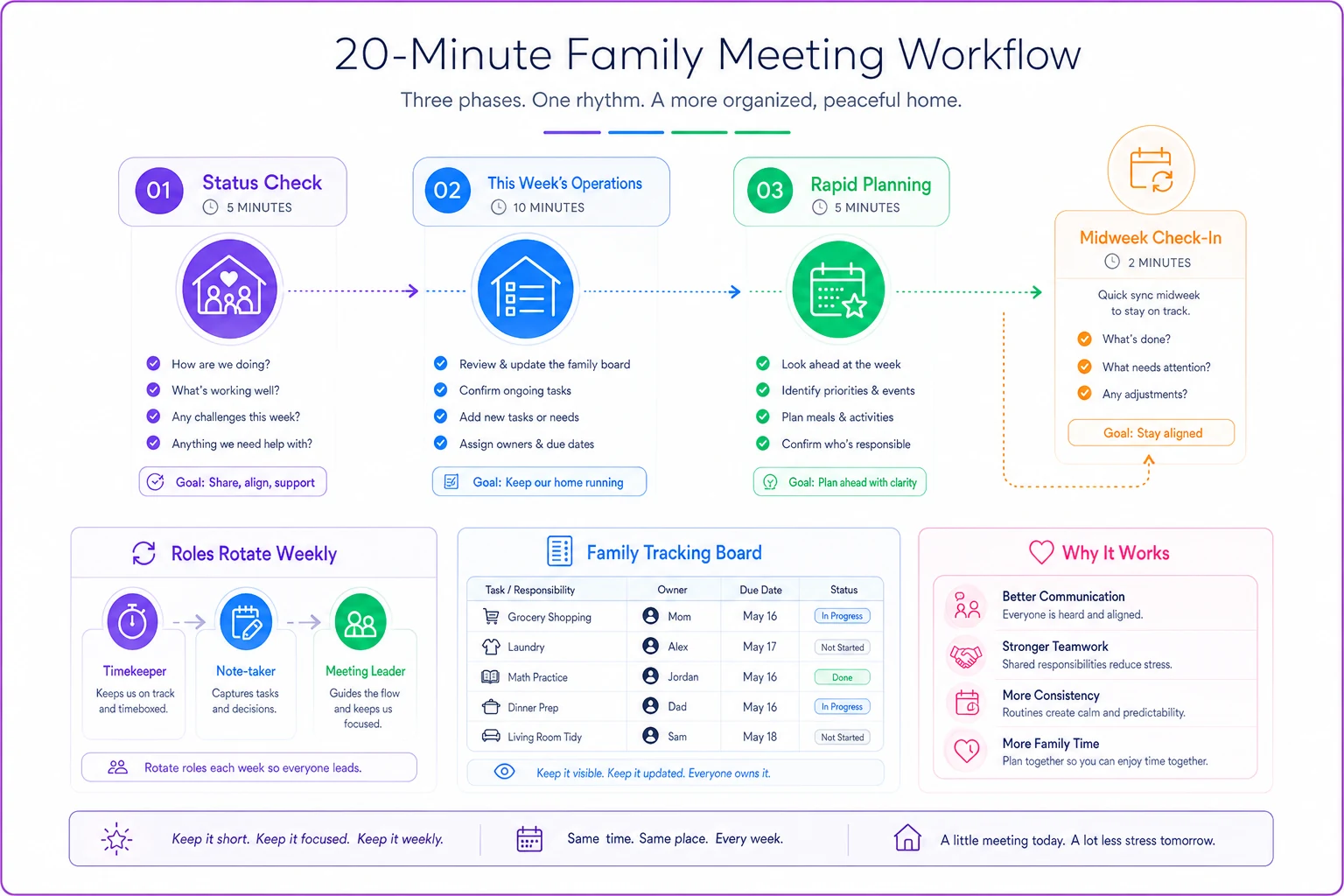
This flow shows who does what and when in a single glance.
Every task has one owner—never "someone" or "we'll figure it out."
The tracking board that makes accountability automatic
Forget complicated project management systems. You need something the whole family can update without thinking.
Simple Weekly Tracking Format
| Action Item | Owner | Due | Status | Notes |
|---|---|---|---|---|
| Buy science fair posterboard | Mom | Tuesday | ✓ Done | Got extra for next project |
| Schedule dentist appointments | Dad | Thursday | In Progress | Calling tomorrow morning |
| Submit field trip form + $20 | Sarah | Wednesday | Not Started | Money in envelope |
| Clean out sports bag | Jake | Saturday | Not Started | - |
| Research summer camps | Mom | Next Sunday | In Progress | Found 3 options |
Keep this visible all week. Stick it on the fridge, share it in the family group chat, or use a shared note everyone can edit. The visibility alone drives completion—nobody wants to show up Sunday with their column full of "not started" items.
Roles that rotate (and why your 8-year-old should sometimes run the meeting)
Three roles, rotating weekly:
Timekeeper: Moves the meeting along, announces phase transitions, cuts off tangents. This person has authority to interrupt anyone, including parents. When the 10-year-old tells Dad his story needs to wait, something magical happens—everyone starts respecting the structure.
Note-taker: Captures action items on the tracking board. Must be someone who can write/type quickly. They don't participate much in discussion, just document.
Meeting Leader: Runs through the agenda, asks for updates, assigns tasks when there's debate about ownership. Not the family CEO—just the person keeping things moving.
Rotating these roles does something unexpected. Kids learn to respect the process because they've been in the hot seat. Parents model how to accept direction from the timekeeper. Everyone experiences the frustration of trying to take notes while people talk over each other.
Rotate the roles weekly to keep kids engaged and build genuine ownership.
The kid running the meeting actually matters more than it sounds. When your 8-year-old is officially in charge for 20 minutes, everyone unconsciously adjusts their behavior. Adults stop dominating the conversation. Siblings can't steamroll each other as easily.
The follow-up cadence that eliminates surprises
The meeting alone won't fix your coordination problems. You need a midweek check that takes literally two minutes.
Wednesday night, during dinner: meeting leader asks about any action items due by Thursday. Not a discussion, just a quick status check. "Jake, is your sports bag cleaned out?" Binary answer, move on.
If something's blocked or delayed, it gets flagged for Sunday's meeting. No solving, no debating, just awareness.
For families with teens, a shared digital checklist works better. Update your status by Wednesday night or lose input privileges for next week's meeting. Harsh? Maybe. Effective? Absolutely.
When this system actually breaks down
This framework fails in three predictable ways:
The perfectionism trap: Some families try to track everything. Every tiny task, every minor decision, every household motion. The tracking board becomes overwhelming and the meeting stretches to 45 minutes. Stick to operational items that actually need coordination. Solo tasks don't need group tracking.
The democracy illusion: Not every family decision needs group input. Parents still make executive decisions about budgets, major purchases, house rules. The meeting handles operations, not governance. When families try to vote on everything, meetings become painful negotiations instead of quick coordination sessions.
The skip week spiral: Miss one week and suddenly you're playing catch-up. Miss two and the system falls apart. Treat this meeting as non-negotiable as school pickup. It happens whether everyone can attend or not. Three people present? Run the meeting. One parent traveling? Video call in for ten minutes.
Why clear ownership beats family teamwork
Here's what nobody tells you about family coordination: shared ownership is fake ownership. When "everyone" is responsible for keeping the mudroom clean, nobody actually owns it. When "we all need to help with groceries," nothing gets bought until someone's eating cereal with water.
The most functional families operate more like small businesses than democracies. Clear task ownership, defined responsibilities, specific deadlines. Your 14-year-old owns taking trash bins to the curb every Tuesday. Not "helping with trash when asked"—complete ownership of that specific workflow.
This feels harsh to parents who want to teach collaboration. But when kids own specific outcomes completely, they learn to plan ahead, ask for help when needed, and deliver results. That's real preparation for adult life, not the vague "everyone pitch in" approach that creates learned helplessness.
Single ownership doesn't mean isolation. Kids can still ask for help, trade tasks, or request backup when something goes wrong. The difference: one person is ultimately responsible for the outcome. That's where accountability actually happens.
Making it sustainable when life gets chaotic
Families who run these meetings successfully for years keep the format even when it feels silly. Only two people home? Run the five-minute version. Holiday week? Still meet, just cover the basics. The rhythm matters more than perfect attendance.
They adjust ownership based on reality, not fairness. If Dad travels three weeks per month, he doesn't own time-sensitive tasks. If your teenager has SAT prep every Thursday, they don't own Thursday errands. Match tasks to actual availability, not theoretical equality.
They use the meeting to prevent fires, not fight them. When the dishwasher breaks, that's not meeting material—someone just needs to call for repair. The meeting prevents the situation where nobody calls because everyone assumes someone else will handle it.
Some weeks the meeting feels pointless. You cover the same basic items, nothing dramatic happens, everyone knows what they're doing anyway. Those are the weeks it's working best.
The compound effect of consistent execution
After running this format for two months, families report something interesting: the meetings get shorter and smoother, but more gets done. The first week might feel forced and awkward. By week eight, you're closing twelve action items in fifteen minutes.
Kids start adding their own items to the agenda. Parents stop having the same argument about who was supposed to handle what. The mental load of running a household gets distributed instead of sitting on one person's shoulders.
The real shift: the family starts operating asynchronously. Instead of constant texts about logistics, everyone checks the board. Instead of daily negotiations about responsibilities, people just handle their column. The meeting becomes a quick sync, not a major event.
This isn't about turning your family into robots or removing spontaneity. It's about creating just enough structure that the basics get handled without drama, leaving more energy for the stuff that actually matters—conversations, activities, being present instead of constantly coordinating.
The bottom line on family meetings that work
Your family doesn't need more discipline, better attitudes, or a complicated system. You need twenty focused minutes per week with clear roles, a simple tracking board, and the commitment to show up even when it feels unnecessary.
Start this Sunday. Assign roles, set a timer, stick to the format even if it feels weird. Track five action items, not fifty. Follow up once midweek. Rotate roles next Sunday.
The families who make this work aren't special. They just figured out that twenty minutes of structure beats two hours of confusion, every single week.
The families who make this work aren't special. They just figured out that twenty minutes of structure beats two hours of confusion, every single week.
Ready to simplify your household management?
Join thousands of families using Famioly to save time, reduce home management stress, and keep the household running smoothly.