



Most families don't have a project problem. They have a concurrency problem. The garage reorg, the bathroom re-caulk, switching pediatricians, planning summer camp logistics, and finally dealing with the closet in the guest room — none of those are hard on their own. They become impossible when they all land in the same three-week stretch, colliding with soccer season and a work deadline, and nobody decided which one mattered more.
That's the gap a household project pipeline fills. Not a to-do list. A pipeline — a way to take incoming "we should really…" ideas and run them through a consistent process so only the right number are active at once, with clear ownership and a defined window. The point isn't productivity theater. It's protecting the routines that hold the week together.
Here's how the whole thing actually functions, where it breaks, and what changes as your household gets busier.
Why household projects quietly overwhelm capacity
Household projects don't get scheduled, they get triggered. Someone sees a Pinterest photo, a neighbor mentions their contractor, a warranty expires, a kid outgrows a room. Each trigger feels urgent the moment it appears, so it jumps straight to "active" without ever being compared against everything else already in flight.
This is exactly how businesses drown too — every request becomes work-in-progress the second it arrives. No intake step means no throttle. A household running four "active" projects at once isn't really running four projects. It's running zero projects and generating a lot of stress, because attention and evenings are a fixed resource and four things are all drawing from the same account.
The second failure is invisible cost. Repainting the living room doesn't just cost money and a weekend. It displaces the couch, kills the TV routine for the kids, means dinner happens somewhere weird for four days, and quietly eats the mental bandwidth of whoever's coordinating it. Nobody scores that going in. So the family says yes to something that "only takes a weekend" and then wonders why the whole week felt off.
A pipeline forces two decisions before anything starts: is this worth doing now, and what will it cost us in routine disruption.
The intake step: a gate, not a suggestion box
Intake is the single most valuable part of the whole system, and it's the part families skip. Nothing becomes an active project until it's been written down in one place and passed a short set of criteria.
Stop losing track of household duties.
Famioly helps you organize, assign & complete family tasks efficiently.
- Centralized task management
- Shared family calendar
- Budget & expense tracking
No credit card required
You don't need a fancy form. You need a consistent set of questions every idea has to answer before it earns a slot:
-
What problem does this actually solve? (If the honest answer is "it'd be nice," it goes to a someday list, not the pipeline.)
-
Is it time-sensitive? A warranty expiring in 40 days is different from "the fence looks tired."
-
Who would own it? If no one has capacity to own it, it can't be active. Full stop.
-
What routines does it touch? Kitchen, bedrooms, mornings, transportation, screens — name them.
-
What's the rough effort? A single evening, a weekend, or a multi-week thing.
-
What has to be true before it can start? Money set aside, a vendor booked, a room cleared.
The thing most people miss: intake isn't about capturing more ideas. It's about creating a place for ideas to wait so they stop nagging you into starting them early. A written someday list is what makes the discipline possible. When the guest-closet idea is safely captured, you stop feeling like you have to act on it today.
A simple intake table can live in a shared doc or your household hub:
| Project | Problem it solves | Time-sensitive? | Proposed owner | Routines touched | Rough effort | Prereqs |
|---|---|---|---|---|---|---|
| Repaint living room | Walls scuffed, feels dark | No | Sam | Living room, evenings | Weekend + drying | Pick color, move furniture |
| Switch pediatrician | Current wait times too long | Somewhat | Dana | Appointments | 2–3 evenings | Records transfer request |
| Garage reorg | Can't park in winter | Yes (before snow) | Sam | Weekend, parking | 2 weekends | Buy shelving, haul-away |
Three columns of clarity beat a mental list of eleven half-remembered intentions.
Family‑impact scoring: putting a number on disruption
This is where a household project pipeline stops feeling like a chore list and starts feeling like a real operating tool. The problem with "which project first?" is that everyone argues from their own vantage point. One parent weights money, the other weights the mess, the kids weight whether their room gets touched. A family-impact score gives you a shared language so the debate ends faster.
Keep the scoring dead simple — a 1-to-5 scale across a handful of factors, where higher means more disruptive or more risky. You're not trying to be precise. You're trying to be consistent.
Sample factors:
-
Routine disruption (how much daily life changes)
-
Duration (a day vs. weeks of living around it)
-
Coordination load (how many people or vendors have to sync)
-
Reversibility (can you pause it halfway with no harm?)
-
Kid/elder sensitivity (does it hit someone who handles change poorly?)
A sample scoring table:
| Project | Routine | Duration | Coordination | Reversibility | Sensitivity | Total |
|---|---|---|---|---|---|---|
| Repaint living room | 4 | 3 | 2 | 4 | 2 | 15 |
| Garage reorg | 2 | 3 | 3 | 2 | 1 | 11 |
| Switch pediatrician | 1 | 2 | 3 | 2 | 3 | 11 |
| Master bath re-tile | 5 | 5 | 5 | 5 | 3 | 23 |
PRO-TIP-SENTENCE: Score coordination load conservatively; it's often underestimated.
Now the picture changes. The bathroom re-tile scores a 23 — that's the one that will eat your life. It doesn't mean don't do it. It means don't do it at the same time as anything else, and definitely not during an already chaotic month. The garage reorg and the pediatrician switch both score low enough that they can probably run in parallel without wrecking the week.
One pattern worth flagging: families consistently underestimate coordination load and overestimate their tolerance for half-finished work. A project you can't cleanly pause is far more dangerous than a long one you can. A two-week job you can stop mid-stream is safer than a three-day job that leaves a bathroom unusable the moment it starts.
Set a household rule: only one high-score project (say, 18+) active at a time. Everything else waits or has to be low enough to run alongside it.
Phased windows: deciding *when*, not just *whether*
Scoring tells you what's disruptive. Phased windows tell you when disruption is affordable.
Every household has predictable low-capacity and high-capacity stretches. Back-to-school ramp, the holiday sprint, tax season, the start of a sports season — those are terrible windows to launch anything scoring above about 12. A quiet stretch in late winter or a school break with no travel is exactly when a big project belongs.
-
Green windows — low external load, high slack. Big projects live here.
-
Yellow windows — normal life. Only low-impact projects, one at a time.
-
Red windows — high load (start of school, holidays, deadlines). Pipeline is frozen except emergencies.
Then you phase bigger projects across those windows. A kitchen refresh doesn't have to be one giant push — order and stage materials in a yellow window, do the disruptive install in a green window, handle finishing touches whenever. Phasing is what lets a high-impact project happen without a high-impact month.
This connects directly to the thinking behind a good lifecycle maintenance calendar and warranty triggers system — because a lot of your "projects" are actually maintenance items with deadlines you can see coming. If you know the water heater is aging and the HVAC service is due, those slot into green windows on purpose instead of ambushing you.
When phasing makes sense: any project scoring above roughly 15, anything involving a vendor's schedule, anything that makes a core room unusable.
When it's overkill: a single-evening task. Don't build a three-phase plan to hang shelves. The pipeline should reduce overhead, not manufacture it.
Temporary responsibility transfers: who covers the gap
When a project pulls someone out of their normal role — say the parent who usually does bedtime is now deep in a closet build every night for a week — someone has to catch what they dropped. If nobody explicitly picks it up, it doesn't get done, and the "small project" turns into resentment.
A temporary responsibility transfer is just naming, in advance, what routine work moves and to whom for the duration. A handoff with an expiration date.
-
Bedtime routine → Dana → for the 5 days of the garage project
-
Weeknight dinners → takeout/simple rotation → Mon–Thu of paint week
-
Morning school drop → Sam → until the master bath project wraps
The reason to write these down is the same reason the household operating system template with roles and a cadence matrix works as a backbone — routines only survive disruption when ownership is explicit and temporary changes are visible to everyone. A verbal "hey can you grab bedtime this week" evaporates by Wednesday. A written transfer with an end date holds.
One more thing: transfers should default back automatically. The end date matters as much as the start. Otherwise you get the classic drift where one person "temporarily" took over a chore and it's now just theirs forever, which nobody agreed to.
Minimal communication plans that don't become a group-chat mess
Projects generate updates, and updates generate noise. The instinct is to over-communicate — a running text thread where every trip to the hardware store gets narrated. That's exhausting and, ironically, causes people to tune out and miss the important messages.
A minimal communication plan is just the smallest set of updates that keeps everyone aligned, on a predictable rhythm. A workable pattern for most household projects looks like this:
-
One kickoff message when a project moves to active
what it is, who owns it, the window, and what routines change.
-
Status only on change — you post when something shifts (delayed, blocked, done), not on a fixed schedule.
-
One closeout when it's finished, including any responsibility transfers that now expire.
For a low-score project, that might be three total messages start to finish. For a bigger phased one, maybe a short check-in at each phase boundary.
> [Project kickoff] Starting: Garage reorg. Owner: Sam. Window: this Sat–Sun. Routines affected: no parking in garage, Dana on bedtime both nights. Blocked by: shelving delivery (arriving Fri). Will post when done.
Communication load should scale with impact, not enthusiasm. High-score projects get more touchpoints because more can go wrong and more people are affected. Low-score projects should stay nearly silent. When every project gets the same volume of updates, people stop reading any of them.
A real scenario: two working parents, one overloaded spring
A dual-income household with two kids (7 and 10) had five projects they needed to finish before summer: repaint two bedrooms, reorganize the garage, replace an aging dishwasher, switch dentists, and build a raised garden bed. In past years they'd have tried to cram all of it into April and May and burned out around week two, with two projects half-finished and everyone irritable.
This time they ran intake and scored everything. The dishwasher and dentist switch came in low — around 11 and 9. The bedrooms scored around 16 because they displaced the kids. The garden bed was low but weather-dependent. They set the rule: one high-score project at a time, everything else fits around it.
Over about eight weeks: the dishwasher and dentist switch got knocked out first in a yellow window, running in parallel because neither touched core routines. The bedrooms got phased — prep and paint one over a school break, the second three weeks later. The garden bed slotted into a free Saturday. Each disruptive stretch had a written responsibility transfer, so bedtime and dinners never fell through the cracks.
Nothing dramatic happened, and that was the point. No blown-up weekends, no half-finished rooms sitting for two months, no dining table buried under tools for a week. The projects that used to define a stressful spring just quietly got done, spread out enough that the week never buckled.
Keeping the disruption itself small
Even well-scheduled projects create mess, and mess creates its own second wave of work. Building the reset into the plan — not treating cleanup as an afterthought — is what keeps a finished project from bleeding into the following week.
The same logic behind a distributed deep-clean schedule using rotation blocks applies to project cleanup: assign it, time-box it, and don't let it become an unowned weekend swallow. A project isn't "done" when the work is done. It's done when the space is back to normal and the temporary transfers have expired. That distinction matters more than it sounds — leaving cleanup ambiguous is how a two-week project quietly becomes a three-week one.
Who this system is not for
Not every household needs this. If you naturally run one project at a time and have genuine slack in your weeks, a formal pipeline is overhead you don't need — keep a someday list and go.
Where it earns its keep is the busy household with competing priorities, multiple people whose routines can't afford to collapse, and a habit of overcommitting because each idea looks manageable in isolation. If you've ever finished a "quick project" and realized the whole week fell apart around it, that's the signal.
Bringing it together
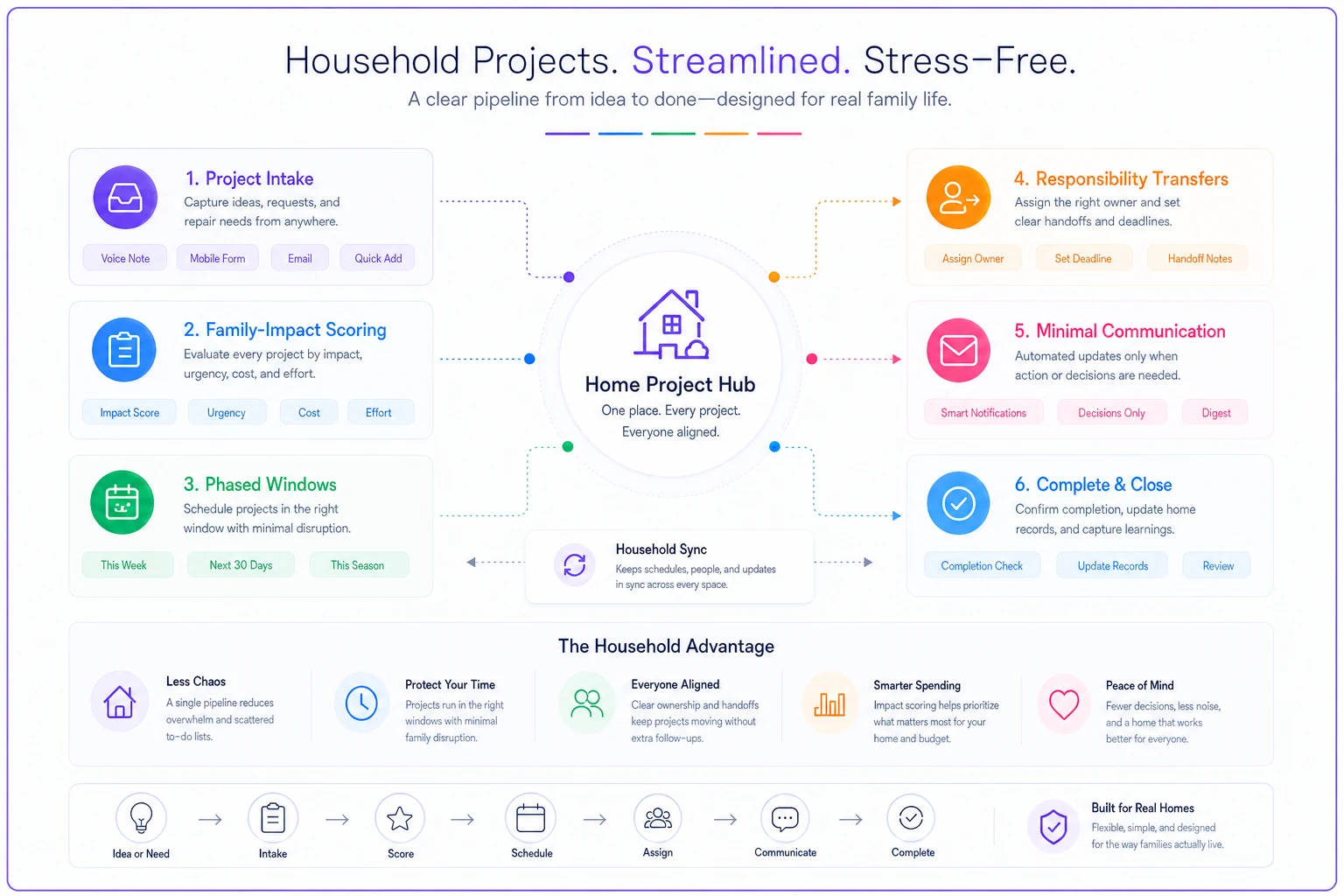
The whole system is four moves working as one: intake decides what's even allowed in, family-impact scoring decides what's worth the disruption, phased windows decide when that disruption is affordable, and responsibility transfers plus minimal communication keep normal life intact while the work happens. Skip any one of them and the others weaken — scoring without windows means you still start the big thing during the worst month; windows without transfers means routines quietly collapse anyway.
A visual workflow helps tie the four moves together.
Start smaller than you think. Pull your current mental list of "we should really…" items into a single intake table this week, score them, and pick exactly one high-impact project to run. Let the rest wait. The families who protect their routines aren't the ones doing fewer projects — they're the ones deciding, deliberately, how many they'll allow to be alive at the same time.
Start smaller than you think. Pull your current mental list of "we should really…" items into a single intake table this week, score them, and pick exactly one high-impact project to run. Let the rest wait. The families who protect their routines aren't the ones doing fewer projects — they're the ones deciding, deliberately, how many they'll allow to be alive at the same time.
Ready to simplify your household management?
Join thousands of families using Famioly to save time, reduce home management stress, and keep the household running smoothly.