

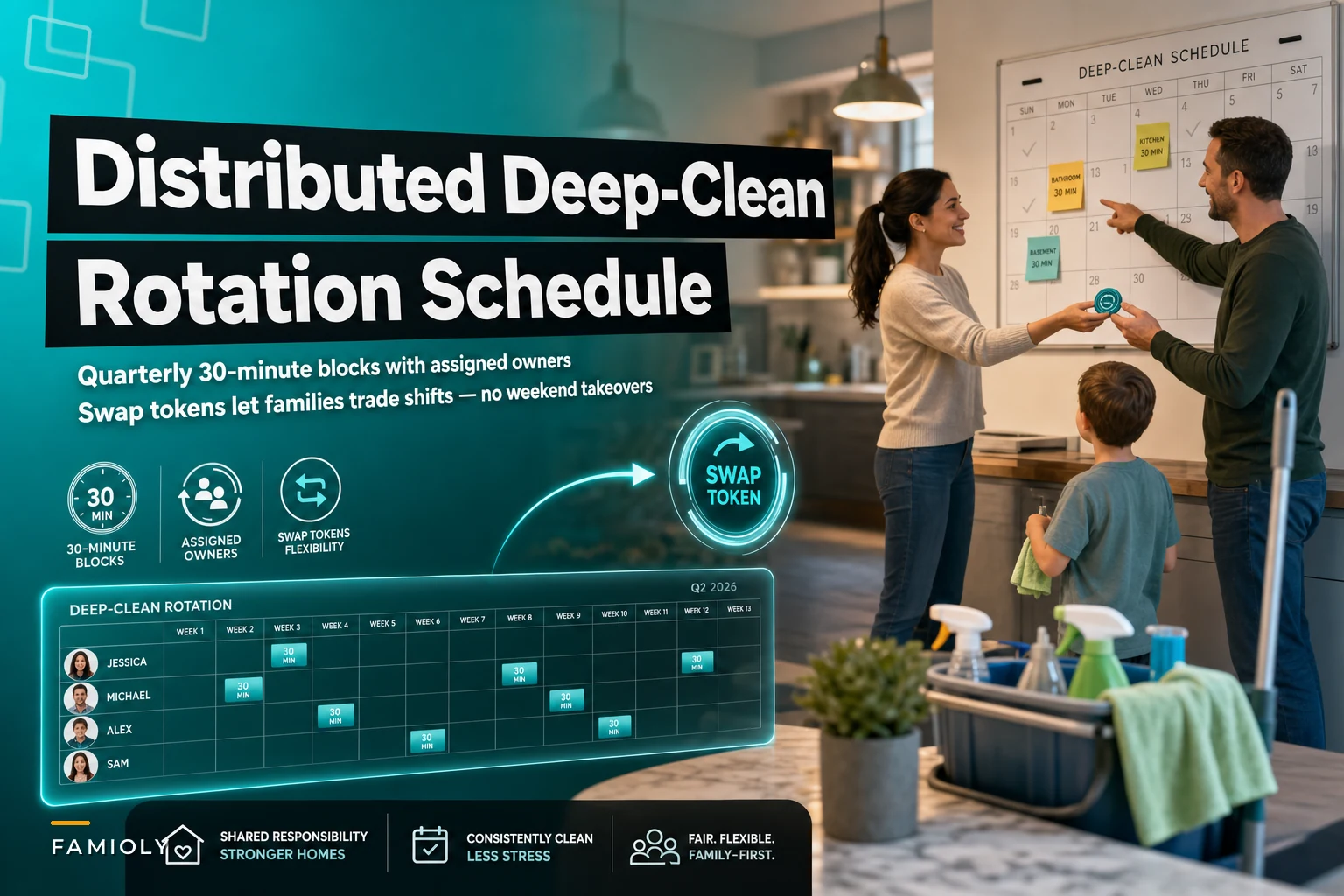

Your bathroom grout looks questionable. The baseboards behind the couch have developed their own ecosystem. And that oven? We're not discussing what's happening at the bottom.
You're not avoiding deep cleaning because you're lazy. You're avoiding it because the traditional approach—sacrificing an entire weekend every few months—feels like punishment. The rotating deep-clean schedule consistently emerges as the sanity-saver nobody taught us growing up.
Most households operate on extremes: either ignore deep cleaning until guests visit, or burn through entire weekends doing marathon cleaning sessions that leave everyone exhausted and resentful. Both approaches create operational bottlenecks that ripple through family dynamics.
The weekend marathon trap nobody warns you about
Traditional deep cleaning follows a predictable pattern. Every three months, someone (usually the same person) declares a cleaning weekend. The family groans. Tasks get hastily assigned Friday night. Saturday starts with good intentions but devolves into arguments about standards, forgotten supplies, and why certain people always disappear when toilets need scrubbing.
By Sunday afternoon, the house sparkles, but relationships feel strained. Kids learn to dread "cleaning weekends." Partners develop resentment over unequal workloads. The person who initiated the cleaning feels unappreciated. Within weeks, the cycle starts building toward the next marathon session.
This pattern creates more problems than dirty baseboards ever could. It teaches kids that maintaining a home requires periodic suffering. It builds tension between partners who have different cleanliness thresholds. It makes hosting spontaneous gatherings stressful because the house might be "between cleanings."
The quarterly rotation with 30-minute blocks changes this dynamic. Instead of sacrificing weekends, you distribute deep cleaning across regular life. Instead of one person managing everything, ownership rotates naturally. Maintenance becomes invisible.
Breaking down the 30-minute block system
The magic number isn't actually 30 minutes—it's whatever time block doesn't feel overwhelming in your household. For some families, that's 20 minutes. For others, 45. The principle remains: deep cleaning tasks get broken into chunks small enough that they can happen during regular weekdays without disrupting life flow.
Stop losing track of household duties.
Famioly helps you organize, assign & complete family tasks efficiently.
- Centralized task management
- Shared family calendar
- Budget & expense tracking
No credit card required
A typical quarterly rotation for a family of four might look like this:
-
Week 1-2
Kitchen Deep Clean
-
Monday
Clean inside oven (30 min)
-
Wednesday
Degrease hood and backsplash (30 min)
-
Friday
Deep clean refrigerator (30 min)
-
Next Monday
Cabinet fronts and handles (30 min)
-
Next Wednesday
Pantry organization and wipe-down (30 min)
Week 3-4: Bathrooms
-
Tuesday
Master bathroom grout and tiles (30 min)
-
Thursday
Master bathroom fixtures and glass (30 min)
-
Next Tuesday
Kids' bathroom full deep clean (30 min)
-
Next Thursday
Powder room and supply organization (30 min)
The blocks continue through living areas, bedrooms, and forgotten spaces like garages or basements. Each quarter, the rotation starts fresh, but with owner assignments shifted.
What makes this work isn't just time management—it's the psychological shift. A 30-minute task on Tuesday evening feels manageable. You can listen to a podcast, have a glass of wine, make it pleasant. Compare that to spending six hours scrubbing on Saturday while everyone else enjoys their weekend.
Owner assignments that actually stick
Traditional approach assigns tasks. Mom does bathrooms. Dad handles the garage. Kids vacuum. This creates expertise silos where only one person knows how to properly clean certain areas, making the system fragile when someone's unavailable.
Quarterly rotation flips this. Each quarter, different people own different zones entirely. Q1, teenager owns kitchen deep-clean blocks. Q2, they own bathrooms. Q3, living areas. Q4, their own room plus one common area. Parents rotate similarly.
This rotation builds several operational advantages:
-
Everyone learns every area's maintenance needs
-
Standards equalize across the household
-
No single person becomes the "bathroom person" forever
-
Knowledge transfers naturally through practice
The ownership model means the assigned person decides when their 30-minute blocks happen within their assigned weeks. Monday after homework? Saturday morning before activities? Their choice, their schedule, their responsibility.
The swap mechanics that prevent system breakdown
Real life doesn't respect cleaning schedules. Kids get sick. Work deadlines hit. Sports tournaments appear. The system needs flexibility without falling apart.
Built-in swap mechanics handle this reality. Each household member gets two "swap tokens" per quarter. They can trade their assigned block with someone else's future block, no questions asked. The trade happens in a shared calendar (paper or digital), visible to everyone.
Beyond swaps, the system includes "float blocks"—unassigned 30-minute slots that anyone can claim for makeup work. Miss your Tuesday block because of a migraine? Grab Saturday's float block. These typically sit on weekend mornings, providing flexibility without consuming entire days.
The penalty system stays simple: missed blocks without swaps roll forward but double. Skip this week's 30-minute bathroom block? Next week you owe 60 minutes. This natural consequence encourages either completion or proactive swapping without requiring enforcement or nagging.
Some families add a "buyout" option—pay $10 into a fund that hires occasional professional cleaning for the tasks nobody wants. This gives teenagers especially a way to opt out occasionally while still contributing.
Why distributed cleaning beats weekend marathons
Several benefits consistently emerge beyond just clean houses.
Relationship preservation. Partners stop fighting about cleaning weekends. Kids stop hiding when deep cleaning gets mentioned. The household operates more smoothly because maintenance happens continuously rather than in stressful bursts.
Skill development. Everyone learns complete home maintenance, not just their assigned chores. Teenagers leaving for college actually know how to deep clean a bathroom, not just surface-wipe it.
Schedule flexibility. Hosting becomes easier when deep cleaning happens continuously. No more panicking three days before guests arrive. The house maintains a baseline cleanliness that only needs light touch-ups.
Mental load reduction. The person who usually manages cleaning (often mom) doesn't carry the entire mental load. The rotation runs itself once established, removing the need for constant coordination and reminders.
Financial awareness. When everyone rotates through all areas, the whole family understands maintenance costs. They see when appliances need repair, when supplies run low, when professional help might be worth it.
Real household example: The Chen family transformation
The Chens—two parents, two teenagers—used to do quarterly cleaning weekends that everyone dreaded. Mom would spend the week before creating lists, buying supplies, and getting increasingly stressed. The weekends themselves featured at least one major argument and someone inevitably claiming they "did more than everyone else."
They shifted to 30-minute blocks with quarterly rotation last spring. Each person owns one zone per quarter, with 2-3 blocks per week maximum. They use a simple whiteboard calendar in the kitchen for scheduling and swaps.
Six months later, their house stays consistently cleaner with less effort. More importantly, the cleaning tension disappeared. Their 16-year-old actually chose to do her bathroom blocks while FaceTiming friends, making it social. Their 14-year-old discovered he doesn't mind kitchen cleaning if he can blast music.
Mom no longer manages everyone's cleaning. Dad stopped viewing deep cleaning as "helping out" and sees it as shared operations. The house runs smoother, and weekends returned to being weekends.
Common mistakes when starting rotation systems
Most families mess up the initial setup by going too aggressive. They assign too many blocks, create elaborate spreadsheets, or demand rigid schedules that nobody can maintain.
Starting too aggressive. Begin with fewer, longer blocks if needed, then gradually increase frequency as habits form.
Over-engineering the schedule. Keep it simple: zone, week, owner. Details can evolve naturally.
Forcing specific timing. Let people choose when their 30 minutes happens within their assigned week. Flexibility prevents rebellion.
Skipping the swap mechanism. Without built-in flexibility, the system breaks at the first schedule conflict. Swaps aren't optional—they're what makes the system sustainable.
Not rotating ownership. Permanent zones recreate the expertise silo problem and build resentment toward whoever gets bathrooms forever.
Setting up your quarterly rotation
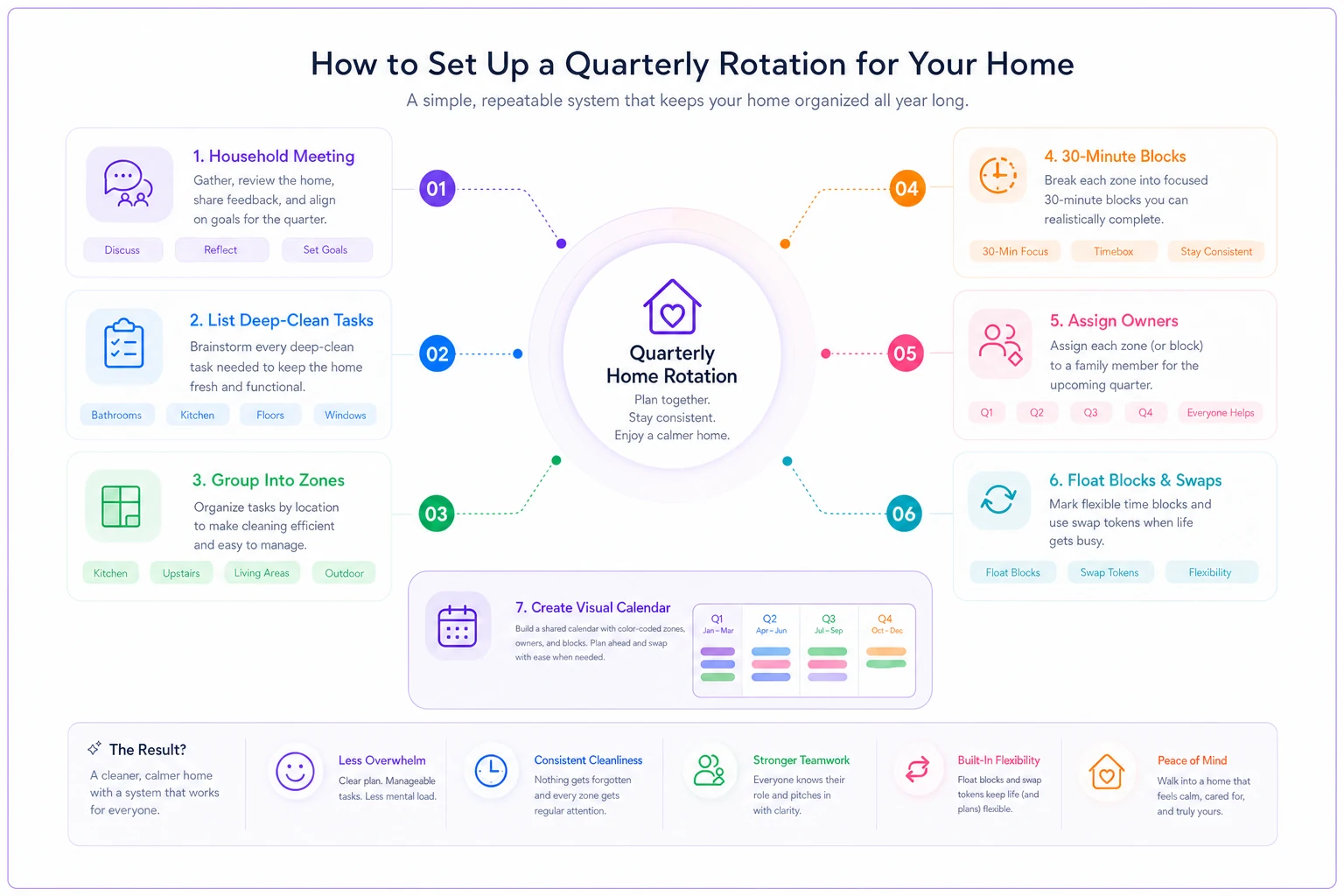
Begin with a household meeting where everyone participates in the initial design. List every deep-clean task needed quarterly. Group them into logical zones. Divide zones into 30-minute blocks.
Create a simple visual calendar—paper or digital—showing the quarter at a glance. Assign initial owners to each zone. Mark float blocks. Explain swap mechanics. Set a start date at least a week out to let everyone mentally prepare.
Below is a simple workflow visualization for setting up a quarterly rotation.
The first quarter will feel awkward. People will forget blocks, swaps will be messy, and some tasks will take longer than estimated. This is normal operational adjustment. By the second quarter, the rhythm develops. By the third, it runs automatically.
Consider these setup elements:
Supply stations. Each zone needs cleaning supplies readily available. Under-sink caddies for bathrooms, a kitchen cleaning drawer, basement supplies near the laundry. Hunting for supplies kills momentum.
Timer commitment. When the 30 minutes ends, stop. Even if not finished. This maintains trust that blocks truly are just 30 minutes, not "30 minutes that turns into two hours."
Quality standards. Define "done" for each zone without micromanaging. "Kitchen deep clean" might mean oven, refrigerator, and cabinet fronts are clean, but drawer organization is optional.
Celebration rituals. Some families do monthly pizza nights when everyone completes their blocks. Others add $5 to a vacation fund for each completed week. Small rewards maintain momentum.
Technology and tools that support rotation (without overcomplicating)
Most families overthink the tracking part. A paper calendar works fine, but several digital tools can reduce friction if your household already uses shared technology.
Shared calendar apps let everyone see upcoming blocks and available swaps. Reminder notifications prevent forgotten assignments. Photo checklists show what "clean" looks like for each zone without lengthy explanations.
Some families use task management apps where completing blocks earns points toward privileges. Others stick with a basic whiteboard and stickers. The tool matters less than consistent use.
What typically doesn't work: over-engineered systems with QR codes, detailed subtask lists, or quality scoring. These add complexity without meaningful benefit.
| Household Size | Blocks Per Week | Zones Per Quarter | Swap Tokens |
|---|---|---|---|
| 2 adults | 3-4 blocks | 2 zones each | 3 tokens each |
| 2 adults + 1 teen | 4-6 blocks | 1-2 zones each | 2 tokens each |
| 2 adults + 2+ teens | 6-8 blocks | 1 zone each | 2 tokens each |
| Single parent + teens | 4-5 blocks | Shared zones | 3 tokens each |
For households running broader operational systems, cleaning rotation becomes one component of a larger household management platform. AI-enhanced scheduling can automatically adjust blocks around known conflicts, suggest optimal swap partners, and track completion patterns. These operational software platforms help families coordinate schedules, manage household tasks, and reduce the manual coordination work that usually falls on one person.
If your family already uses a shared calendar, set blocks with reminders to cut down on manual swaps.
Even without technology, the core rotation principle transforms how families handle deep cleaning. The compound effect shows up around month four when deep cleaning becomes less necessary since every area gets attention every 12 weeks.
The compound effect of distributed maintenance
Something interesting happens around month four of rotation: deep cleaning becomes less necessary. When every area gets attention every 12 weeks, buildup never reaches critical levels. That oven stays manageable. Soap scum doesn't become geological. Dust bunnies can't establish civilizations.
This compounds into broader household benefits. Appliances last longer with regular maintenance. Surfaces stay in better condition. You notice small problems before they become expensive repairs. The house feels consistently welcoming rather than cycling between "just cleaned" and "disaster zone."
Kids raised with this system develop different relationships with household maintenance. They don't see cleaning as punishment or women's work or something to avoid until absolutely necessary. They understand it as simple operational maintenance, like charging your phone or putting gas in the car.
The mental shift from "cleaning is sacrifice" to "cleaning is just operations" changes household dynamics. Arguments decrease. Resentment fades. The house runs smoother. Weekends return to their intended purpose: actual rest and recreation.
Making distributed cleaning sustainable long-term
The biggest threat to any household system is gradual decay. Initial enthusiasm fades. People get busy. Blocks get skipped. Suddenly you're back to marathon weekends.
Building sustainability requires accepting imperfection. Some weeks, blocks won't happen. Some quarters, the rotation gets messy. Some family members will consistently need more reminders. This doesn't mean the system failed—it means it's operating in reality.
Regular quarterly reviews help maintain momentum. What zones took longer than 30 minutes? Which swaps happened most? Should float blocks move to different days? Small adjustments based on actual experience keep the system functional.
Consider seasonal modifications. December rotation might be lighter due to holidays. Summer might shift to early morning blocks. School years versus summers need different rhythms. The system should flex with life rather than fighting against it.
Celebrate the win of not sacrificing weekends. When Saturday morning arrives and nobody's facing six hours of cleaning, that's operational success. When guests can drop by without panic-cleaning, that's the system working. When teenagers leave for college knowing how to maintain living spaces, that's long-term victory.
The rotating deep-clean schedule approach isn't about perfection. It's about creating sustainable operations that preserve relationships, develop skills, and maintain homes without sacrificing quality of life. Start small, adjust often, and watch how 30-minute blocks transform both your house and your household dynamics.
Ready to simplify your household management?
Join thousands of families using Famioly to save time, reduce home management stress, and keep the household running smoothly.