



Your HVAC quietly turned 14 years old last month. The water heater just passed its 9-year mark. That dishwasher making weird noises? Installed when you moved in 7 years ago. Each one runs fine today, but they're all marching toward expensive failures that'll hit when you least expect them.
Most families discover system lifespans the hard way. The furnace dies during a February cold snap. The AC quits in August. The water heater floods the basement while you're on vacation. Each emergency replacement costs thousands more than planned maintenance would have—plus the stress of scrambling for contractors while dealing with actual damage.
This pattern destroys household budgets repeatedly. Not because families ignore maintenance, but because they lack visibility into what needs attention and when. The refrigerator gets wiped down regularly while the roof quietly deteriorates. The car gets oil changes on schedule while the sump pump hasn't been tested in three years.
A seasonal home maintenance calendar for families isn't about becoming a maintenance expert. It's about creating simple systems that track what you own, when it needs attention, and how much runway you have before an expensive surprise hits.
Why traditional maintenance advice fails busy families
Generic maintenance checklists assume infinite time and attention. "Check your water heater monthly." "Inspect your roof quarterly." "Service your HVAC twice yearly." Stack all those recommendations and you'd need 40 hours a month just for home inspections.
Real families don't operate that way. Soccer practice runs late. Work deadlines hit. Someone gets sick. The weekend you blocked for gutter cleaning becomes emergency homework help or a last-minute birthday thing. Those monthly water heater checks? Realistically, they happen twice a year if you remember at all.
The bigger issue runs deeper than time. Most maintenance guides treat each system independently. Your furnace filter schedule sits in one place. Roof inspection reminders live somewhere else. Warranty information hides in random folders or email archives. When something breaks, you're digging through papers trying to figure out if you still have coverage while water pools on the floor.
What makes this harder for modern families: systems have gotten more complex while lifespans have shortened. A furnace from the 1970s might run 30 years with basic upkeep. Today's high-efficiency models pack in electronics, sensors, and control boards that typically fail within 15-20 years. More components, more failure points—but most families still operate like they own simple mechanical systems.
The coordination problem compounds in busy households too. Even if one parent tracks everything, what happens when they're traveling? The other parent has no idea when the water softener was last serviced or where warranty documents live. The information lives in one person's head and nowhere else.
The real lifecycle math nobody talks about
Here's what homeownership actually costs when you map system lifespans honestly:
Stop losing track of household duties.
Famioly helps you organize, assign & complete family tasks efficiently.
- Centralized task management
- Shared family calendar
- Budget & expense tracking
No credit card required
-
Roof
20-30 years ($8,000-$15,000 replacement)
-
HVAC system
15-20 years ($5,000-$10,000 replacement)
-
Water heater
8-12 years ($1,500-$3,000 replacement)
-
Appliances
8-15 years ($800-$2,500 each)
-
Windows
20-25 years ($500-$1,500 per window)
-
Deck/Patio
15-25 years ($5,000-$20,000 replacement)
-
Driveway
20-30 years ($3,000-$8,000 replacement)
Stack these timelines and patterns emerge. A house built or renovated 15 years ago enters an expensive phase where multiple systems approach replacement simultaneously. The HVAC needs replacing while the roof needs major repairs. The water heater fails just as appliances start breaking down.
Most families discover this clustering effect too late. They budget for one major expense, then get blindsided when three more hit the same year. Emergency fund drains. Credit cards max out. Deferred maintenance accelerates other failures.
What changes with visibility: when you know your water heater has 2-3 years left, you can set aside $50 monthly instead of scrambling for $2,500 overnight. When you know your roof is 18 years into a 25-year lifespan, you can plan repairs during the off-season when contractors actually have availability and prices are better.
The warranty layer adds another dimension most families miss. That noisy dishwasher might have a 5-year parts warranty you forgot about. The HVAC system probably came with a 10-year parts warranty that requires annual service to stay valid—miss one service call and thousands in coverage just disappears. Extended warranties on appliances often cover repairs that families pay out of pocket simply because they lost track of dates.
Building your lifecycle tracking system (that actually works)
Skip the complex spreadsheets and maintenance apps that require constant updating. A functional system for busy families needs three things: a simple timeline map, automated reminders for critical tasks, and a lightweight documentation system anyone can access during an emergency.
Start with the timeline map. One document listing every major system with its install date and expected lifespan. Approximate dates work fine—"Water heater, installed around 2018, expect replacement 2028-2030." Add purchase price if you know it and estimated replacement cost. This single document becomes your financial planning tool.
For each system, note three trigger points:
-
Warranty expiration – When free repairs end
-
Maintenance threshold – When preventive service becomes critical
-
Replacement planning – When to start budgeting for replacement
Your furnace might have warranty until 2025, hit its maintenance threshold around 2027, and need replacement budgeting starting 2030. These triggers tell you when each system needs different types of attention, and they're easy to act on because they're separated by years, not months.
Now the reminder system. Don't create 50 different alerts—you'll ignore them all. Use seasonal triggers that batch related tasks:
Spring package (March):
-
AC service scheduling
-
Roof and gutter inspection
-
Deck/patio assessment
-
Outdoor faucet checks
Summer package (June):
-
Warranty review session
-
Appliance cleaning day
-
Window and door seals
-
Septic service (if applicable)
Fall package (September):
-
Heating service scheduling
-
Chimney inspection
-
Weatherization checks
-
Gutter cleaning
Winter package (December):
-
Emergency kit review
-
Document backup check
-
Budget planning for next year's replacements
-
Insurance policy review
Each seasonal package gets one reminder, not twenty. When the spring reminder hits, you handle all spring items in one focused session.
Below is a simple workflow visualization showing how the timeline map, reminders, and documentation connect.
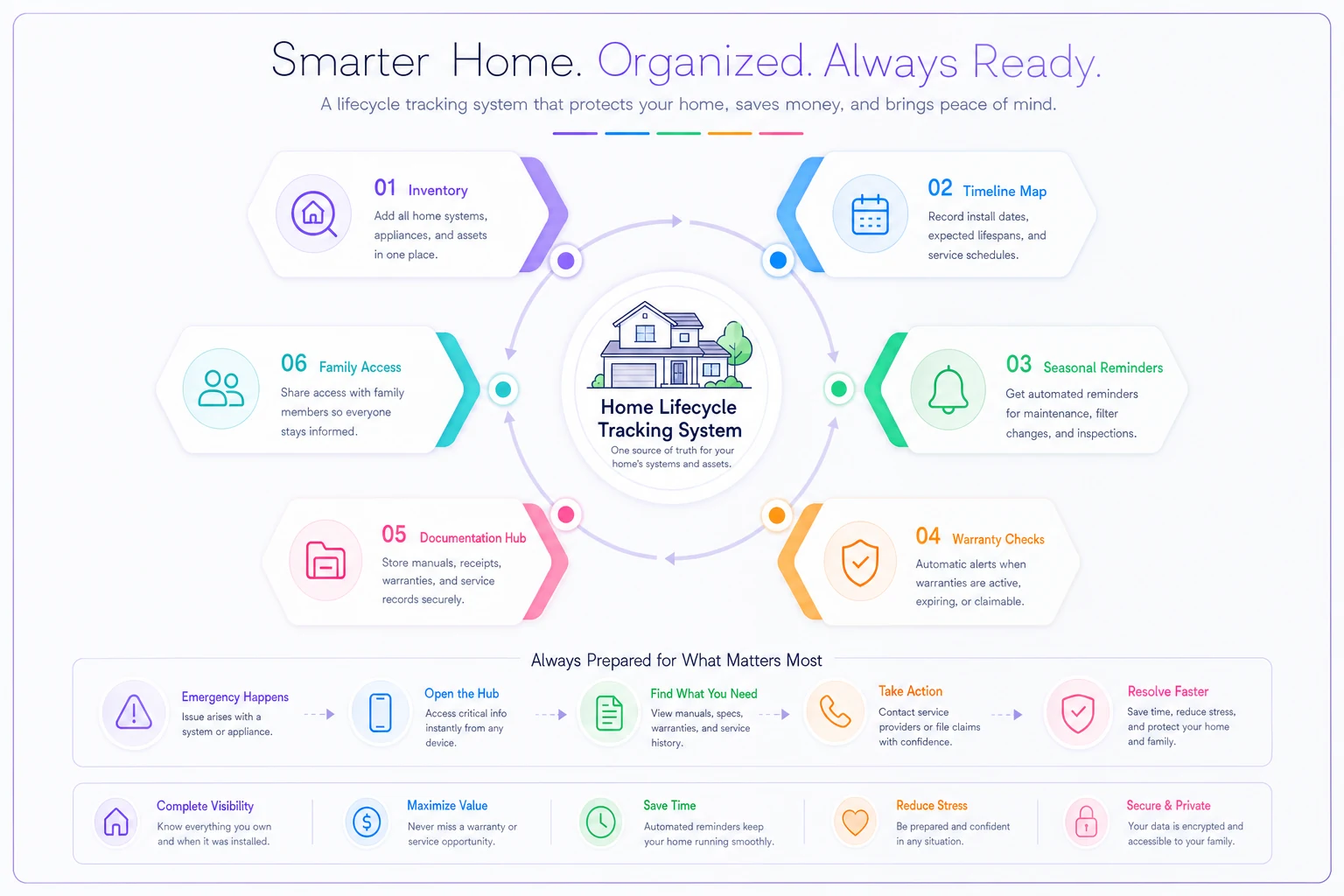
Don't create 50 different alerts—you'll ignore them all. Use seasonal triggers that batch related tasks.
The warranty trigger system that saves thousands
Warranties become worthless without timely claims, yet most expire quietly while covered problems get paid out of pocket. The fix isn't tracking every warranty individually—it's setting triggers that catch coverage before it disappears.
Three universal warranty checkpoints worth building into your calendar:
30 days before expiration: Inspect the item thoroughly. Run all cycles on appliances. Test every function. Document anything suspicious with photos. If something seems off, file a claim immediately. That subtle washer vibration might indicate bearing wear covered today but expensive tomorrow.
6 months before expiration: Evaluate extended warranty offers. Generally skip them for items under $500, but consider coverage for complex appliances—smart refrigerators, high-efficiency washing machines—where repairs run $400-800 easily.
At expiration: Move the item to "self-insured" status and start setting aside monthly reserves equal to replacement cost divided by remaining lifespan in months. A dishwasher costing $1,200 with 5 years left needs roughly $20 monthly.
For proof of purchase and warranty documentation, stop trying to maintain perfect filing systems. Take phone photos of receipts, warranty cards, and serial numbers. Email them to yourself with the subject line "Warranty - [Item] - Expires [Date]." Your email search becomes your filing system.
-
Item name and location
-
Purchase date and store
-
Warranty expiration
-
Service company contact
-
Model and serial numbers
Keep it simple enough that any family member can find information during an emergency. Fancy organizing systems fail when the basement is flooding and you need warranty info right now.
Seasonal execution for families (not fantasy land)
Real seasonal maintenance happens in focused bursts, not perfect monthly schedules.
The Spring Sprint (one weekend in March/April):
Saturday morning: Walk the house exterior with a checklist. Look for winter damage—loose siding, damaged shingles, cracks in the foundation. Take photos of anything concerning. Thirty minutes catches problems worth thousands.
Saturday afternoon: Schedule professional services. Book AC service, any repairs from your morning walk, gutter cleaning if needed. Making five phone calls in one session beats spreading them across weeks.
Sunday morning: Indoor systems check. Replace HVAC filters, test smoke detectors, run water in unused bathrooms, check under sinks for leaks. Run the garbage disposal with ice cubes. Test the sump pump. Total time: about 45 minutes.
The Fall Focus (one weekend in September/October):
Similar structure but winterization-focused. The exterior walk looks for gaps where cold air or mice might enter. Professional scheduling covers heating service and chimney cleaning. Indoor checks include weather stripping, testing heating zones, and bleeding radiators if applicable.
Monthly Minimums (10 minutes):
-
Run water in guest bathrooms
-
Check HVAC filter, replace if needed
-
Look for water spots on ceilings
-
Verify sump pump pit has normal water level
This quick pass catches developing problems before they become emergencies.
Some months even 10 minutes won't happen. That's fine. The seasonal big pushes matter more than perfect monthly execution. A missed monthly check won't damage your house. A missed spring AC service might mean no cooling in July when every tech is booked solid.
Budget smoothing strategies that prevent panic
Standard advice says save 1-2% of home value annually for maintenance. On a $400,000 home that's $4,000-8,000 yearly. But this ignores how expenses actually hit—nothing for three years, then $15,000 in six months.
Map your actual replacement timeline instead:
| System | Years Remaining | Replacement Cost | Monthly Set-Aside |
|---|---|---|---|
| Water Heater | 3 | $2,400 | $67 |
| Dishwasher | 4 | $1,200 | $25 |
| HVAC | 6 | $7,200 | $100 |
| Roof | 8 | $12,000 | $125 |
| Windows (partial) | 5 | $6,000 | $100 |
Total monthly reserve needed: $417
This approach means you're actually prepared when systems fail. No credit card panic. No depleted emergency fund. No choosing between the water heater and Christmas.
Raw replacement costs only tell part of the story, though. Factor in these often-missed expenses:
Emergency premiums: Emergency replacement runs 20-40% more than planned replacement. That $7,200 HVAC becomes $9,500 when it dies in August and you need immediate installation.
Cascade damages: Water heater failures cause water damage. Budget an extra 20% buffer for secondary effects.
Permit and code updates: Replacement often triggers code compliance requirements. Your $2,400 water heater becomes $3,200 after expansion tanks, drain pans, and permit fees.
Disposal costs: Removing old systems costs $200-500 depending on item and location.
Start reserves even for newer systems. Your 2-year-old dishwasher doesn't need immediate replacement funds, but $15 monthly now means you'll have close to $1,000 ready when it fails around year eight.
When prevention beats prediction
Some maintenance genuinely extends system life. Other maintenance drains money without much return.
High-value prevention:
HVAC filter changes add years to system life. Monthly filter costs of around $15 save thousands in early replacement. The math isn't complicated.
Water heater flushing extends life by a few years if you have hard water. An annual $150 service call pays for itself more than once.
Gutter cleaning prevents foundation problems, roof damage, and basement flooding. Biannual cleaning at a few hundred dollars yearly prevents damage measured in tens of thousands.
Low-value maintenance myths:
Duct cleaning rarely improves anything unless you have specific contamination issues. That $500 every three years does nothing for system longevity in most homes.
Extended appliance warranties on basic items are usually a bad deal. A $200 warranty on an $800 dishwasher doesn't make sense when repairs average $300.
Annual chimney cleaning for gas fireplaces provides minimal benefit. Wood-burning fireplaces need it; gas units need inspection every 3-5 years at most.
The 80/20 maintenance rule:
-
Change HVAC filters religiously
-
Keep gutters clear
-
Fix small leaks immediately
-
Service moving parts annually
-
Maintain proper drainage around the foundation
Skip the 80% of recommended tasks that prevent only 20% of issues—monthly appliance deep cleaning, quarterly window washing, annual carpet cleaning, seasonal garage door lubrication, monthly drain enzyme treatments. None of that moves the needle much.
It's worth being direct about this: most maintenance content treats every task equally. It's not. The tasks above are genuinely worth your time. The rest are mostly nice-to-haves.
Information architecture for household chaos
When your water heater fails at 6 AM on a Saturday, you need warranty information, a plumber's number, and the shut-off valve location immediately. Not after searching through folders, emails, and mystery boxes in the garage.
Create a one-page emergency reference sheet. Laminate it. Stick it inside your electrical panel door or a kitchen cabinet. Include:
-
Main water shut-off location
-
Electrical panel location
-
Gas shut-off location
-
Plumber, electrician, HVAC contacts
-
Home insurance policy number and phone
-
Location of warranty folder or digital files
This sheet alone saves thousands when someone can shut off water quickly during a leak.
For ongoing documentation, pick one system and stick with it:
Email method: Create a dedicated house email address. Forward all receipts, warranties, and service records there. Search becomes your filing system.
Photo method: Photograph every receipt, warranty card, and service record. Store in one phone album called "House Docs." Back up to cloud storage.
Binder method: One physical binder with plastic sleeves. Receipts go in chronologically. No fancy organization—just date order.
Shared document method: One Google Doc or similar with tables listing every system, purchase date, warranty status, and service history. Anyone can access it during emergencies.
Don't mix methods. Pick one and use it exclusively. Mixed systems guarantee lost information exactly when you need it most.
Automation tools and memory aids
Manual tracking fails eventually. Someone forgets to check the calendar. Life gets busy. The spring maintenance window passes without notice. Simple automation prevents these lapses without requiring constant attention.
Start with basic calendar automation. Create four recurring annual events, one per season, set for the first Saturday of March, June, September, and December. Add seasonal tasks to the event description. Set reminders for one week prior and day-of. This catches 90% of necessary maintenance with almost no ongoing effort.
For warranty tracking, use email rules. Create a folder called "Warranties" and set rules to automatically file emails containing "warranty," "receipt," or "purchase confirmation." When something breaks, search that one folder instead of your entire inbox.
Phone photo reminders work well for visual checks. Take a photo of your HVAC filter when you install it. Set a reminder for 30 days with the photo attached. When it appears, the photo shows exactly what needs checking.
For shared households, a simple synced note or document covers most coordination needs. One person updates the furnace filter date; everyone sees it. Add a "last completed" column to track what actually got done versus what was planned.
Set both a one-week and a one-day reminder on each seasonal calendar event to increase completion rates.
Some automation makes things worse. Smart home sensors that alert for every minor humidity fluctuation create notification fatigue. Maintenance apps requiring constant data entry get abandoned within a few months. Complex spreadsheets break when someone enters data wrong. The best automation stays invisible until needed—a calendar reminder that appears twice yearly beats a daily app notification you train yourself to ignore.
Making it stick in real family life
Perfect systems fail in real households. Kids have tournaments during maintenance weekends. Work trips overlap with service appointments. Responsibilities shift and nobody updates the system.
Build flexibility in from the start:
Maintenance windows, not dates: Schedule "AC service between March 15-April 30" not "AC service on March 22." Six weeks of flexibility makes completion far more likely than a single date.
Delegation-ready tasks: Write tasks so anyone can complete them. "Schedule furnace service with ABC Heating (555-1234) for October" beats "deal with furnace."
Recovery protocols: Miss spring maintenance? Add missed items to summer's list or block a catch-up weekend. Imperfect maintenance beats no maintenance.
Age-appropriate involvement: Teens can handle filter changes and basic checks. Tweens can photograph receipts and update records. Younger kids can test flashlights and check emergency supplies. Everyone participates without overwhelming anyone.
-
Teens
filter changes and basic checks
-
Tweens
photograph receipts and update records
-
Younger kids
test flashlights and check emergency supplies
The documentation system needs similar flexibility. If the designated tracker gets sick or travels, others need access. Shared digital systems beat personal spreadsheets. Physical binders beat hidden folders. Simple beats perfect.
Lower the bar for success. A seasonal home maintenance calendar for families doesn't need military precision. If you hit 70% of planned maintenance, you're ahead of most households. That 70% prevents the catastrophic failures. The missed 30% rarely matters much.
Track what actually happens, not just what you planned. Note when you skipped fall gutter cleaning because of weather. Record when you deferred HVAC service because of finances. That history helps you spot patterns and adjust the system to match your family's actual life.
From reactive to ready
Building this system takes roughly four hours upfront—one to list all systems with ages, one to create your calendar and reminders, one to gather existing documentation, and one to set up your tracking method. Those four hours prevent dozens of emergency scrambles and thousands in preventable expenses.
A seasonal home maintenance calendar becomes your family's operational backbone for home management. Instead of reacting to failures, you anticipate them. Instead of emergency replacements, you plan transitions. Instead of warranty surprises, you capture coverage before it expires.
This isn't about becoming maintenance experts or spending every weekend on house projects. It's about minimal effort yielding real protection. Ten minutes monthly plus a focused weekend each season keeps your largest investment running while preventing budget-destroying surprises.
The houses that last aren't the ones getting constant attention—they're the ones getting the right attention at the right time. Your future self will thank you when the HVAC dies gracefully after 20 well-maintained years instead of failing at year 12 and taking your emergency fund with it.
Ready to simplify your household management?
Join thousands of families using Famioly to save time, reduce home management stress, and keep the household running smoothly.