

Most family conflict isn't about the actual decision. It's about who gets to make it, how fast, and what happens when two people think they own the same call. You see this the moment a household grows past two adults and one kid. Suddenly there's a nanny, a grandparent who watches Tuesdays, a teenager with opinions, and a shared calendar nobody fully trusts. Decisions that used to take thirty seconds now take three text threads and a low-grade resentment that carries into the weekend.
A household governance playbook fixes this by making the routing explicit. Not the values, not the parenting philosophy — the plumbing. Who handles the $40 decision. Who handles the $4,000 one. What happens when the person who's supposed to decide isn't answering. Get that right and most of the friction disappears, because people stop negotiating the process every single time.
This is the whole system laid out on one page. Copy it, adapt the tiers, and drop the scripts into whatever your family actually uses to keep things running.
Why the wheels come off (and it's rarely the big stuff)
Households almost never break down over genuinely major decisions. Nobody accidentally buys a car. The breakdowns happen in the murky middle — decisions that are too small to schedule a conversation about, but too consequential to just wing.
A typical example: one parent tells the sitter it's fine for the kids to skip the usual bedtime because it's a special night. The other parent finds out at 9:40pm when a kid is still wired and there's school tomorrow. No rule was broken because no rule existed. That's the actual failure — not the bedtime, but the undefined decision right. The information lived in one head and never made it into the shared system.
Scale makes this worse in a specific, predictable way. Two adults can hold most shared understanding in their heads and patch the gaps by talking. Add a third caregiver, irregular schedules, or kids old enough to ask two different people until they get a yes, and the informal system quietly stops working. You don't notice the exact day it fails. You just notice you're arguing more and coordinating less.
The other driver is what I'd call decision inflation — treating everything as a joint call. When couples over-index on "we decide everything together," small stuff clogs the pipe. The grocery list becomes a meeting. Whether the 8-year-old can have a friend over becomes a negotiation. People burn their coordination energy on trivia and have nothing left for conversations that actually deserve real attention. A good charter does the opposite: it pushes decisions down to the lowest sensible level and reserves joint deliberation for the things that genuinely need it.
The one-page charter (copy this)
The charter isn't a family mission statement. Keep it to a single page, keep it boring, and keep it visible. Here's the skeleton:
Stop losing track of household duties.
Famioly helps you organize, assign & complete family tasks efficiently.
- Centralized task management
- Shared family calendar
- Budget & expense tracking
No credit card required
-
Purpose of this doc So nobody has to guess who decides what. Update it when it stops matching reality.
-
Roles Who owns which domains (money, medical, school, meals, home maintenance, social calendar). One primary owner per domain, one backup.
-
Decision tiers The matrix below — what's a solo call, what's a check-in, what's a joint decision.
-
Escalation ladder What to do when the owner is unreachable, or when two people disagree.
-
Where the record lives The single place decisions and changes get logged (calendar, shared note, whatever you'll actually open).
-
Review cadence When you'll revisit this — quarterly is plenty for most families.
The trick is the one owner per domain rule. Shared ownership sounds fair but it's operationally weak — when everyone owns it, nobody drives it, and things fall through. A backup handles absence without diluting accountability. If you've already built out roles and a cadence, this charter sits right on top of your household operating system template as the governance layer.
Here's a quick visual to show how the charter sits on top of daily decisions and where logging and escalation fit in.
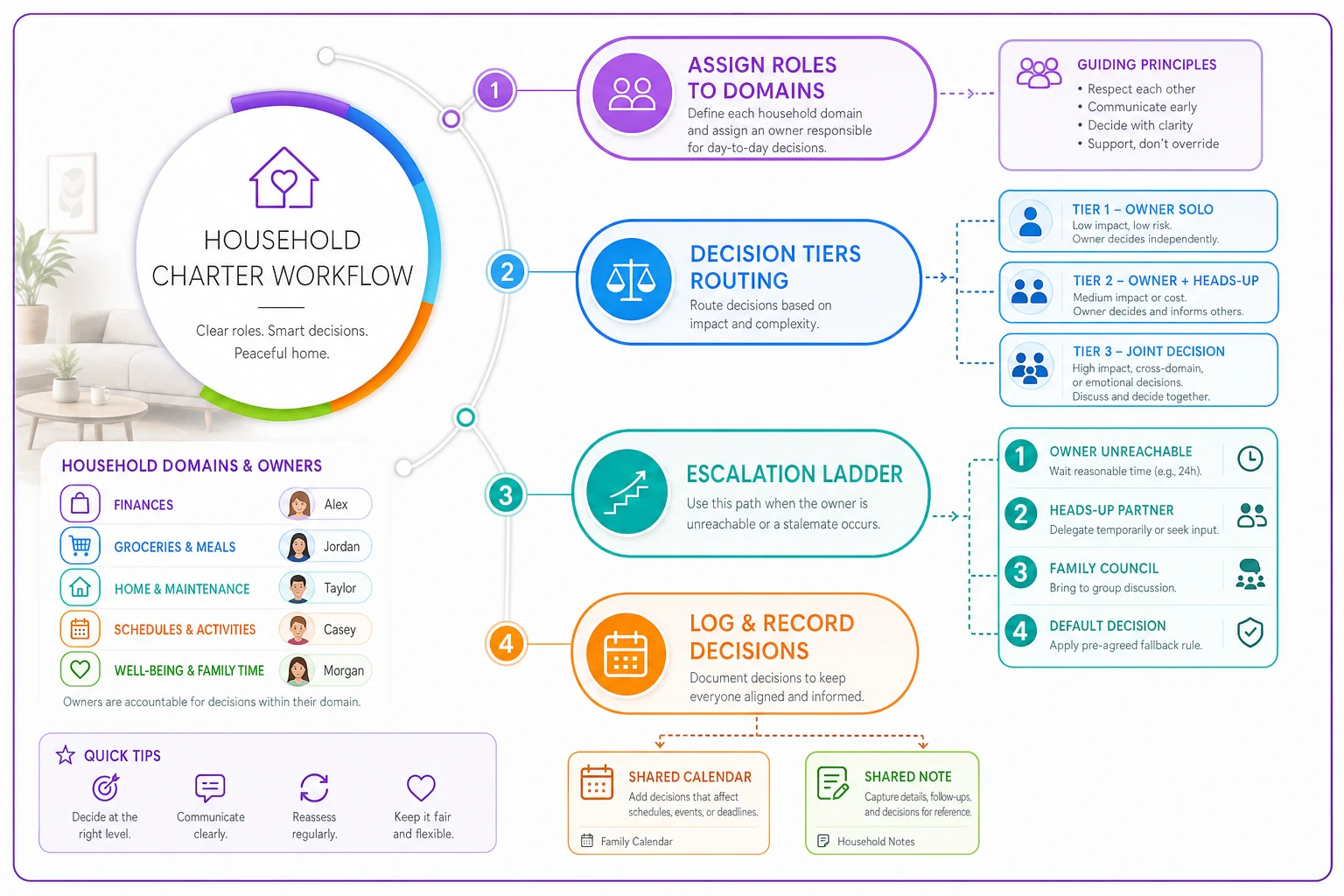
If you want it to work, keep the charter visible and simple. It should be a reference you actually open, not a document you swear you'll use someday.
The decision-tier matrix
This is the core of the whole thing. The point is to sort decisions by reversibility and impact, not by how you feel about them in the moment. Three tiers works for most households:
| Tier | What it covers | Money guide | Who decides | What's required |
|---|---|---|---|---|
| Tier 1 — Recurring / reversible | Daily logistics, meals, routine errands, kid activities that fit existing routines, small replacements | Under ~$75 | Domain owner, solo | Log it if it affects others; no approval needed |
| Tier 2 — Notable / semi-reversible | New recurring commitments, schedule changes affecting others, medium purchases, sitter/caregiver policy exceptions | Roughly $75–$600 | Domain owner + one heads-up to the other adult | Quick check-in; either can pause for 24h |
| Tier 3 — Major / hard to reverse | Large purchases, moves, school changes, taking on debt, anything affecting the whole family long-term | Above ~$600, or non-financial but high-impact | Joint decision, both adults | Real conversation; log the outcome and reasoning |
A few notes on how this plays out in practice.
The dollar thresholds matter less than the categories. A $200 impulse buy and a $200 planned monthly commitment aren't the same thing — the recurring one is Tier 2 because it compounds. Adjust the numbers to your budget, but keep the recurring-vs-one-time distinction sharp. That's where money quietly leaks.
The 24-hour pause in Tier 2 is the single most useful mechanic in the whole system. Either adult can say "hold on, let's talk" without it turning into a fight — it's just using the agreed process. It kills the "you already decided without me" spiral because the pause is built in and pre-agreed.
Tier 3 requires logging the reasoning, not just the decision. Six months later when someone asks "why did we go with the more expensive daycare," the answer exists somewhere instead of becoming a new argument. This is exactly the logic behind clear decision rights and channel rules — the record is what makes the rights stick over time.
The escalation ladder
Tier 1 → Owner decides solo → Log if it affects others Tier 2 → Owner decides + heads-up → Either can invoke 24h pause Tier 2 stalemate → Bumps to Tier 3 at next check-in Tier 3 deadlock → Default to "no irreversible action" or agree on a trial Recurring escalation → Charter needs an edit, not another decision
Decision tiers tell you who decides when things are normal. The escalation ladder covers when they're not — owner on a flight, two people genuinely stuck, or a Tier 2 pause that turned into a days-long cold shoulder.
-
Owner unreachable, decision is time-sensitive Backup owner decides using the default rule for that domain. Logs it. Owner reviews when back — the point is to keep things moving, not relitigate later.
-
Two people disagree on a Tier 2 call Either invokes the 24-hour pause. Still stuck after the pause, it bumps up to a Tier 3 conversation at the next family check-in.
-
Tier 3 deadlock Don't power through it. Either (a) agree on a small reversible trial and set a date to reassess, or (b) default to the "no change" option until you can talk properly. Deadlock defaulting to no irreversible action is a feature, not a bug.
-
Recurring conflict in the same domain That's a signal the ownership or the rule itself is wrong. Fix the charter, not the individual decision.
That last rung matters more than people expect. If the same type of decision keeps escalating, the problem isn't that decision — it's that your tier boundaries or role assignments don't match your actual life. Escalation patterns are telling you where the charter needs an edit.
Worked example scripts
The charter and matrix are useless if nobody has words to use in the moment. These are meant to be low-drama and short — copy them, soften them to your voice, and reuse.
Tier 1 log (solo decision, just informing): > "Heads up — swapped Thursday's plan, taking the kids to the library instead of the park. Same pickup time. Logged in the calendar."
Tier 2 heads-up (owner deciding, giving the other a pause window): > "Thinking of signing Maya up for the Saturday swim class — it's about $110/month and runs through spring. I'm leaning yes. Shout if you want to talk it through before Friday, otherwise I'll book it."
Tier 2 pause (using the 24h without it being a fight): > "Can we hit pause on the swim class for a day? Not a no — I just want to check it against the Saturday schedule. Let's decide tomorrow night."
Escalation — owner unreachable: > "Couldn't reach you and the plumber needed a yes on the [$X] repair to hold today's slot. I approved it since it was under our emergency threshold. Details logged, we can review tonight."
Tier 3 kickoff (major decision, both in): > "This one's a Tier 3 — let's put 20 minutes on it after the kids are down. Bringing the two options and the cost difference so we can decide, not just vent."
The point of scripts isn't to sound robotic. It's to remove the emotional overhead of starting these conversations, so you're not inventing tone and structure while also tired and slightly annoyed. Once these become habit, they stop feeling like scripts and just become how your household talks.
A real scenario
Take a blended household — two working parents, three kids across two schedules, plus a part-time caregiver three afternoons a week. Most of their friction lived in the Tier 2 zone: caregiver making judgment calls the parents disagreed on afterward, small recurring signups piling into the budget, and a running argument about "who said yes to that."
They wrote a one-page charter over a weekend. Assigned single owners to money, medical, and the kid calendar. Set the tier thresholds at roughly $75 and $600. Gave the caregiver an explicit Tier 1 lane — routine calls, decide and log — with a clear line at Tier 2: anything new or recurring, text first.
Over the next couple of months the change wasn't dramatic on paper, but the texture shifted. The "wait, who decided this?" conversations dropped noticeably. The caregiver stopped hesitating on small stuff because she knew her lane. They also caught two recurring signups they would've drifted into, saving somewhere in the range of $60–$80 a month that used to leak through undefined Tier 2 calls. Nobody had to become a more organized person. The system just routed decisions to the right place.
When this actually makes sense
Worth doing when your household has more than two decision-makers, or when your schedule is irregular enough that "we'll just talk about it" keeps failing because you're never in the same room at the right time.
It also earns its keep during transitions — a new caregiver, a move, a teenager who's suddenly making real decisions with real consequences.
When it's overkill
If you're a household of two with aligned instincts and low volume, a full tier matrix is more machinery than you need. You'll get most of the benefit from just agreeing on the Tier 3 line — the big stuff we always decide together — and leaving everything else informal.
Don't build governance for problems you don't have. Over-structuring a simple household creates its own friction, and you'll quietly abandon it within a month.
Who should skip most of this
Households in active crisis — a health emergency, a sudden income shock — shouldn't be writing charters. In those moments you need contingency handoffs and immediate coverage, not a governance layer.
Build the charter when things are calm, so it's already in place when they're not. Governance is a fair-weather project that pays off in storms.
Making it stick
The charter dies if it lives in a drawer. Two things keep it alive: a visible copy where decisions actually happen, and a light recurring review so it keeps matching reality.
The easiest way to build that review habit is to fold it into a rhythm you already have — a quick "did the tiers hold this week, and did anything keep escalating?" fits naturally into a short recurring check-in like a 20-minute family meeting.
Pin the charter in your family's shared notes so it's one click away during decisions.
You'll know it's working when the arguments change shape. Instead of fighting about who should have decided, you'll occasionally disagree about the actual decision — which is the good kind of disagreement, the kind worth having.
That shift, from process friction to substance, is the whole point. The governance isn't there to make every call for you. It's there so you stop burning energy figuring out who's holding the pen, and can spend it on the decisions that actually deserve the thought.
Ready to simplify your household management?
Join thousands of families using Famioly to save time, reduce home management stress, and keep the household running smoothly.