



My neighbor's family had the same Saturday morning fight for three years. Their teenager would announce at 8am that she needed a ride to a friend's house at noon. Dad would say yes. Mom would remind everyone about the family lunch plans. The 12-year-old would complain that nobody told him about lunch. Chaos. Every. Weekend.
The problem wasn't communication—they talked constantly. They had a shared calendar, family group chat, even a whiteboard on the fridge. The problem was nobody knew who actually got to make which decisions, or where different announcements belonged.
Most families think they need better communication. What they really need are family communication protocols—clear rules about who decides what, where different messages go, and what happens when people disagree. Not another app. Just decision rights and channel rules that everyone follows.
The hidden cost of unclear decision boundaries
Every family has invisible decision patterns that nobody's discussed. Mom handles doctor appointments. Dad manages car stuff. The oldest kid decides... well, that's where it gets messy.
These unspoken rules work fine until they don't. Until dad schedules car repair during the school play. Until mom books a dentist appointment during the big game. Until both parents tell the kids different bedtimes the same night.
The average family makes roughly 35 decisions per week that affect multiple people. School pickups, dinner plans, weekend activities, screen time, bedtimes, purchases, social plans. Without clear decision rights, you either get decision paralysis (nobody acts) or decision chaos (everyone acts differently).
What makes this worse is that family decisions have different urgency levels and reversal costs. Choosing tonight's dinner? Low stakes. Committing to travel soccer? That's multi-month, multi-thousand-dollar decisions affecting everyone's schedule. Most families treat both the same way—whoever speaks first wins.
Three buckets every household decision falls into
Every household decision fits into one of three categories, and mixing them up causes most family conflicts.
Stop losing track of household duties.
Famioly helps you organize, assign & complete family tasks efficiently.
- Centralized task management
- Shared family calendar
- Budget & expense tracking
No credit card required
Notify decisions are made by one person who informs others. "I'm working late Thursday." "Soccer practice moved to 4pm." These aren't up for debate. The decision-maker has full authority, but they need to communicate properly.
Input decisions require consultation but one person makes the final call. "I'm thinking about evening classes—what would that mean for our schedule?" You gather feedback, but you decide.
Consensus decisions need actual agreement. Moving houses. Switching schools. Getting a pet. Major purchases. These require everyone affected to actually agree, not just be informed.
The magic happens when families explicitly assign their common decisions to these buckets. Dental appointments? That's a notify decision by whoever manages medical stuff. Weekend plans involving the whole family? Consensus. Kid wants to quit piano? Input decision—get their reasoning, but parents decide.
Channel rules that actually prevent message chaos
Your family group chat is probably a disaster zone of mixed message types. Grocery requests mixed with schedule changes mixed with random memes mixed with urgent pickups needed NOW.
Different message types need different channels. Not because it's fancy, but because human brains cannot process urgent requests when they're buried under 47 messages about tacos or pizza.
Immediate/safety channel - Text messages or calls only. "Pick me up NOW." "Running 20 minutes late." "Someone's sick." If it needs action within 2 hours, it goes here.
Daily logistics channel - Your main family chat. Schedule changes, meal planning, activity coordination. Check it morning and evening.
Planning/discussion channel - Email or separate thread. Vacation planning, major purchases, school decisions. Things that need thoughtful responses, not instant reactions.
Announcement board - Physical or digital. "Soccer starts Tuesday." "Grandma visiting next month." One-way information that doesn't need discussion.
The key is brutal consistency. The second someone puts an urgent pickup request in the planning channel, or starts debating vacation spots in the emergency text thread, the whole system collapses.
A simple visual of how messages should flow makes it easier for everyone to follow the channels.
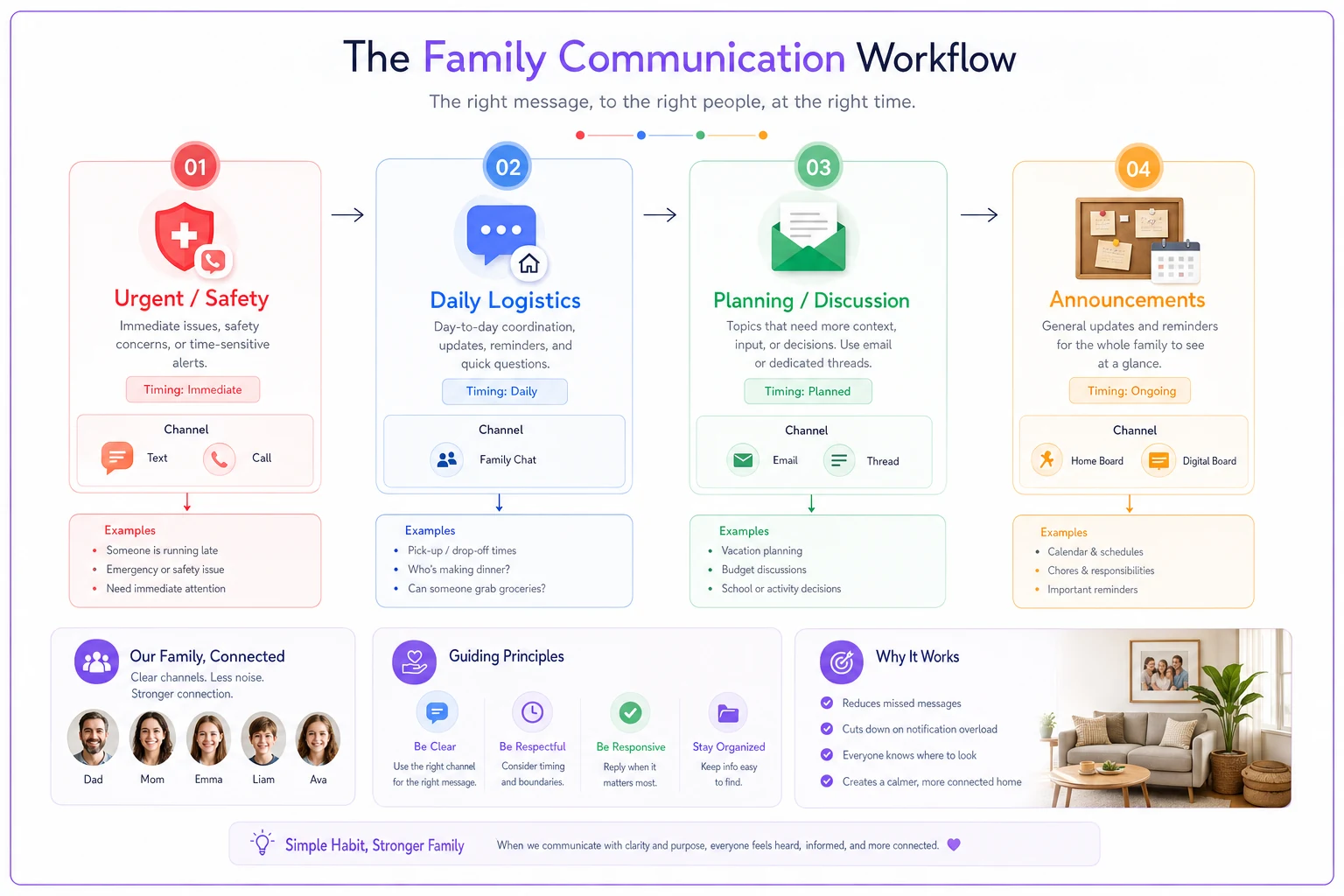
Put a pinned message at the top of your family chat that explains what belongs there to reduce mis-posts.
The key is brutal consistency. The second someone puts an urgent pickup request in the planning channel, or starts debating vacation spots in the emergency text thread, the whole system collapses.
De-escalation scripts that stop arguments before they start
Most family arguments follow predictable patterns. Someone feels unheard. Someone feels blindsided. Someone feels overruled. Having actual scripts ready breaks these patterns before they spiral.
When someone announces a decision that should've been discussed:
"I hear that you've already decided about [thing]. I'm feeling frustrated because this affects my schedule/budget/plans too. Can we back up and make this an input decision where I get to share my concerns before we commit?"
When the same person keeps getting overruled:
"I notice I haven't gotten my choice the last few times we've decided [category]. Could we set up a rotation where different people get priority on these decisions?"
When someone won't respect a notify decision:
"This is one of my notify decisions that we agreed on. I'm informing you as a courtesy, but I'm not asking for permission. Is there something about the impact on you that I'm not seeing?"
When consensus is impossible:
"We've been discussing this for 20 minutes without progress. Let's table this for 24 hours, and everyone can write down their main concern. Tomorrow we'll address those specific concerns instead of debating everything at once."
When someone springs a last-minute change:
"I know things come up, but when plans change this last-minute, it really stresses me out. Next time could you either give me more notice or check if the timing works before committing?"
These scripts work because they name the pattern, express the impact, and request a specific change. No blame. No drama. Just clarity about what needs to happen differently.
The decision template that eliminates 90% of confusion
You can implement this today with zero fancy tools. Just fill out this template for your family's common decisions:
| Decision Type | Owner | Input From | Channel | Notice Needed |
|---|---|---|---|---|
| Kids' medical appointments | Parent A | Check calendar | Announcement | 48 hours |
| Weekend social plans (family) | Consensus | Everyone affected | Planning chat | 1 week |
| Grocery shopping | Whoever shops | Anyone (add to list) | Daily logistics | Ongoing |
| Kid activity signup | Parents | Kid's input | Planning chat | 2 weeks |
| Bedtime changes | Parent on duty | None | Notify only | Same day |
| Major purchases ($500+) | Consensus | Both parents | In-person | 1 week |
| School pickup changes | Notify decision | None | Immediate text | ASAP |
| Chores/responsibilities | Parents | Kids' input | Family meeting | Weekly |
Start with just 10 decisions that cause the most friction in your house. Post this somewhere visible. Reference it during conflicts. "According to our decision matrix, this is Mom's notify decision" ends arguments faster than any amount of explaining or convincing.
Why traditional family meetings fail (and what works instead)
The classic weekly family meeting sounds great in theory. In practice, they become complaint sessions where nothing gets decided. Or they get skipped the moment life gets busy—which is exactly when you need them most.
What works better is separating different types of family communication:
Daily stand-up (2 minutes at breakfast or dinner): "What's everyone's one big thing today?" Not a discussion. Just awareness.
Weekly logistics (10 minutes, same time each week): Next week's unusual schedule items. Who needs rides where. What's the meal plan. Not a debate—just information sharing.
Monthly decisions (30 minutes max): This is where you actually decide stuff. New rules. Activity signups. Vacation planning. Keep a running list through the month so you're not scrambling for topics.
Quarterly reviews (45 minutes): Are our decision rights working? What patterns are causing friction? What needs to change?
The separation matters because mixing logistics with decision-making with general complaints means nothing gets properly resolved. Each conversation type needs its own space and rules.
Special protocols for divorced and blended families
Split households face unique challenges because decision rights literally change based on location and custody schedules. What works at Mom's house might be banned at Dad's. The kids become expert manipulators of these gaps.
The solution isn't forcing identical rules (impossible and unfair). It's being explicit about what changes and what doesn't:
Universal decisions (apply everywhere): Medical care, education, safety rules, major activities. Both houses follow the same protocol. These require actual co-parent consensus regardless of personal feelings.
House-specific decisions (change by location): Bedtimes, screen time, chores, food rules. Each house decides independently. Kids need to understand these aren't negotiable by playing parents against each other.
Transition protocols: Clear handoff communication about homework status, behavior issues, health concerns. Not commentary or criticism, just facts the other parent needs.
One divorced couple uses a shared spreadsheet just for universal decisions. No editorializing, no discussion of house rules, just the stuff that must be coordinated. Their kids stopped the "but Mom said" game within a month because both parents could point to the same source of truth.
Money decisions and the conversation nobody wants to have
Financial decisions destroy more family harmony than almost anything else, yet most families have no protocol beyond "we'll discuss it." That vague promise leads to someone buying a $400 robot vacuum while the other person is stressed about the credit card balance.
Create spending tiers with different rules:
Under $50: Individual discretion, no discussion needed
$50-200: Notify decision, mention it but don't need permission
$200-500: Input decision, get feedback but one person decides
Over $500: Consensus required, both must actively agree
The numbers matter less than having explicit tiers. Adjust them for your budget. But without clear thresholds, every purchase becomes a potential fight about whether it needed discussion.
Also establish "sacred categories" that bypass normal rules. Maybe medical stuff never needs consensus under $1000. Maybe each person gets one hobby category with higher individual discretion. The point is making these exceptions explicit, not discovering them during arguments.
Digital tools versus paper systems (the surprising winner)
Families love downloading apps to fix communication problems. Shared calendars, task managers, messaging platforms. But what actually happens: the techie parent maintains it religiously while everyone else ignores it, then complains they weren't informed.
The most functional families use hybrid systems. Digital for what digital does best (calendars, document storage), physical for what needs to be unavoidable:
Physical command center: A single location (usually kitchen) with the weekly schedule, decision matrix, and any urgent announcements. No app to open. No password to remember. It's just there.
Digital backup: Photo of the physical board, shared calendar for appointments, cloud storage for important docs. But digital supports physical, not the other way around.
Text for urgent only: Not discussions, not planning, just "pick me up" and "running late." Everything else has a proper channel.
The resistance to paper feels outdated until you realize that a whiteboard never has a dead battery, doesn't require wifi, and can't be ignored because notifications were turned off.
When kids are ready for decision rights
Most parents either give kids no decision authority (creating helpless young adults) or too much too soon (creating overwhelmed kids). The sweet spot is graduated decision rights based on demonstrated capability, not age.
Start with narrow notify decisions: "You can decide your outfit if you're dressed by 7:30am." If they handle that for a month, expand slightly: "You can plan your homework schedule if it's done by 8pm."
Move to input decisions: "You can give input on your extracurricular activities, but we make the final choice considering budget and logistics."
Finally, consensus decisions: "We'll decide on your curfew together, but everyone needs to agree it's safe and reasonable."
The progression teaches decision-making as a skill, not a right. Kids learn that good decisions lead to more autonomy, while poor decisions lead to less. This mirrors adult life better than arbitrary age-based rules.
Measuring if your protocols actually work
How do you know if your family communication protocols work? Count the repeat conversations. If you're having the same discussion about the same topic more than twice a month, you don't have a communication problem—you have a protocol problem.
-
Decision speed
How long from issue raised to decision made? Good protocols cut this by 70%.
-
Revision rate
How often do decisions get reversed or relitigated? Should drop to near zero for notify decisions.
-
Surprise conflicts
How often does someone say "nobody told me" or "I didn't agree to that"? This should become rare.
One family started keeping a "friction log"—just hash marks for each family conflict. Not to blame anyone, just to spot patterns. They discovered 60% of their arguments happened Sunday evening when trying to plan the week without clear decision rights. Fixed the protocol, eliminated the friction.
The compound effect of clear family protocols
The real value isn't the time saved on individual decisions. It's the compound effect of removing daily friction.
When kids know exactly how to request schedule changes, they stop negotiating every single time. When parents know who handles what, they stop the "I thought you were doing that" dance. When everyone knows where urgent messages go, actual emergencies get handled immediately instead of being buried in the group chat.
Clear protocols teach kids how functional systems work. They learn that good processes prevent problems, that clear communication has rules, and that decision rights come with responsibilities. These lessons transfer directly to their future workplaces and relationships.
Families with clear protocols spend less time discussing logistics and more time actually connecting. The weekend isn't consumed by figuring out who's doing what. The dinner table isn't a business meeting. The mental load gets distributed because everyone knows their lane.
Start with one protocol today
Don't try to implement everything at once. Pick the single decision that causes the most friction in your house. Maybe it's screen time. Maybe it's weekend plans. Maybe it's whose turn to pick dinner.
Define who owns that decision. Pick the right channel for it. Write down the protocol where everyone can see it. Use it for one week. Then add the next most painful decision.
Within a month, you'll have protocols for your top 10 friction points. Within three months, the kids will be reminding you about decision rights. Within six months, you'll wonder how you ever functioned without them.
The families that thrive aren't the ones who communicate more. They're the ones who communicate clearly, with established protocols that remove ambiguity and prevent the same conflicts from recurring endlessly.
Your family is already making all these decisions. You might as well make them efficiently, peacefully, and in a way that teaches everyone involved how to be better decision-makers. Start today with just one protocol. Your future self will thank you when you're not having the same argument next Saturday morning.
Ready to simplify your household management?
Join thousands of families using Famioly to save time, reduce home management stress, and keep the household running smoothly.