


Most households don't have a money problem. They have a timing problem.
The monthly budget works fine. Groceries, mortgage, daycare, car payment — all accounted for. Then the water heater dies, the minivan needs tires and brakes in the same month the roof inspector says you've got maybe two winters left, and suddenly a family that was "doing fine" is putting $4,000 on a credit card and arguing about it at 11pm.
This keeps happening not because of poor discipline, but because nearly every home is a bundle of depreciating assets — roof, HVAC, appliances, cars, water heater, flooring, exterior paint — each quietly marching toward its own replacement date. Almost nobody maps those dates against each other. So instead of a smooth, predictable schedule of replacements, you get clustering: three or four big-ticket items landing inside the same 18-month window, purely by bad luck of when they were installed.
Budgeting harder won't fix it. What actually fixes it is building a household financial lifecycle — a system that treats every major asset like it has a birth date, a lifespan, and a funeral fund, then rolls all of that into a simple capital plan you glance at a few times a year.
Why the monthly budget can't see this coming
A monthly budget is built for flow — recurring in, recurring out. It's genuinely bad at lumpy, infrequent, high-dollar events, because those events don't show up on any given month's statement until they explode.
The structural flaw: most families mentally file big home expenses under "emergencies." But a roof wearing out after 22 years is not an emergency. It's an appointment you've had for two decades and refused to look at. The only thing that made it feel like a surprise was the lack of a schedule.
Households that stay out of this trap generally do one thing differently: they separate predictable large expenses from true emergencies. The emergency fund covers the job loss, the ER visit, the genuinely unforeseeable thing. The replacement of a 14-year-old dishwasher is not that. It belongs in a dedicated, scheduled pool — a sinking fund — because you knew it was coming.
Mixing the two is the most common mistake in this category. People raid their emergency fund for a known replacement, feel the drain, then get blindsided when an actual emergency lands on top of it. If you want to go deeper on the account structure that prevents this, we've covered setting a cadence and decision rules for shared vs. personal accounts separately — the lifecycle plan sits on top of that foundation.
The three pieces that make the system work
A working household financial lifecycle has exactly three moving parts. Lose any one of them and it falls apart.
Stop losing track of household duties.
Famioly helps you organize, assign & complete family tasks efficiently.
- Centralized task management
- Shared family calendar
- Budget & expense tracking
No credit card required
1. The asset register. A plain list of every major thing that will eventually need replacing, with its install date and expected lifespan. This is the part everyone skips, and it's the part that makes everything else possible. You can't fund a replacement schedule you haven't written down.
2. Sinking funds. Small monthly contributions, set aside now, against those future replacements. The whole point is converting a terrifying $6,000 lump into a boring $90-a-month line item you barely notice.
3. A rolling capital plan. A 3–10 year forward view that shows which replacements are likely to land in which year — so you can see the clustering before it happens and smooth it out deliberately.
The three connect directly. The asset register feeds the capital plan — it tells you when things are due. The capital plan feeds the sinking funds — it tells you how much to save monthly. And the sinking funds feed back into reality, because once you see you're underfunded for Year 3, you either raise contributions or push a replacement. That's a decision you make calmly, months in advance, instead of in a panic the week the compressor fails.
[Asset Register] → (install dates + lifespans) → [Rolling Capital Plan] [Rolling Capital Plan] → (monthly targets per asset) → [Sinking Funds] [Sinking Funds] → (balance vs. target check) → [Quarterly Review] → (adjustments) → [Asset Register] The loop is intentional. The quarterly review closes the cycle so the plan stays current instead of drifting out of date.
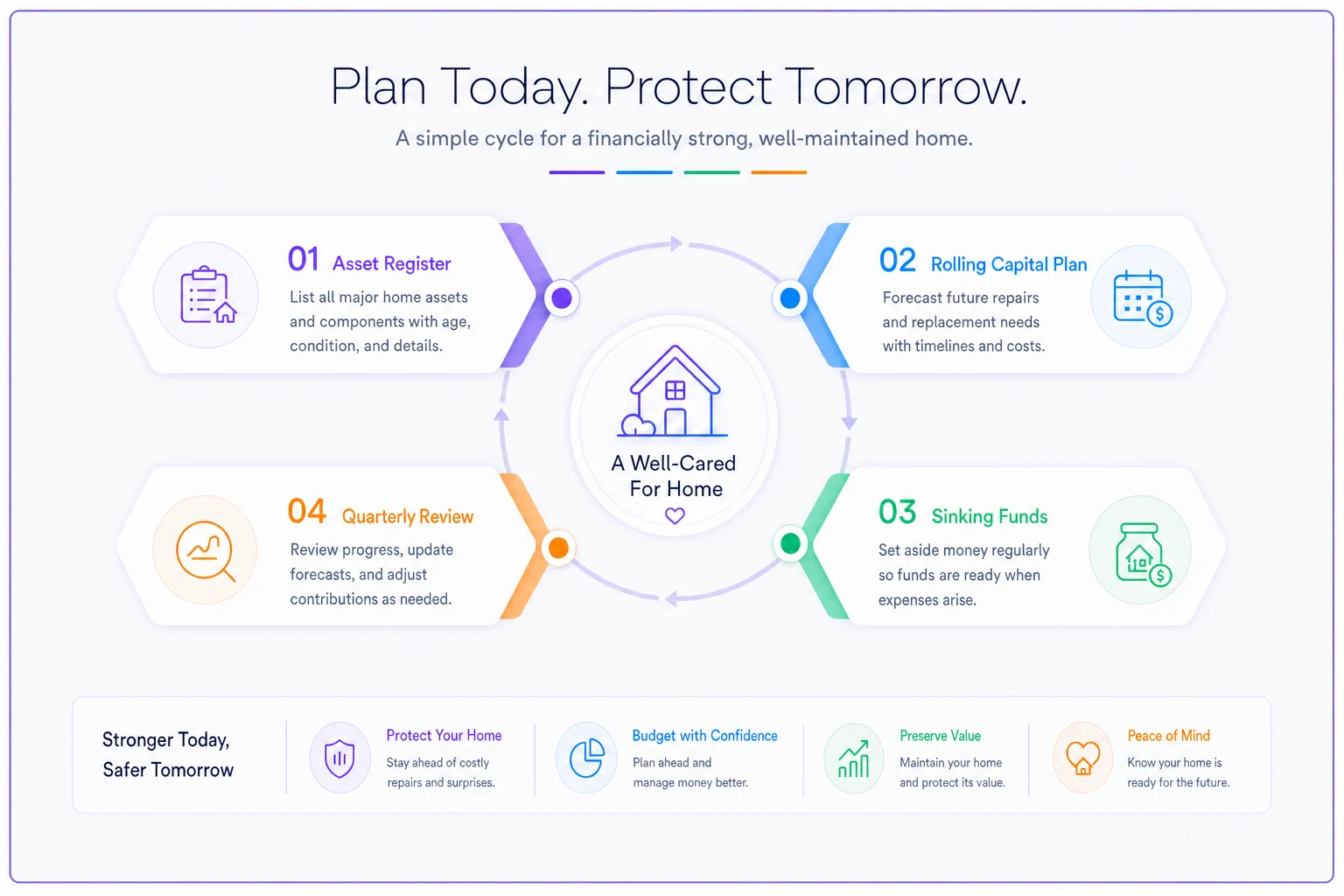
This diagram shows the simple loop you'll run every quarter: update, forecast, fund, review, repeat.
Building the asset register
Start with the expensive, slow-moving stuff. You don't need to track every lamp. You need the items that cost four figures to replace and fail without much warning.
Here's a realistic lifespan reference to anchor your register. Treat these as planning estimates, not guarantees — climate, usage, and build quality swing them considerably.
| Asset | Typical lifespan | Rough replacement cost | Suggested monthly sinking contribution |
|---|---|---|---|
| Asphalt shingle roof | 20–25 yrs | $9k–$16k | $45–$65 |
| HVAC system (full) | 12–18 yrs | $6k–$11k | $40–$60 |
| Water heater (tank) | 8–12 yrs | $1.3k–$2.5k | $15–$20 |
| Refrigerator | 10–14 yrs | $1.2k–$2.8k | $12–$18 |
| Dishwasher | 9–12 yrs | $600–$1.1k | $8–$10 |
| Washer/dryer pair | 10–13 yrs | $1.4k–$2.6k | $12–$18 |
| Exterior paint | 7–10 yrs | $4k–$8k | $45–$60 |
| Primary vehicle (replace) | 10–14 yrs | $18k–$30k used | $120–$200 |
| Flooring (carpet/mid) | 8–12 yrs | $3k–$7k | $30–$45 |
The column that matters most is the last one. Add up the monthly contributions for everything you actually own and you get your total monthly capital reserve — usually somewhere between $300 and $600 for a typical single-family home with two cars. That number surprises people. But it's not new spending. It's the true cost of owning these things, finally made visible instead of arriving in unpredictable chunks.
Start by listing only the items that cost roughly four figures or more — everything else can wait.
One thing worth flagging: the install date does more work than the lifespan estimate. A roof and HVAC installed the same year by the previous owner means both big-ticket items will likely cluster together. That's exactly the kind of collision you want surfaced early, which is why the register has to include dates — not just items.
Turning the register into a rolling capital plan
Now you spread the replacements across a timeline. This is the part that changes everything, because it exposes the clustering before it arrives.
Take an asset's install year, add its expected lifespan, and you get its likely replacement year. Drop every asset onto a simple 3–10 year grid and the picture becomes obvious fast.
| Year | Likely replacements | Estimated cost | Running capital reserve needed |
|---|---|---|---|
| Year 1 | Water heater, dishwasher | ~$2,000 | Low |
| Year 2 | — | $0 | Build buffer |
| Year 3 | HVAC, refrigerator | ~$9,000 | High — danger cluster |
| Year 4 | Exterior paint | ~$5,500 | Moderate |
| Year 5 | Vehicle #1 replacement | ~$22,000 | High |
| Year 6 | Washer/dryer | ~$2,000 | Low |
| Year 7 | Roof | ~$13,000 | High |
| Year 8+ | Flooring, vehicle #2 | ~$25,000+ | Plan early |
Look at Year 3 and Year 5. Those are the years that would have wrecked an unprepared family. But because you can see them three and five years out, you have real options:
-
Start a dedicated HVAC sub-fund now so Year 3 is fully covered.
-
Pull the exterior paint from Year 4 forward or back to avoid stacking it near Year 5's vehicle replacement.
-
Stretch the roof a year if the inspection allows, so it doesn't land on top of a car year.
None of that is financial wizardry. It's just scheduling — the kind you can only do when the whole timeline is in front of you instead of revealed one disaster at a time.
When sinking funds actually make sense (and when they don't)
Sinking funds aren't free. Every dollar parked for a future water heater is a dollar not paying down debt or getting invested. So be honest about when this system earns its keep.
It makes sense when:
-
You own your home and will be there long enough to hit these replacement windows.
-
You have multiple aging big-ticket assets (most homes over 10 years old qualify).
-
Lumpy expenses have historically pushed you toward credit card debt.
-
Your income is steady enough to automate the monthly contributions.
It's a bad idea — or at least a lower priority — when:
-
You're carrying high-interest debt. Pay off the 22% credit card before funding a dishwasher reserve. The math isn't close.
-
You rent, and the landlord owns the assets. Your lifecycle plan is lighter — mostly vehicles and personal gear.
-
You're planning to sell within a year or two. At that point the question shifts from "fund the replacement" to "price it into the sale or disclose it."
Households with new construction or recently replaced systems don't need twelve sub-funds yet. One consolidated capital reserve of a few hundred a month is plenty until the assets age into their danger zones.
The real skill isn't funding everything to the dollar. It's knowing which three or four replacements are close and getting ahead of specifically those.
The quarterly review cadence that keeps it alive
A capital plan built once and never touched is a dead document. The thing that keeps it useful is a light, repeatable review — four times a year, maybe twenty minutes each.
-
Pull up the asset register. Did anything get replaced, repaired, or start acting up since last quarter? Update install dates for anything new.
-
Re-check the rolling plan. Has anything moved up? A water heater showing rust or an AC struggling through summer means you pull its replacement year forward.
-
Reconcile the sinking funds. Are the balances tracking against the plan? If Year 3's HVAC fund is behind, decide now: raise the contribution or adjust the timeline.
-
Scan warranties and service records. Expiring warranties change the repair-vs-replace math. Items under warranty get repaired; items past it move closer to replacement.
-
Pick one proactive action. Book the inspection, get the quote, schedule the maintenance that extends a lifespan. One thing, every quarter.
That fourth step connects to a system most families underinvest in. Knowing what's actually covered changes every repair-or-replace decision, which is why a minimal warranty tracking system with tagging and reminder triggers pairs so well with the capital plan — expired coverage is often what flips an asset from "repair it again" to "time to replace."
The register also doubles as a maintenance driver. A lot of these lifespans are earned, not guaranteed. Flushing a water heater, changing HVAC filters, resealing exterior wood — small things that can add real years. We've gone deep on the maintenance side in a lifecycle maintenance calendar with warranty triggers. Think of that calendar as the thing that protects the replacement dates sitting in your capital plan.
A real scenario: the Year-Three collision
A two-income family, home built around 2006, bought it in 2015. Comfortable monthly budget, roughly $1,500 of slack after everything. No capital plan — just a $6,000 emergency fund they considered healthy.
Over about fourteen months they got hit with: a failed AC compressor ($5,200), a dead refrigerator ($1,900), and a water heater that went shortly after ($1,600). Just under $9,000 in a little over a year. The emergency fund evaporated, and the remaining balance went on a card at around 21%. With that debt lingering, the cluster ended up costing them close to $3,000 extra in interest before it was cleared.
The brutal part: all three were forecastable. The AC and fridge were both close to original in a 2006 build. Any asset register would have flagged both as past lifespan, with the water heater right at the edge. A capital plan would have shown all three landing in the same window — and a sinking fund of roughly $110/month across those items, started when they bought the house, would have covered the entire cluster with cash to spare.
After they built the register, the next big one — the roof two years later — played out completely differently. They saw it coming from the quarterly review, funded it steadily at about $70/month, got three quotes without time pressure, and paid in full. Same size expense. Zero debt. The only variable that changed was visibility.
Keeping the whole thing lightweight
The failure mode for this kind of system isn't that it's wrong. It's that it becomes too much work and gets abandoned by spring. A capital plan living in someone's head, or buried in a spreadsheet nobody opens, is functionally the same as not having one.
What keeps it alive is centralizing the moving parts so the quarterly review is a glance, not a research project. The asset register, replacement dates, sinking fund balances, and warranty expirations ideally live somewhere that surfaces the right item at the right time — so the plan stays current in the background and you only step in to make real decisions. Lightweight household management tools handle this kind of recurring, date-triggered coordination well. But the tooling is secondary.
You could run this on paper and a kitchen whiteboard and still beat most households, because the edge here is almost entirely in looking ahead. The spreadsheet is optional. The habit of mapping aging assets against a timeline is the whole game.
The households that never get ambushed by a $9,000 month aren't richer or more disciplined. They just stopped treating predictable things as surprises. Write down what you own, when it was installed, and when it'll likely need replacing. Spread those dates across the next decade. Fund the near ones quietly, month by month. Then let the quarterly check keep the picture honest. That's the entire system — and it quietly removes most of the financial drama families assume is just part of owning a home.
The households that never get ambushed by a $9,000 month aren't richer or more disciplined. They just stopped treating predictable things as surprises. Write down what you own, when it was installed, and when it'll likely need replacing. Spread those dates across the next decade.
Fund the near ones quietly, month by month. Then let the quarterly check keep the picture honest. That's the entire system — and it quietly removes most of the financial drama families assume is just part of owning a home.
Ready to simplify your household management?
Join thousands of families using Famioly to save time, reduce home management stress, and keep the household running smoothly.