

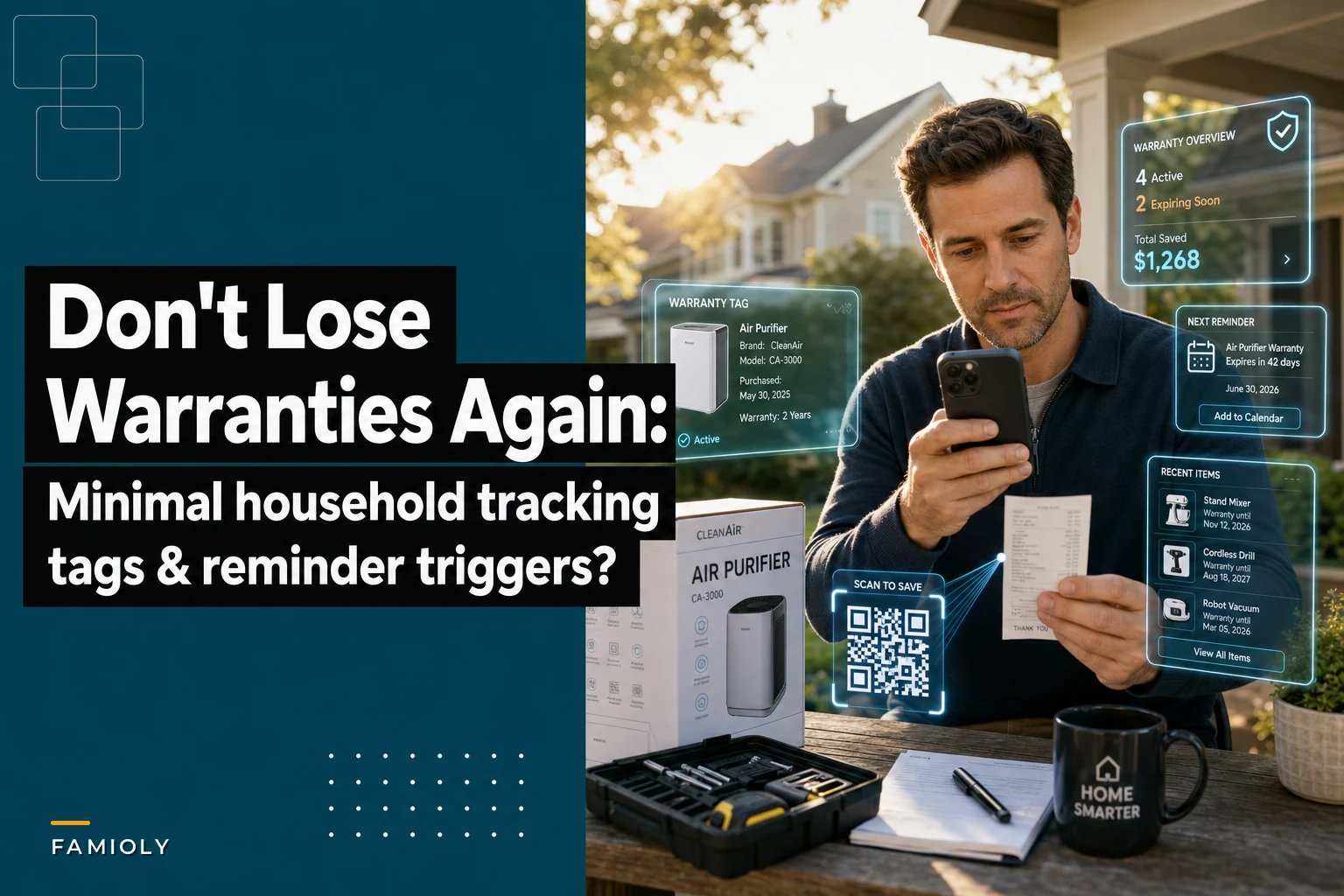

My neighbor tossed a barely-used dishwasher last month. Not because it couldn't be fixed—she just couldn't find the warranty paperwork when the control panel died. The repair would've been free under warranty. Instead, she bought a whole new unit for $1,400.
This stuff happens constantly. People aren't disorganized idiots. Traditional filing systems just collapse under how we actually buy things now. Warranties come as PDFs buried in email, receipts get stuffed wherever, manuals pile up in drawers, and nobody tracks when that water heater needs its annual maintenance to stay covered.
After watching families lose money on repairs that should've been free, I started tracking this. Not through some elaborate system—just smart tagging and reminders that take maybe five minutes per purchase.
Why the old filing advice doesn't work
"Keep everything in a filing cabinet" assumes you have infinite space and remember what needs attention when.
Your household deals with messier realities. You're buying from Amazon, local stores, manufacturers directly. Kids open packages. Different people handle different purchases. Warranties arrive as physical cards, email confirmations, or PDFs you need to register within 30 days.
Your water heater might have six-year tank coverage but only one year on parts. The fridge has separate warranties for the ice maker and compressor. That expensive laptop needs registration by a certain date or the warranty doesn't activate at all.
Most households now juggle 40-50 warranted items at once. When something breaks two years later, good luck remembering who bought it, when, or where the paperwork ended up.
Start with tags, not alphabetical filing
Forget trying to organize by manufacturer or purchase date. Tag items based on how you think about them when they break.
Stop losing track of household duties.
Famioly helps you organize, assign & complete family tasks efficiently.
- Centralized task management
- Shared family calendar
- Budget & expense tracking
No credit card required
Location tags first: kitchen, garage, basement, outdoor. When the garbage disposal starts grinding weird, you search "kitchen" and see every covered item in that space immediately.
Status matters too: active-warranty, expired, extended-coverage, needs-registration. Shows you what's still protected.
Action tags drive the real value: needs-service, register-by-date, maintenance-due. These connect to your actual to-dos.
Purchase source helps: amazon, costco, home-depot, manufacturer-direct. Different retailers handle warranty claims completely differently. Costco automatically doubles most manufacturer warranties. Home Depot processes certain brand warranties in-store. Amazon has its own separate claim system.
Here's a washing machine entry:
-
Item
Whirlpool WTW5000 Washer
-
Tags
laundry, active-warranty, needs-annual-cleaning, costco
-
Purchase date
March 15, 2023
-
Warranty expires
March 15, 2024 (manufacturer), March 15, 2025 (Costco extended)
-
Maintenance
Clean filter monthly, professional service yearly
-
Documents
Receipt photo, warranty PDF, manual link
When that washer acts up fourteen months from now, you'll know instantly that Costco still covers it even though the original warranty expired.
Use short, consistent tags like 'kitchen' and 'active-warranty' to make searches fast.
Purchase source helps: amazon, costco, home-depot, manufacturer-direct. Different retailers handle warranty claims completely differently.
Reminders that actually trigger action
Calendar alerts fail because they assume you'll handle warranty stuff on random Tuesdays. Better to use scenario-based triggers.
Maintenance reminders fire two months early. HVAC needs annual service to stay covered? Remind yourself in October if service is due by December. Contractors book weeks out during busy seasons.
Registration deadlines get immediate flags. Many electronics need registration within 30-60 days. Tag these "register-by" with the deadline date. Check this weekly after any shopping trips.
Warranty expirations warn three months ahead. Gives you time to evaluate extended coverage or start shopping replacements. Laptop warranty ending in March? You know by December whether to extend or start browsing deals.
For complex warranty terms, add specific coverage notes:
"Refrigerator ice maker covered separately - expires 2025. Compressor covered 10 years through 2033. Labor only covered first year (already expired)."
Items people forget to track (but shouldn't)
Small kitchen appliances usually carry 1-3 year warranties people never save. That espresso machine, food processor, stand mixer—probably still covered. Instant Pot requires registration but offers solid coverage.
Power tools often have longer warranties than anyone realizes. DeWalt gives three years standard, seven with registration. Ridgid offers lifetime coverage if you register. Milwaukee provides five years on most tools. Yet people assume they died naturally when they quit after eighteen months.
Smart home devices surprise people. Video doorbells, smart locks, thermostats, security cameras typically include 1-2 year coverage. That glitchy Nest thermostat? Probably still covered.
Furniture catches people off guard. Couches have frame warranties. Mattresses split comfort and structural warranties with different terms. Office chairs often cover mechanisms for 5-10 years. Dining tables might have lifetime warranties on wood but only one year on finish.
Outdoor equipment gets ignored until it breaks in spring. Grills, mowers, pressure washers, patio heaters. Weber grills carry 10-year warranties on many parts that people never claim.
Outdoor equipment always surprises people with coverage duration.
How this plays out in real life
A family I know had their garage crammed with warranted stuff: cars, lawn equipment, tools, bikes, camping gear. Zero documentation for anything.
Their riding mower died in July. They figured it was old and out of warranty, so they bought a new one for almost three grand. Turns out they'd bought the dead mower three years prior with four-year coverage. Without proof of purchase or maintenance records, they couldn't claim anything.
After setting up the tagging system, they discovered the generator they thought was ancient still had two years left. The pressure washer needed annual maintenance to stay covered (never done). Mountain bike had lifetime frame warranty they didn't know existed.
Setting up tags took about two hours total. Within four months, they'd claimed over $800 in warranty repairs they would've paid for otherwise.
Digital tools vs paper systems
Paper works for original receipts and critical documents. But pure paper systems can't remind you about maintenance, can't be searched when you're standing in a store trying to remember if something's covered, and definitely can't be accessed from multiple locations.
Digital systems need to stay simple though. Complex databases become their own maintenance burden.
Best approach combines both. Photograph receipts immediately. Store digitally with tags. Keep originals in one basic folder—no elaborate filing since you'll search digitally first. Gives you legal proof while maintaining searchable convenience.
Some families use note apps with good search. Others prefer home inventory apps. The tool matters less than consistent tagging and reminder habits. Even a shared Google Doc works if you maintain tag consistency.
For multiple properties, digital becomes essential. Can't physically file documents in three locations. Cloud systems let property managers, family members, and contractors access warranty info from anywhere.
Most people need something simple and accessible. Too many features just create another system to abandon.
Warranty strategies most people miss
Credit cards often extend warranties automatically. Many cards add a year to manufacturer coverage up to $10,000 per item. You need documentation of both original warranty and credit card purchase though. Tag credit card purchases with "extended-by-card."
Store protection plans aren't always garbage. For items with high failure rates in years 2-3 (dishwashers, fridge ice makers, washing machines), the math might work. Only if you'll actually use it though. Tag these "extended-protection" with the claim number.
Some warranties transfer to new owners—adds value during home sales. Major appliances, water heaters, HVAC systems can increase sale price if warranties remain active. Tag these "transferable" and include in sale documents.
| Warranty Type | Duration | Transfer Rules | Key Details |
|---|---|---|---|
| Major Appliances | 1-10 years | Usually transfer | Parts/labor split common |
| Power Tools | 1-7 years | Registration required | Often extend with registration |
| Electronics | 1-3 years | Registration within 30-60 days | Credit cards may extend |
| HVAC Systems | 5-25 years | Transfer with proper maintenance | Annual service required |
| Water Heaters | 6-12 years | Transfer to new homeowner | Tank vs components differ |
Don't overlook manufacturer incentives either. Some companies offer cash back for registering warranties or provide upgrade discounts when coverage expires.
When minimal isn't enough anymore
This system handles most household needs. Certain situations need more robust tracking though.
Multiple properties require centralized systems accessible to property managers. Can't rely on tenants maintaining warranty docs. Cloud-based inventory with role access becomes necessary.
High-value collections (art, instruments, wine, electronics) need detailed documentation for insurance beyond warranties. Requires photos, appraisals, condition notes alongside warranty tracking.
Home businesses must track warranties for tax purposes. IRS wants documentation for equipment depreciation and repairs. Needs date tracking, cost basis, repair history beyond basic warranty management.
Managing over 100 warranted items, or dealing with regular insurance claims? Consider operational software that automates tracking. These platforms use AI automation to extract warranty terms from receipts, set intelligent reminders based on actual requirements, and even initiate claims through proper channels automatically. When managing warranties across multiple properties or high-value assets, automation prevents expensive oversights.
Making it stick
Perfect systems nobody uses are worthless. This minimal approach works because it needs almost no ongoing maintenance.
Here's the workflow that actually works:
-
Photograph receipts before leaving the store parking lot (10 seconds)
-
Add tags during TV time that evening (1 minute)
-
Set reminders for registration deadlines or maintenance (30 seconds)
-
Search tags instead of digging through drawers when something breaks
-
Weekly 5-minute review of upcoming deadlines
Process purchases within the week they happen. Not same day—unrealistic. But within a week while you remember details and still have packaging with model numbers.
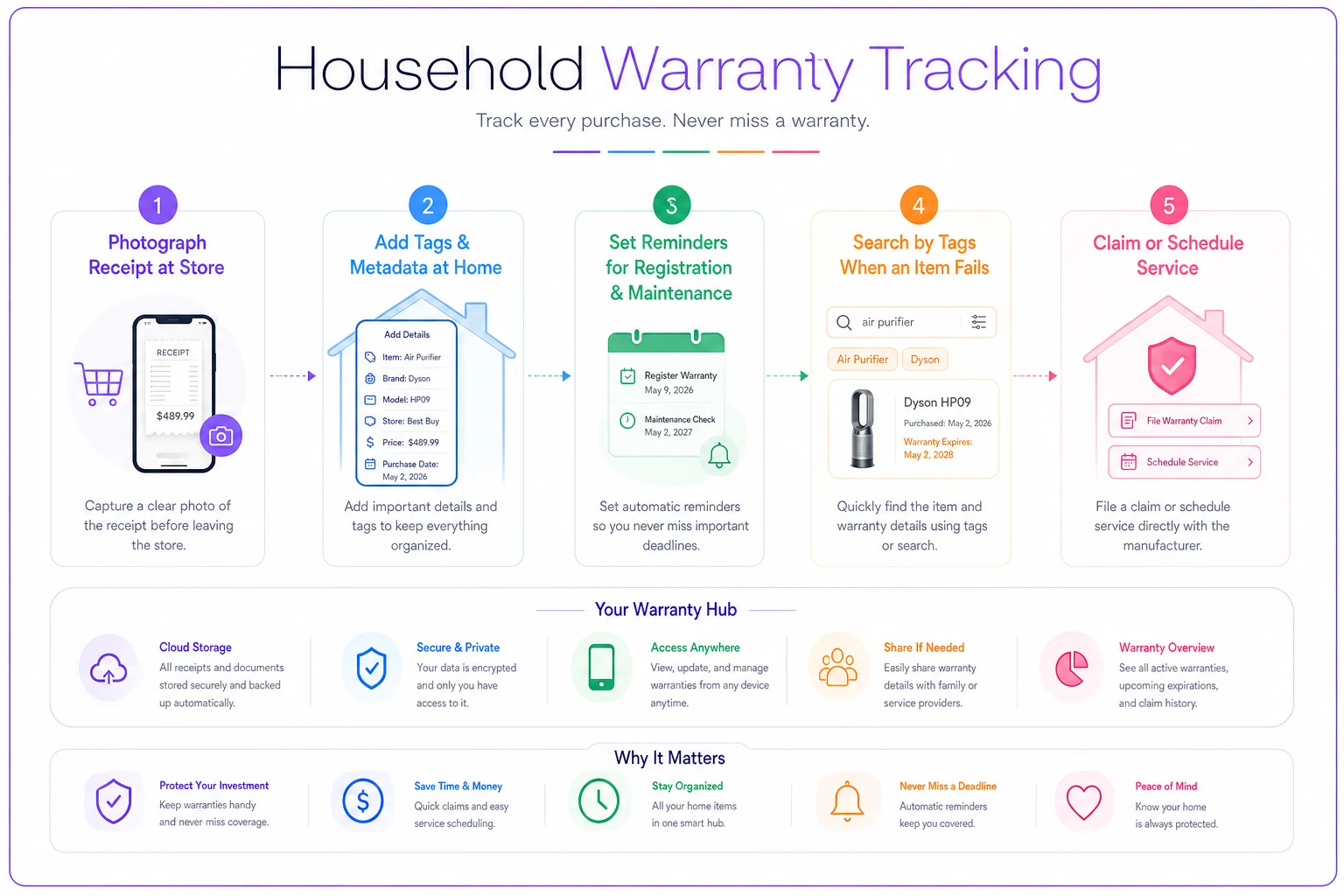
This diagram shows the five-step workflow in sequence.
For families, assign warranty tracking to whoever handles most household purchases. Split responsibility creates gaps. One person maintains it, everyone searches it.
Biggest mistake? Trying to document everything you currently own retroactively. Start with new purchases. Add old items only when you naturally find their documentation. Building the habit beats perfect historical records.
Stop throwing away coverage you already paid for
Your household runs dozens of warranties simultaneously. Without a system, you're throwing away insurance built into purchase prices. My neighbor's dishwasher? One phone call and receipt photo would've fixed it free.
Location tags, status tags, action triggers, five minutes per item. Transforms warranty management from storage problem into searchable database.
Start with your next purchase. Photograph receipt, add three tags, set one reminder. Build the habit before perfecting the system.
Most households can reclaim hundreds or thousands annually in warranty benefits they're currently missing. The best organizational system isn't the most comprehensive—it's the one you'll actually use.
Your household runs dozens of warranties simultaneously. Without a system, you're throwing away insurance built into purchase prices. My neighbor's dishwasher? One phone call and receipt photo would've fixed it free.
Start with your next purchase. Photograph receipt, add three tags, set one reminder. Build the habit before perfecting the system.
Most households can reclaim hundreds or thousands annually in warranty benefits they're currently missing. The best organizational system isn't the most comprehensive—it's the one you'll actually use.
Ready to simplify your household management?
Join thousands of families using Famioly to save time, reduce home management stress, and keep the household running smoothly.