

Most households don't realize they're running a small procurement operation until something goes wrong. The HVAC guy who serviced your unit last spring? Nobody remembers his name or whether the work is still under warranty. The cleaner who quit texting back? No record of what she was paid or when she last showed up. The "great" handyman a neighbor recommended? He billed $340 for a job that should've been $120, and there's no paper trail to push back.
A typical family works with somewhere between 8 and 20 recurring vendors over a year — lawn care, pest control, pool service, cleaners, appliance repair, gutter cleaning, HVAC, electrician, plumber, tree work, and the occasional one-off. That's a real supply chain. And most families manage it entirely from memory, scattered text threads, and a shoebox of receipts.
A home vendor management system isn't about corporate procurement software. It's about having four connected pieces — an onboarding checklist, a service history log, a simple scorecard, and clear renewal/termination triggers — so you stop losing money, stop repeating the same conversations, and stop rehiring people who already burned you once.
The real problem isn't any single vendor — it's that nothing connects
Each vendor lives in a separate silo. The cleaner is in your text messages. The landscaper is in your spouse's email. The plumber's invoice is a photo buried somewhere on your phone. The warranty paperwork from the water heater install is... who knows.
So when a real decision comes up — should we rehire this company, is this repair still covered, why did the bill jump $80 — there's no single place to look. You reconstruct the answer from fragments, and half the time you get it wrong.
-
Repeat repairs. The dishwasher gets "fixed" three times in eight months by the same tech, and nobody connects it to a recurring failure that should've pushed you toward replacement.
-
Warranty gaps. Work gets done, something fails four months later, and the labor warranty — usually 30 to 90 days — has quietly expired because nobody logged the date.
-
Vendor drift. A cleaner who was excellent for two years slowly declines — missed corners, later arrivals, price creeps — but because there's no record, the decline feels like "just a feeling" instead of a documented pattern you can act on.
None of these are people problems. They're information problems. The vendor didn't get worse overnight; you just had no system to catch the slide and no threshold that said time to reassess.
The four pieces and how they feed each other
Think of this as one workflow with four checkpoints, not four separate lists. Onboarding creates the record. The service log fills it in over time. The scorecard reads the log and turns it into a judgment. The triggers turn that judgment into an action. Break the chain anywhere and the whole thing degrades.
Stop losing track of household duties.
Famioly helps you organize, assign & complete family tasks efficiently.
- Centralized task management
- Shared family calendar
- Budget & expense tracking
No credit card required
| Piece | What it captures | What it feeds |
|---|---|---|
| Onboarding checklist | Contact info, license/insurance, rate, scope, warranty terms | Creates the vendor record everything else attaches to |
| Service history log | Every visit, date, cost, what was done | Feeds the scorecard and warranty tracking |
| Scorecard | Reliability, quality, price, communication | Feeds renewal/termination decisions |
| Renewal/termination triggers | Thresholds that force a decision | Closes the loop, prevents vendor drift |
The value isn't in any one piece — it's that a logged service visit automatically updates the warranty window and the scorecard and moves you closer to a renewal decision.
Visualizing the workflow helps.
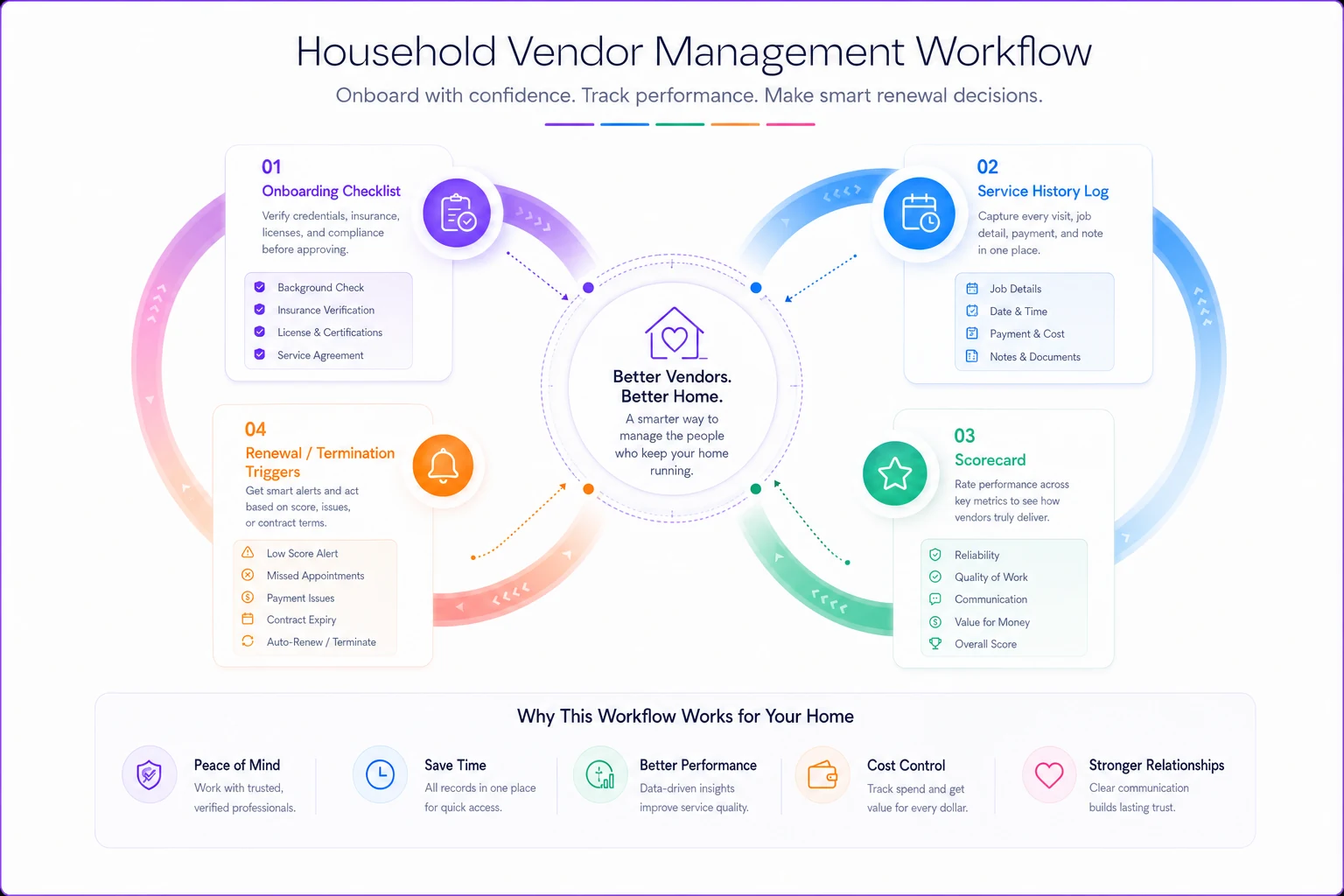
That's the difference between a filing cabinet and an actual system.
The vendor onboarding checklist
Onboarding is the moment you set the terms of the relationship, and it's the step everyone skips. A vendor shows up, does a job, and becomes "your guy" without you ever writing down their insurance status, their rate structure, or what happens if the work fails.
-
Full business name + the specific person who'll actually do the work (they're often different)
-
Two contact methods (phone + email or text), so a dead phone number doesn't orphan the relationship
-
License and insurance status for anyone doing electrical, plumbing, roofing, or tree work — ask for a photo of the certificate
-
Rate structure
flat, hourly, per-visit, trip charge, after-hours premium
-
Scope of what's included vs. what's an upcharge (a cleaner "deep clean" vs. standard is the classic dispute)
-
Warranty terms in writing — how long is labor guaranteed, how long are parts guaranteed, what voids it
-
Preferred scheduling method and typical lead time
-
Payment terms — due on completion, net 15, accepted methods
This takes about ten minutes per vendor and prevents the two most common disputes: "I thought that was included" and "you said it was under warranty."
What most people miss: onboarding isn't paperwork for its own sake. Every field you capture becomes a field you can compare later. You can't score price fairness if you never recorded the rate structure. You can't enforce a warranty you never wrote down.
The service history log
This is the piece that quietly does the most work. It also connects directly to your broader home maintenance and warranty tracking. If you've already set up a lifecycle maintenance calendar and warranty triggers, the service log is the layer that records what actually happened versus what was scheduled.
For each visit, log five things:
-
Date of service
-
Vendor
-
What was done (one plain sentence — "replaced capacitor on AC unit")
-
Cost (parts + labor if itemized)
-
Warranty end date for that specific work
That fifth column is where the log links back to your warranty system. If you're already using a minimal household tracking system with tagging and reminder triggers, the service log is where the tag gets created — the moment a plumber replaces a valve, you log the visit, tag the warranty, and set the reminder in one motion.
A workflow that actually holds up looks like this:
Vendor finishes job → snap photo of invoice → add one row to the log → warranty end date populates a reminder
Do it at the moment of service or it won't happen.
Ninety seconds, done at the door while the tech is still packing up. The failure mode is always the same — people intend to log it later, and later never comes. Do it at the moment of service or it won't happen.
The simple scorecard
You don't need a complex rating system. Three or four dimensions, scored casually after each job or once a quarter, is plenty. The point isn't precision — it's turning a vague feeling ("I don't love them anymore") into something you can actually act on before it costs you.
-
Reliability — do they show up when they say?
-
Quality — is the work done right the first time?
-
Communication — do they respond and explain?
-
Price fairness — is the cost consistent and reasonable for the work?
A vendor sitting at 4s and 5s stays. One drifting into 2s across two visits in a row is your early warning. The value is catching the slide before it becomes a problem — a cleaner whose reliability score drops from 5 to 3 over two months is telling you something before it turns into a missed week during a family event.
Price fairness is the score that quietly saves the most money. Reliability and quality problems are obvious. Rate creep is silent — $3 here, a new trip charge there — and without a scorecard prompting you to notice, you'll pay 20 to 30% more over two years and never really register when it happened.
Renewal and termination triggers
A scorecard without triggers is just a diary. The trigger is the rule that says "when X happens, make a decision" — so you're not relying on willpower or a random moment of frustration to act.
-
Two consecutive scores below 3 on any dimension → schedule a conversation or start sourcing a replacement
-
A repair failing within the warranty window → escalate; don't just rebook the same fix
-
Third service call for the same issue in a year → shift from repair mode to replace mode
-
Annual rate increase above roughly 10% with no scope change → get a competing quote
-
Any lapse in required insurance or license → hard stop for licensed trades
Triggers work because they remove the decision from the emotional moment. You're not deciding whether to fire the landscaper while you're angry about a torn-up flower bed — you set the rule months ago, calmly, and now you're just following it.
When this level of structure makes sense — and when it doesn't
This system is worth building if you have more than a handful of recurring vendors, if you own your home (warranties and repair history matter a lot more when you do), or if two adults share vendor management and keep stepping on each other. It's also genuinely useful for anyone managing an aging parent's household alongside their own, where visibility matters more than convenience.
It's overkill if you rent, have two vendors total, and your landlord handles repairs. A single notes page with contact info is fine in that case — don't build machinery you won't use.
Don't over-engineer the scoring either. Nobody keeps up a 12-field rating rubric. The households that actually maintain this are the ones who kept it to five fields and ninety seconds per entry.
A real scenario: the four-repair dishwasher
A dual-income family with three kids was working with about a dozen recurring vendors. Their appliance situation is the clearest example of why the connected system matters.
Over roughly ten months, the same repair company came out four times for a dishwasher that kept failing — a leak, then a drainage issue, then the leak again. Each visit ran $110 to $160. Nobody was tracking it as a pattern; each call felt like a fresh, isolated annoyance, and each got approved in the moment.
Total spend across those four visits landed around $520 — on a dishwasher that was seven years old and could've been replaced for roughly $600. Worse, the second repair almost certainly failed inside its own labor warranty, but with no logged service dates, they paid full price for the third visit instead of pushing back.
Once they set up a basic service log and a "third call for the same issue → replace" trigger, the next appliance showing the same pattern got flagged. The washer failed twice in four months, the trigger fired, and they replaced it instead of sinking another $300 into repairs. Not a dramatic transformation — just a household that stopped quietly bleeding money on decisions it never realized it was making.
Where this fits in the bigger household system
Vendor management isn't a standalone project — it plugs into how your household assigns responsibility and makes decisions in general. If one person onboards vendors and another schedules them and a third pays the invoices, the system falls apart at the handoffs. That's why vendor management works best inside a broader structure of roles and triggers, the kind laid out in a household operating system template with roles, triggers, and a cadence matrix.
The connection is practical: your household OS decides who owns the vendor log and when the scorecards get reviewed. The vendor system decides what gets tracked. One without the other tends to drift — either you have good data nobody looks at, or a review cadence with nothing to review.
For families managing a lot of this manually, shared household tools with reminder automation genuinely help — not because the tracking itself is hard, but because the remembering is. A warranty end date that pings you three weeks out, a scorecard review that surfaces on schedule, a service log both partners can update from their phones — that's what keeps the system alive past month two. The tracking is simple; sustaining it is the real challenge, and light automation is what carries it.
Getting started without overbuilding it
Don't try to backfill two years of vendor history. Start from today. The next time any recurring vendor does a job, run them through the onboarding checklist once and log that first visit. Build the record forward.
Within a few months you'll have a live log for your active vendors, scorecards that reflect real recent work, and triggers quietly watching for the moments that used to cost you. The whole thing runs on maybe ten minutes a month of upkeep once it's set up.
The households that get the most out of a home vendor management system aren't the ones with the fanciest spreadsheets. They're the ones who kept the log easy enough to actually maintain, and trusted their triggers enough to act on them. A slipping cleaner, an expiring warranty, a dishwasher on its fourth repair — these stop being surprises and start being decisions you make on purpose, before the cost shows up on your bank statement.
The households that get the most out of a home vendor management system aren't the ones with the fanciest spreadsheets. They're the ones who kept the log easy enough to actually maintain, and trusted their triggers enough to act on them. A slipping cleaner, an expiring warranty, a dishwasher on its fourth repair — these stop being surprises and start being decisions you make on purpose, before the cost shows up on your bank statement.
Ready to simplify your household management?
Join thousands of families using Famioly to save time, reduce home management stress, and keep the household running smoothly.