
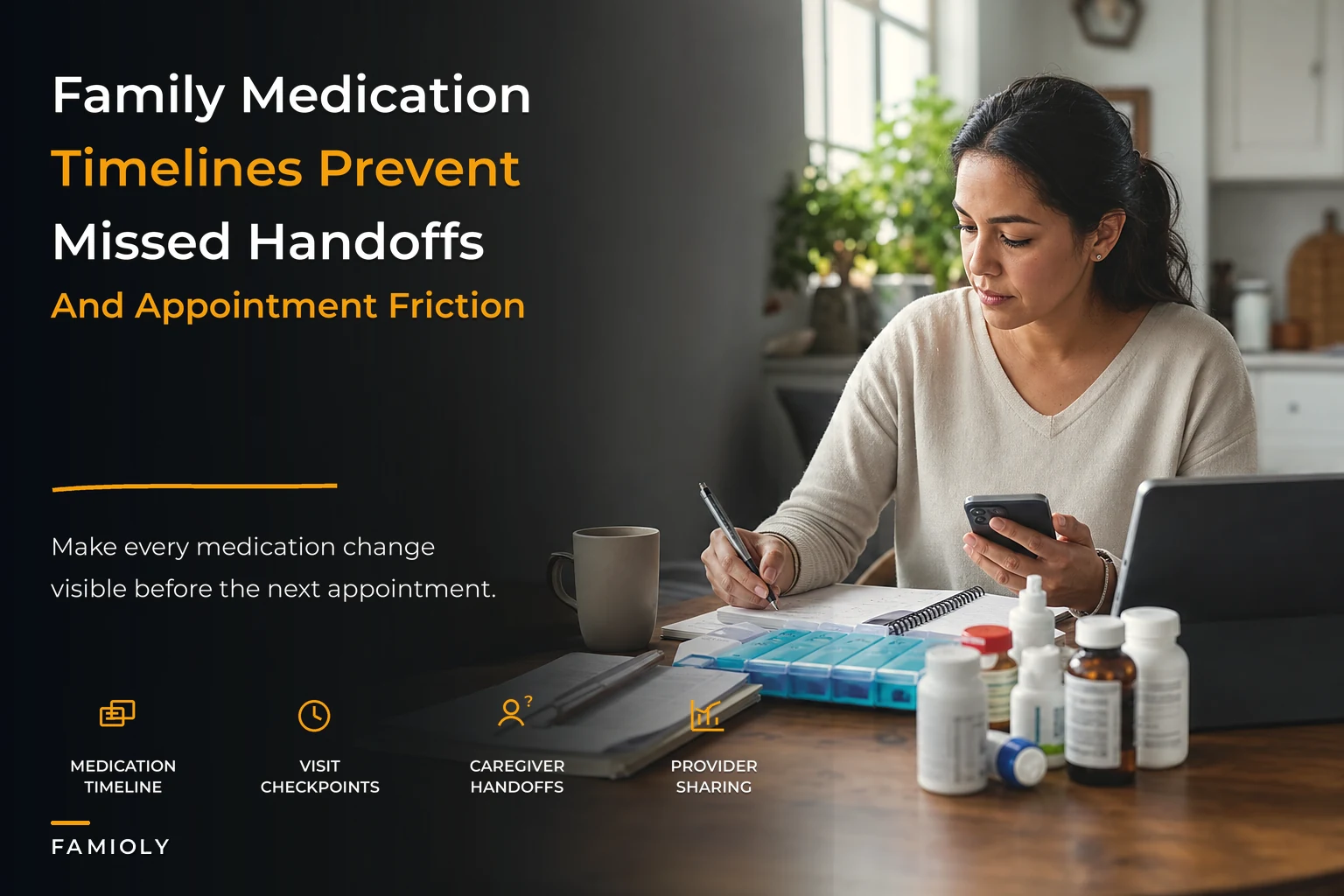

Most families don't realize their medication coordination is broken until something goes wrong. A dose gets doubled because two people both "took care of it." A prescription lapses because nobody knew whose job the refill was. A specialist changes a dosage during an appointment, and that change never makes it back to the person filling the weekly pill organizer.
None of these are dramatic failures. They're quiet ones. And they happen because medication management in a household is almost never treated as a system — it lives in people's heads, in scattered text threads, in a pharmacy app one person checks and nobody else can see.
The fix isn't more diligence. Diligence doesn't scale across three caregivers and two aging parents. The fix is a coordination structure where every medication fact has a traceable origin, every appointment feeds back into the plan, and any caregiver swap can happen without a 20-minute phone briefing.
Why medication coordination quietly falls apart
Medication information has provenance — it comes from somewhere, it changes over time, and the "current truth" depends on knowing the latest source. But most families store medication info as a flat snapshot. A list on the fridge. A note in someone's phone. A mental model that only the primary caregiver holds.
The snapshot approach works fine when one person manages everything and nothing changes. It breaks the moment you add a second decision-maker or a medication that gets adjusted.
Here's the pattern that shows up constantly: a parent is on five medications. The adult daughter manages refills. The son takes dad to the cardiologist. The cardiologist bumps one dosage and discontinues another. The son knows. The daughter doesn't. For three weeks, the pill organizer gets filled with the old plan. Nobody did anything wrong — the information just had no path home.
This is why families with genuinely good intentions still end up with reconciliation errors. It's not carelessness. It's that there's no single place where the question "what is dad actually supposed to be taking right now, and who said so?" gets a clean answer.
What breaks as the household scales
A single person managing their own two medications doesn't need a system. But household medication coordination doesn't scale linearly — it scales with the number of relationships between people, meds, and providers.
Stop losing track of household duties.
Famioly helps you organize, assign & complete family tasks efficiently.
- Centralized task management
- Shared family calendar
- Budget & expense tracking
No credit card required
-
Two caregivers nobody's sure who owns refills, so either both act or neither does.
-
Multiple prescribers the cardiologist doesn't know what the psychiatrist prescribed, and nobody's holding the full list.
-
Changing dosages the "current" dose depends on which appointment you remember.
-
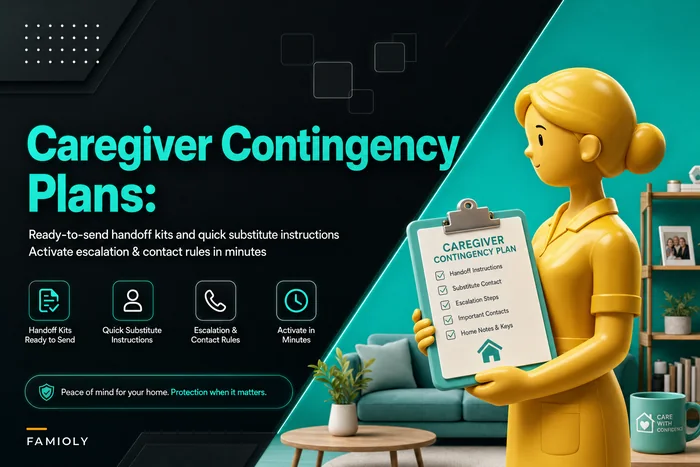
A caregiver goes on vacation the backup person inherits a mess they can't decode quickly.
The last one is where everything compounds. When the person holding the mental model steps away, all the gaps surface at once. This is the same failure mode behind weak contingency plans for caregiver absence — the system only works while one specific human is present, which means it doesn't really work at all.
The three pieces that actually make it work
A durable medication system has three connected parts. Each one solves a different failure, and they only work together.
1. The medication timeline (provenance over snapshots)
Stop keeping a medication list. Keep a medication timeline. The difference matters more than it sounds.
A list says: "Metformin, 1000mg, twice daily." A timeline says: "Metformin started March 2023 by Dr. Reyes; increased to 1000mg twice daily on 11/14 by Dr. Reyes at the endocrinology visit; confirmed still current as of the last refill."
The timeline carries provenance — who said it, when, and why it changed. That's what lets a second caregiver trust the information without re-verifying everything from scratch. When a dose changes, you don't erase the old entry. You add a new one. The current state is always the most recent entry, and the history is there when a doctor asks "when did this change?"
-
The medication and current dose
-
The prescriber who ordered it
-
The date of the change
-
The reason (new condition, titration, side effect, discontinued)
-
The source event (which appointment, which call)
This single shift — from snapshot to timeline — eliminates the most common reconciliation error, because there's no longer any ambiguity about which version is current.
2. The appointment pipeline (closing the feedback loop)
Appointments are where medication plans change, and they're also where information most often fails to come home. The appointment pipeline is the structure that forces every visit to feed back into the timeline.
-
Before pull the current medication timeline and print or screenshot it. Note questions. Assign who's attending.
-
During capture every change in the moment — new scripts, dosage adjustments, discontinuations, follow-up instructions.
-
After within 24 hours, reconcile what changed against the timeline, update entries, and notify the other caregivers.
The "after" step is the one everyone skips, and it's the one that matters most. An appointment that doesn't update the shared timeline is an appointment whose decisions evaporate.
A good pipeline also tracks the appointment lifecycle itself — scheduled, confirmed, attended, reconciled. If a visit shows "attended" but not "reconciled," that's a flag. Something changed and hasn't made it into the record yet.
Here's a simple workflow for the appointment pipeline.
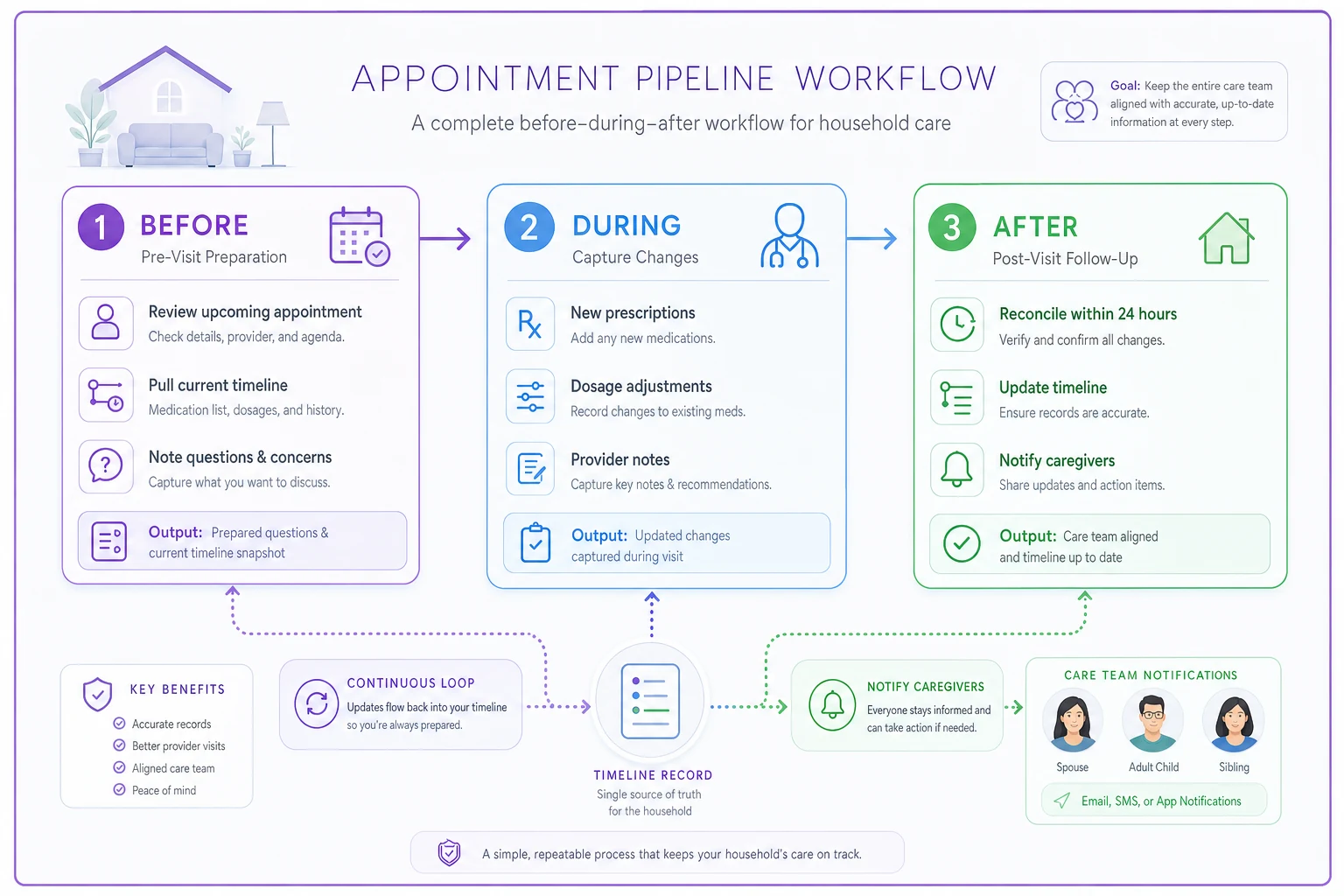
If a visit is marked "attended" without "reconciled," treat it as an action item to finish within 24 hours.
A good pipeline also tracks the appointment lifecycle itself — scheduled, confirmed, attended, reconciled. If a visit shows "attended" but not "reconciled," that's a flag. Something changed and hasn't made it into the record yet.
3. The handoff kit (making caregiver swaps survivable)
The handoff kit is what lets anyone take over medication duties on short notice. It's the medication-specific version of a broader contingency plan, and it should be ready before you need it, not assembled in a panic.
-
The current medication timeline (printed and digital)
-
A simple daily schedule
what gets taken when
-
Pharmacy details and refill status for each med
-
Each prescriber's name, specialty, and contact
-
Known allergies and adverse reactions
-
Upcoming appointments and their purpose
-
A short "what to watch for" note per medication
The test of a good handoff kit is brutal but simple: could a competent adult who has never managed this person's meds take over for a week using only the kit? If the answer requires a phone call to the primary caregiver, the kit isn't done.
Medication reconciliation: the check that prevents the worst errors
Reconciliation is the step where you compare what's supposed to be taken against what's actually happening. Standard practice in hospitals, almost universally skipped at home.
You don't need clinical complexity. You need a recurring check. Once a month, or after any appointment, run through a short reconciliation:
-
Does every medication in the pill organizer match a current timeline entry?
-
Is anything in the organizer that was discontinued?
-
Is anything missing that should be there?
-
Do the doses in the organizer match the latest prescribed doses?
-
Are any refills about to lapse?
Here's a simple comparison of the reconciliation approaches families fall into:
| Approach | How it works | Failure mode |
|---|---|---|
| Memory-based | Primary caregiver mentally checks | Collapses when they're unavailable or distracted |
| Snapshot list | Compare against a static fridge list | Goes stale the moment a doctor changes something |
| Timeline reconciliation | Compare organizer against provenance-tracked timeline | Catches discontinued meds and dose changes reliably |
The third approach is the only one that catches the "ghost medication" problem — a drug that was discontinued but keeps getting put in the organizer because nobody updated the plan. It sounds obvious until you realize how often it actually happens.
Provider-sharing scripts that actually get used
Doctors ask "what medications is he on?" at nearly every visit. Fumbling for a half-remembered answer wastes time and introduces errors. A provider-sharing script is just a ready, consistent way to communicate the current state.
Keep two versions:
The verbal summary (for quick exchanges): "He's on four medications. I have the full list with doses and dates here — would it be easier if I shared the printout?"
The written share (for new providers or specialists): a one-page export of the current timeline, organized by medication, with doses, prescribers, and last-change dates.
The script's real value is consistency. When every caregiver shares the same format, every provider gets the same accurate picture, and the specialist who's never seen your records can get oriented in under a minute. That alone is worth the setup time.
A real scenario
Consider a family managing care for an 81-year-old father across two adult children in different cities. He sees four providers — a GP, a cardiologist, an endocrinologist, and an ophthalmologist — and takes six regular medications plus two seasonal ones.
Before any system: over about eight months, they hit three reconciliation errors. One discontinued blood pressure medication stayed in his organizer for nearly a month. A dosage increase from the endocrinologist took roughly three weeks to reach the sibling filling the pill box. A refill lapsed because each sibling assumed the other had handled it, leaving a two-day gap.
After switching to a timeline-based approach with an appointment pipeline: changes started reaching both siblings within a day of each visit. The monthly reconciliation caught the discontinued med problem before it recurred. Refill lapses dropped to zero because the timeline flagged refill status and ownership was explicit. The recurring "wait, what's he taking now?" phone call that used to eat 15–20 minutes basically disappeared.
Nothing about the family changed. They were conscientious before. The structure changed.
When this level of system makes sense — and when it doesn't
This isn't worth building for everyone.
It makes sense when: you've got multiple caregivers, multiple prescribers, medications that change over time, or someone whose cognition means they can't self-manage reliably. The more relationships between people and meds, the higher the payoff.
It's overkill when: one healthy adult manages their own one or two stable medications. A phone reminder is fine.
Be careful if: you're the only caregiver and you're building this purely in your own head. That's the trap — a sophisticated mental system that nobody else can access is still a single point of failure. The whole point is to make the knowledge portable.
Where this connects to the rest of household operations
Medication coordination isn't a standalone problem. It's one domain inside a larger household operating structure. The same principles — clear ownership, feedback loops, information that lives outside one person's head — show up everywhere from chores to finances.
If you're building medication coordination from scratch, it's worth slotting it into a broader framework rather than treating it as a one-off. A household operating system with roles, triggers, and a cadence matrix gives you the scaffolding to assign medication ownership, set reconciliation cadences, and define what triggers a handoff.
The reconciliation and appointment-review steps also work best when they have a regular home. Folding a quick medication check into a short, structured family meeting means it actually happens instead of getting perpetually deferred. The check takes five minutes when it's part of a rhythm — and never happens when it isn't.
The real shift
The families who get this right aren't more careful than everyone else. They've moved medication knowledge out of a single person's head and into a structure that anyone can read, update, and hand off.
A list tells you what someone is taking. A timeline tells you what they're taking, who said so, and when it changed — and that difference is the whole game. Once the information has provenance, the appointment loop closes, the handoff becomes survivable, and the reconciliation check actually catches the errors that used to slip through quietly.
Start with the timeline. Build the pipeline so appointments feed it. Keep a handoff kit current. Everything else is details.
Ready to simplify your household management?
Join thousands of families using Famioly to save time, reduce home management stress, and keep the household running smoothly.