


Last month, a friend texted me in full panic mode. Their nanny had food poisoning, grandma was traveling, and both parents had unmovable work commitments. They spent the next three hours scrambling — calling backup sitters who didn't know the kids' routines, texting medication schedules, forgetting to mention the 2-year-old's new dairy allergy.
This scenario plays out in households constantly. Not because they're disorganized, but because most families plan for big disasters (fires, medical emergencies) while completely ignoring the mundane crisis of Tuesday morning caregiver absence.
After working with dozens of families through these situations, I started noticing which households recovered smoothly versus which ones descended into chaos. The difference wasn't having more backup options — it was having activation-ready handoff materials that anyone could use immediately.
The gap between having backup caregivers and being able to use them
Most families think they're prepared because they have backup sitters saved in their phones. But there's a massive gap between knowing someone's phone number and being able to hand them functional care instructions in under five minutes.
Consider what actually needs to transfer when your regular caregiver suddenly can't work:
Your regular nanny knows medication goes in applesauce, not yogurt. She knows the car seat buckle sticks. She knows your 4-year-old will claim he's allergic to vegetables (he's not). She has muscle memory for your house — where the spare diapers hide, which playground is walking distance, how to work your overcomplicated coffee maker.
A backup caregiver has none of this context. Even experienced sitters need operational knowledge specific to your household. Without it, you're asking someone to reverse-engineer your entire childcare system while managing actual children.
I learned this running operations for a home care agency. We'd send highly qualified substitutes to cover regular caregiver absences, and still get frantic calls about seemingly basic issues. Not because the subs were incompetent, but because every household runs on hundreds of micro-decisions that regular caregivers absorb over time.
The solution isn't training every potential backup or writing a 47-page manual. It's creating handoff kits designed for zero-notice activation.
Building your 5-minute handoff kit
A functional handoff kit isn't a binder gathering dust on a shelf. It's stored in three places — your phone, your partner's phone, and physically in your home — ready to send or hand over instantly.
Stop losing track of household duties.
Famioly helps you organize, assign & complete family tasks efficiently.
- Centralized task management
- Shared family calendar
- Budget & expense tracking
No credit card required
Start with the absolute minimums for safety and functionality. Not ideal care, just viable care. You're optimizing for speed of deployment.
The Core Kit Components:
| Component | Details |
|---|---|
| Immediate Safety Card (first 30 minutes) | Medical conditions and medications Allergies with specific examples ("NO peanuts, tree nuts, or items processed in nut facilities") Emergency contacts in order of availability Car seat configuration if applicable Full address written out for 911 calls |
| Today's Survival Guide (hours 1-4) | Current nap schedule with flexibility notes Feeding times and current preferences Screen time rules and passwords Approved activities that work right now "Break glass in case of meltdown" tactics |
| House Operations Sheet | WiFi password Alarm code and instructions Where to find essentials (diapers, wipes, snacks, first aid) Appliance quirks ("microwave runs hot, use 70% power") Parking restrictions |
| Kid Decoder Ring | Comfort items and where they live Current fears or anxieties Bathroom/diaper routines Bedtime non-negotiables Which battles to skip today |
| Contact Hierarchy with Context | Parent 1: availability windows and best contact method Parent 2: same format Designated emergency decision maker if neither parent available Neighbor who has house key Pediatrician with after-hours protocol |
Format this as a single document that's scannable in under two minutes. Use headers, bullets, and bold text for critical items. Skip paragraphs — they won't get read during activation.
Creating activation triggers that actually work
Having a handoff kit means nothing if you can't activate it when you need it. Most families create beautiful contingency plans that require 45 minutes of morning coordination to implement.
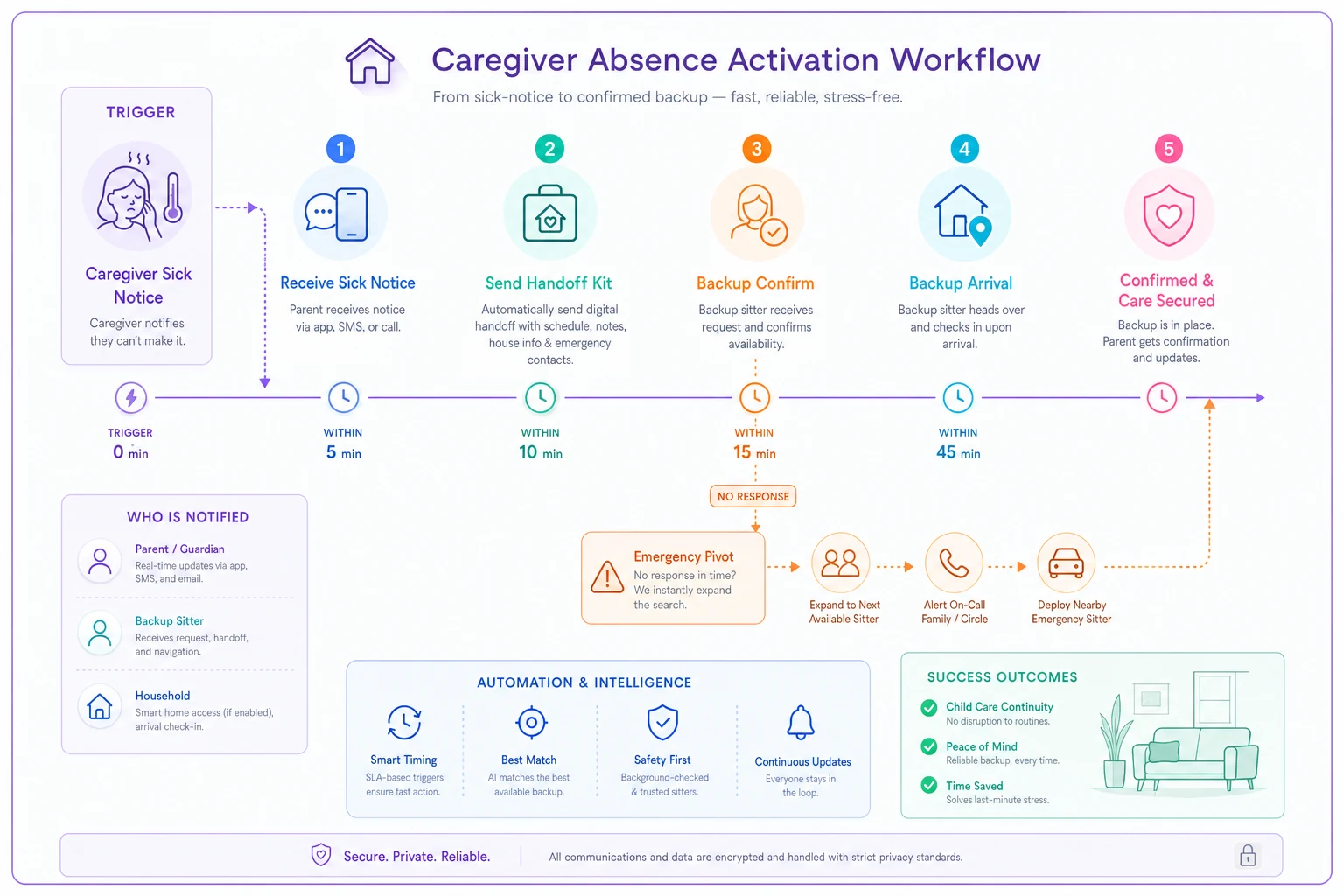
Real activation looks like this: You get the sick text at 7:14 AM. By 7:16, you've sent the handoff kit to your backup. By 7:18, they've confirmed they can arrive by 8:00. By 7:20, you're back to getting ready for your day.
This only works with pre-set triggers that remove decision-making from the crisis moment.
Your Activation Protocol:
First, establish your coverage threshold. Mine is simple: if regular care is unavailable with less than 2 hours notice, activate backup immediately. Don't waste time hoping the situation resolves.
-
Backup Option 1
Text by 7:15 AM, needs response by 7:25 AM
-
Backup Option 2
Contact at 7:25 if no response from Option 1
-
Backup Option 3
Contact at 7:35 if neither previous option confirmed
-
Emergency pivot
At 7:45, one parent stays home
Notice the specific times, not "wait a few minutes." Specificity removes decision fatigue during activation.
Pre-written activation messages:
Draft these when calm, save them in your phone's notes:
"Hi [Name], our regular nanny is sick and we need coverage from 8 AM - 5 PM today. Can you help? I'll send our handoff guide immediately if yes. Need to know by [specific time]."
Include timing, duration, and response deadline. Skip explanations about why your regular person is out.
Here's a quick visual of the activation workflow.
Include timing, duration, and response deadline. Skip explanations about why your regular person is out.
The difference between instructions and useful instructions
Most caregiver instructions fail because they're written like employee handbooks instead of emergency operation guides. They assume the reader has time to study, remember, and refer back throughout the day.
Real substitute care happens while juggling actual children. Your backup is reading instructions while your toddler is testing whether crayons are food.
Bad instruction: "Timothy takes his ADHD medication daily with breakfast. The prescription is methylphenidate, 10mg, and should be given between 7-9 AM with food to prevent stomach upset."
Useful instruction: "MEDICATION: Give Timothy 1 blue pill from kitchen counter bottle at breakfast (around 8 AM). Must eat first. He'll resist — put it in applesauce."
Another example:
Bad: "Lucy is currently exploring different foods and we encourage her to try new things while respecting her preferences."
Useful: "Lunch: PB&J (no crust), apple slices, goldfish. She'll ask for cookies — they're for after nap only. Backup meal if she refuses: mac and cheese (pantry, takes 8 minutes)."
Why most contingency plans fail at activation
Most families create elaborate plans for true emergencies — house fires, natural disasters, medical crises. Important, yes. But not helpful when your nanny has the flu and you have a presentation in two hours.
-
Caregiver illness (happens 6-8 times per year)
-
Transportation breakdown
-
School closure with minimal notice
-
Caregiver family emergency
-
Schedule miscommunication
These situations need operational handoffs, not evacuation plans.
The most effective households treat caregiver absence like restaurants treat server callouts — an operational inconvenience that happens regularly enough to warrant systematic preparation.
Testing your system before you need it
The only way to know if your contingency plan works is to activate it when you don't need it.
Schedule a "drill day" quarterly. Have your regular caregiver call in "sick" the night before, then run your full activation protocol. You'll immediately discover:
-
Which information is missing from your handoff kit
-
How long activation actually takes
-
Whether your backup options are truly available
-
Which household systems break without explanation
One family discovered during their drill that their backup sitter couldn't figure out their car seat system. Another realized they'd never written down their apartment building's parking rules, leading to their backup getting towed.
Time each drill and log every question your backup asks.
Track what questions your backup asks during the drill. Each question represents missing information in your handoff kit. After three drills, you'll have a battle-tested system.
The hidden cost of not having instant handoffs
When you spend three hours managing a childcare crisis, you're not just late to one meeting. You're behind on everything that day, which pushes into tomorrow, which affects the whole week. The makeup work happens at the expense of something else — usually sleep, exercise, or family time.
There's also relationship cost. Every frantic "can you help TODAY?" text to backup caregivers erodes their willingness to be available. They start screening your calls. But when you can send comprehensive handoff instructions instantly, being your backup becomes manageable.
Families transform their backup relationships by having activation-ready materials. Instead of apologetic panic texts, they send professional handoffs. Their backups feel prepared rather than blindsided. Some even prefer to sub for prepared families because the shifts run smoother.
Building redundancy into your contingency plans
Single points of failure kill contingency plans. If your handoff kit lives only on your phone, what happens when your phone dies?
-
Information storage
Keep your handoff kit in a shared cloud folder, printed in your home (labeled clearly in kitchen), and saved in both phones as a PDF.
-
Contact redundancy
Both parents need all backup caregiver contacts. Save them properly with labels like "Backup Nanny - Sarah" not just "Sarah." Include their general availability in the contact notes.
-
Activation ability
Both parents should be able to execute the full activation protocol independently.
-
Payment methods
Your backup needs to handle unexpected costs. Either leave cash in an envelope marked "Backup Sitter Emergency Fund" or ensure they have payment app connections set up in advance.
Update all three locations quarterly.
When over-planning becomes the problem
There's a temptation to create the perfect contingency plan — detailed instructions for every scenario, multiple backup layers, elaborate decision trees. This actually makes activation harder.
The best contingency plans optimize for speed and clarity over completeness. Your backup doesn't need to provide perfect care. They need to keep kids safe, fed, and reasonably content until normal operations resume.
Avoid:
-
Multi-page instruction manuals
-
Complex decision trees
-
Expecting backup care to maintain regular developmental activities
-
Over-explaining philosophy behind rules
Focus on:
-
Safety non-negotiables
-
Basic schedule maintenance
-
Clear escalation triggers
-
Simple comfort strategies
The best contingency plans optimize for speed and clarity over completeness.
Technology and tools that actually speed activation
The real test of operational software comes during contingency activation. Modern platforms can transform a 45-minute scramble into a 5-minute handoff.
The key is having your contingency information living inside the same system you use for regular household operations. When everything is centralized — schedules, contacts, medical information, house details — you can generate and send handoff packages instantly.
Some families set up automated triggers: if the regular caregiver marks themselves unavailable with less than 2 hours notice, the system automatically sends handoff kits to predetermined backup options. This removes the emotional labor of managing the crisis and ensures nothing gets forgotten.
AI-assisted platforms can maintain your handoff materials automatically, pulling updates from your regular operational notes. When you note a new food allergy or medication change in your daily logs, it automatically updates the emergency handoff kit.
Making contingency planning actually happen
Reading about contingency planning and actually building your handoff kit are different things. Most families understand they need these systems but never build them — until they're in crisis.
Start with just the medical information and emergency contacts. Type them into your phone right now. That alone puts you ahead of most households.
Next week, spend 20 minutes on the house operations sheet while you're in your kitchen. Look around and note what someone would need to know.
The week after, add the kid-specific information. Do this while your kids are actually melting down — you'll remember all the important soothing tactics.
Don't aim for perfection. Aim for something that would help a competent stranger keep your kids alive and relatively happy for eight hours.
The real sign your contingency plan works
You know your contingency plan is effective when caregiver absence stops feeling like a crisis. It becomes an operational inconvenience on par with traffic delays — annoying but manageable.
The best test: when your regular caregiver texts that they're sick, your stress level should stay below a 3 out of 10. You execute your protocol, send your materials, and move on with your morning.
This isn't about having perfect backup care. It's about having reliable activation protocols that remove decision-making from crisis moments. When the system is built properly, contingency activation becomes just another household operation.
The families who maintain effective contingency plans aren't more organized than everyone else. They've just accepted that caregiver absence is a recurring operational challenge that deserves proper infrastructure. They've moved beyond hoping it won't happen to knowing exactly what to do when it does.
Ready to simplify your household management?
Join thousands of families using Famioly to save time, reduce home management stress, and keep the household running smoothly.