

The problem with extracurriculars isn't the activities themselves. It's that each one quietly spawns its own tiny administrative business: a registration deadline, a payment schedule, a uniform order, a carpool arrangement, a coach who texts updates at 9pm, and a refund policy nobody reads until they actually need it. Multiply that by two or three kids and you've got maybe 8–12 micro-operations running in parallel, none of them talking to each other.
Most families manage this reactively. A reminder pops up, someone scrambles, money gets Venmo'd to the wrong parent, and somebody ends up stranded at soccer because two adults each assumed the other had it covered. The fix isn't more willpower or a better calendar app. It's treating extracurriculars as a lifecycle — something that moves through predictable stages — and building a lightweight operating system around those stages.
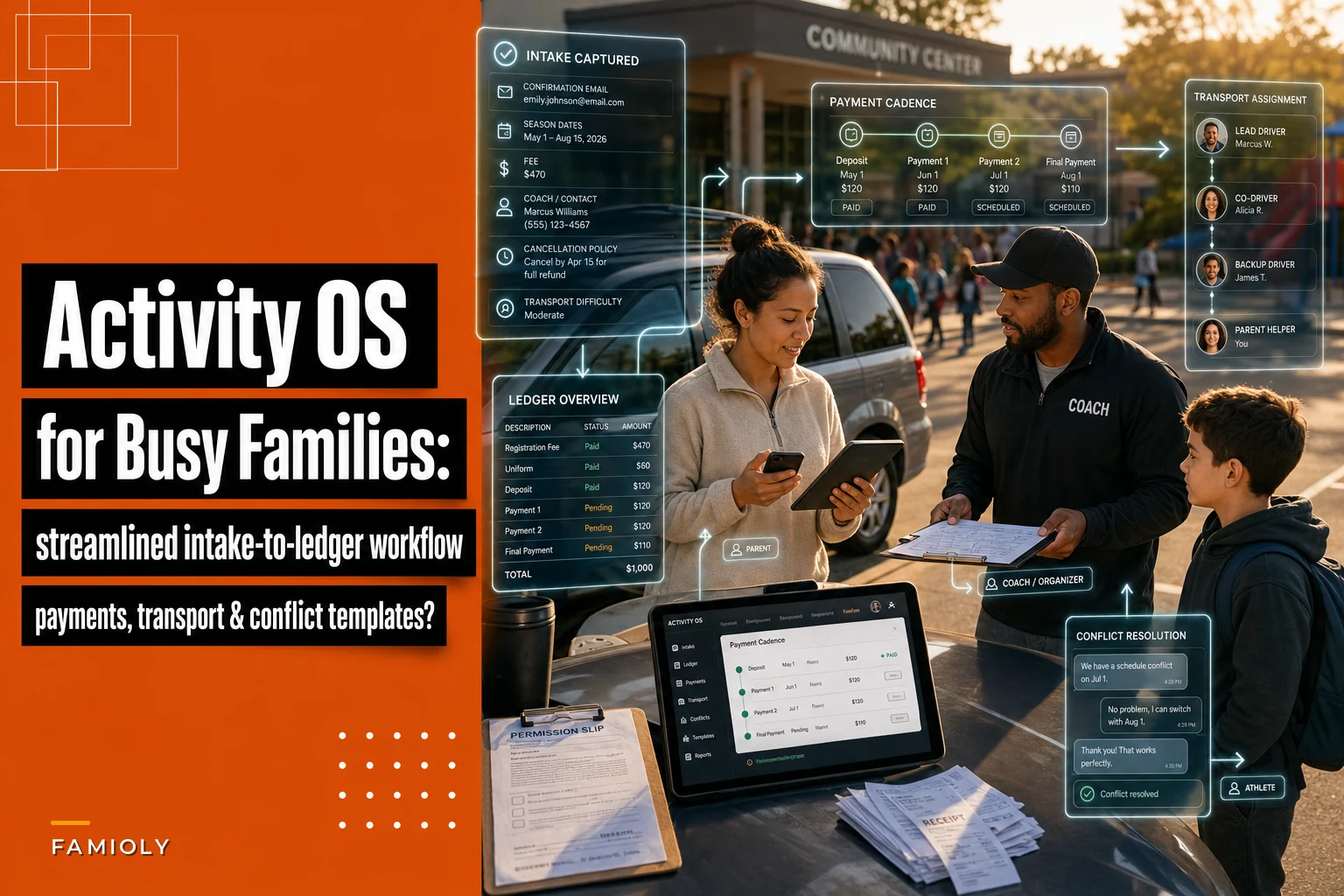
That's what this is: an extracurricular activity OS that runs intake → ledger → payment cadence → transport ladder → conflict resolution, all tied back to a weekly review. Copy-paste scripts and templates included.
Why extracurriculars break down (and it's not what you think)
The usual diagnosis is "we're too busy." But busy families with disorganized systems and busy families with tight systems carry roughly the same number of activities. The difference is where the information lives.
In most households, activity data is scattered across:
-
One parent's email inbox (registration confirmations)
-
A different parent's texts (coach updates)
-
A shared calendar (practice times, usually incomplete)
-
Payment apps (Venmo, Zelle, the rec center portal)
-
Someone's memory (who paid the carpool gas, who owes whom)
When information is scattered like that, every single question — did we pay for spring season? who's driving Thursday? is the uniform ordered? — requires a small investigation. And investigations don't scale. The household that manages four activities fine will fall apart at seven, not because seven is objectively harder, but because the scattered-information model collapses under volume.
The second failure point is money. Extracurricular spending is death by a thousand cuts: a $140 registration here, a $38 uniform top there, $25 for the end-of-season gift, $60 for the tournament that wasn't in the original budget. Nobody tracks it because each piece feels small. By year's end, families are often shocked to find they spent somewhere in the range of $2,800–$4,500 across activities they thought cost "a couple hundred bucks each."
Stage 1: Intake — capture everything in one pass
The moment you commit to an activity is the only moment you have all the information in front of you. The confirmation email is open. The season dates are right there. The fee is visible. The coach's contact is listed. This is the cheapest time to capture it — and the moment almost everyone skips.
Stop losing track of household duties.
Famioly helps you organize, assign & complete family tasks efficiently.
- Centralized task management
- Shared family calendar
- Budget & expense tracking
No credit card required
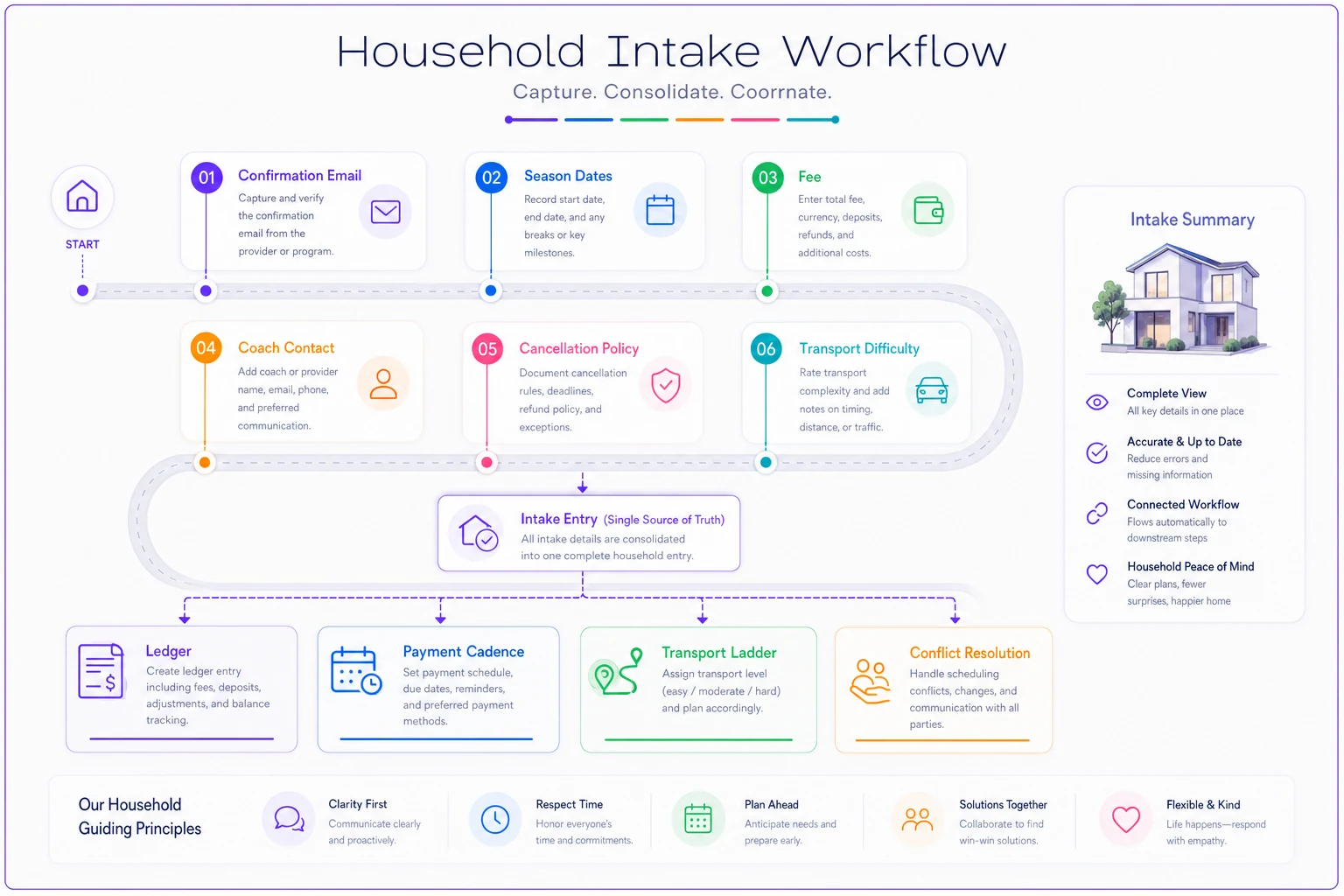
Build a single intake entry for every activity. One row, one record, captured within 24 hours of signing up. Here are the minimum fields that actually prevent problems later:
-
Activity + kid (e.g., "Maya — U10 travel soccer")
-
Season window (start date → end date)
-
Recurring commitment (Tue/Thu 5
30–7, Sat games away)
-
Total known cost (registration + estimated extras)
-
Payment schedule (deposit due date, balance due date)
-
Point of contact (coach name + preferred channel)
-
Cancellation/refund rule (copy the exact sentence from their policy)
-
Transport difficulty (same-site as sibling? far? overlapping times?)
That last field matters more than most people realize. If you flag transport difficulty at intake, you catch the Thursday 5:30 soccer / 5:45 piano collision before you've paid for both. Families who coordinate overlapping schedules well tend to identify conflicts early rather than discovering them live — the same logic behind coordinating multi-kid schedules with priority rules and simple heuristics.
The intake mistake nobody admits to: copying the refund policy "later." You never do it later. By the time you need the refund rule — usually because an injury or schedule change forces a withdrawal — the email is buried and the deadline has passed. Thirty seconds of copy-paste at intake has saved families the $90–$200 they'd otherwise eat.
Thirty seconds of copy-paste at intake has saved families the $90–$200 they'd otherwise eat.
A quick visual of the intake workflow.
The intake mistake nobody admits to: copying the refund policy "later." You never do it later. By the time you need the refund rule — usually because an injury or schedule change forces a withdrawal — the email is buried and the deadline has passed. Thirty seconds of copy-paste at intake has saved families the $90–$200 they'd otherwise eat.
Stage 2: The ledger — a reconciliation sheet for receipts and deposits
Once intake is done, money needs its own home. Not the family budget spreadsheet — a dedicated extracurricular ledger that tracks what was committed, what was paid, and what's outstanding or owed between people.
The reason to separate this out: extracurricular money has a reconciliation problem that regular bills don't. You pay a deposit, then a balance, then reimburse another parent for the carpool, then get a partial refund when the tournament gets cancelled. Regular bills are one-and-done. Activity money is a running tab with multiple parties.
Here's the ledger structure that holds up:
| Date | Activity | Type | Amount | Paid by | Status | Reconciled? |
|---|---|---|---|---|---|---|
| 3/02 | Maya soccer | Deposit | $75 | Dad (card) | Paid | ✅ |
| 3/18 | Maya soccer | Balance | $140 | Dad (card) | Paid | ✅ |
| 4/01 | Leo swim | Registration | $210 | Mom (portal) | Paid | ✅ |
| 4/14 | Soccer carpool | Reimbursement | $30 | Owed to Sarah | Outstanding | ⬜ |
| 5/02 | Soccer tourney | Refund | –$60 | To Dad's card | Pending | ⬜ |
The "Reconciled?" column is the one most families leave off, and it's the one that actually catches errors. A payment isn't done when it leaves your account — it's done when you've confirmed the activity received it and any inter-parent money has settled. The carpool reimbursement sitting "Outstanding" for three weeks is exactly the thing that turns into "wait, did I ever pay you back?" tension two months later.
Families who reconcile monthly — just a 10-minute pass down the Status column — rarely have money disputes. The ones who never reconcile end up with a vague sense that "the money stuff is messy," which is corrosive in a way that's hard to name but easy to feel.
Stage 3: Payment cadence — copy-paste messages that get you paid back
Carpool gas, shared tournament fees, group equipment orders — the second an activity involves other families, you're running informal accounts receivable. And most people are bad at asking for money because it feels awkward.
Pre-written, neutral messages fix that. When the script already exists, you don't have to work up the nerve to write it each time — you just send it. Neutrality matters; the goal is to make the ask feel administrative, not confrontational.
Carpool cost-split (start of season): > "Hi! Setting up the soccer carpool for spring. Planning to split gas evenly across the four of us — works out to about $12–15 each per month. Easiest if I collect at the start of each month. Does Venmo work for you? Totally flexible if you'd rather alternate driving instead."
Gentle reimbursement reminder (one owed, 2+ weeks out): > "Hey — no rush at all, just tidying up the carpool tab before the month closes. You're at $30 for April. Whenever's convenient 🙂"
Shared order collection (uniforms/equipment): > "Team store order goes in Friday. Maya's jersey + shorts came to $48. I'll place the full order and send each family their piece — can you send $48 by Thursday so I'm not floating it? Appreciate you!"
Overpayment / refund-back (when you owe them): > "Quick one — tournament got cancelled and they refunded the team. Your share comes back to $20. Sending it now so we're square."
The cadence rule: collect before you float, remind before the month closes. Floating money for other families is how you end up $150–$300 in the hole across a season without realizing it. Collecting up front removes the whole chasing-people dynamic entirely.
Stage 4: The transport ladder — a matrix, not a daily scramble
Driving is where coordination actually lives or dies. Two kids, three activities, overlapping end times, and two working adults produces a genuinely hard assignment problem — and solving it fresh every week is exhausting.
The solution is a standing transport-assignment matrix that sets defaults, so you're only re-deciding when something breaks the pattern. Build it once per season.
| Day | Activity | Time | Default driver | Backup | Fallback |
|---|---|---|---|---|---|
| Mon | Leo swim | 4:30–6 | Mom | Dad | Carpool w/ Nguyens |
| Tue | Maya soccer | 5:30–7 | Dad | Mom | Skip-permitted |
| Wed | — | — | — | — | — |
| Thu | Maya soccer + Leo piano | 5:30 / 5:45 | Conflict | Split: Dad→soccer, Grandma→piano | Carpool soccer, Mom→piano |
| Sat | Soccer games | varies | Alternate wk | — | Carpool rotation |
The "ladder" part is the three tiers: default → backup → fallback. When the default driver can't make it, you don't reopen the whole discussion — you drop to the next rung. Nobody's negotiating at 4:50pm because the decision is already made.
Notice Thursday is flagged Conflict with a pre-built resolution. That's the payoff of flagging transport difficulty back at intake. You solved Thursday in a calm moment, not in the car.
Worth saying plainly: below three driving commitments across multiple drivers, a shared calendar is probably fine. Don't build a matrix because a framework exists — build it when the volume actually warrants it.
Stage 5: Conflict-resolution templates tied to the weekly review
Even good systems collide. Two activities land on the same Saturday. Both parents are traveling the same week. The tournament's an hour away and the piano recital is the same afternoon. These aren't failures — they're inevitable. The only question is whether you resolve them on a schedule or in a panic.
Tie conflict resolution to a standing weekly family review. Ten to fifteen minutes, same time each week, where you look at the week ahead and surface collisions before they happen. If you don't already run one, the structure in a 20-minute family meeting that actually closes action items is a solid starting frame — just add an "activities scan" as a standing item.
Here's the decision order for resolving a conflict, used live in the review:
-
Can the ladder handle it? Check backup/fallback drivers first. Most conflicts die here.
-
Is one commitment skippable? A regular practice is skippable; a championship isn't. Rank by stakes, not by who's loudest.
-
Can we split? Each parent takes one kid, or you pull in a grandparent or carpool.
-
Does one activity yield this time? If genuinely unsolvable, decide which commitment gives — and apply it consistently so the same kid isn't always the one who loses out.
-
Log the decision. Write down what you chose and why, so next season's intake flags it earlier.
A copy-paste script for the coach when you have to skip: > "Hi Coach — Maya has an unavoidable conflict this Saturday and will miss the game. She'll be at Thursday practice as usual and we'll make sure she's ready for next week. Thanks for understanding."
Families who resolve conflicts ad hoc tend to resolve them by volume and emotion — the kid who complains loudest wins, or the parent with the lighter work week absorbs everything until they resent it. A decision order removes the politics. The same intake-assign-confirm discipline from centralizing school permission slips and forms applies to the paperwork side — same idea, same reason.
A real scenario: the Thursday collision
Two working parents, two kids — a 10-year-old in travel soccer and an 8-year-old starting piano. They'd signed both up separately, weeks apart, in two different inboxes. Nobody noticed that soccer ran Thursdays at 5:30 and piano landed Thursday at 5:45 until the first week of overlap, when both parents were already committed and the 8-year-old missed her first lesson.
That single miss cost a non-refundable $35 lesson fee, plus a week of friction about how they didn't catch it. Over the prior fall season, they later estimated they'd floated roughly $200 in carpool and team-order money that never fully came back, and spent about $900 more on activities than they'd mentally budgeted — because nothing was in one place.
The change wasn't dramatic. They built one intake sheet, moved money into a single ledger, set a transport matrix at the start of spring season, and added a five-minute activities scan to their existing Sunday check-in. Thursday-type conflicts started getting caught at intake instead of live. Carpool money got collected up front. The vague "activity money is messy" anxiety faded because the reconciliation column told them exactly where things stood.
Not a transformation. Just a household that stopped losing small amounts of money and time it never needed to lose.
Keeping the system alive without turning it into a chore
The whole point of a lightweight OS is that it runs on a cadence, not on constant attention. Here's the maintenance rhythm that keeps it from rotting:
-
At signup (per activity) complete one intake entry within 24 hours. Non-negotiable — it's the cheapest 30 seconds in the whole system.
-
Weekly (5 min) activities scan during your family review — surface the week's conflicts, confirm drivers.
-
Monthly (10 min) reconcile the ledger. Clear outstanding reimbursements, confirm payments landed.
-
Per season (15 min) rebuild the transport matrix, log any conflicts to flag at next intake.
If you're already running a shared family tool or household management platform, most of this lives comfortably inside it — a single intake form, a shared ledger view, and a recurring reminder for the weekly scan. The structure matters far more than the software; a well-maintained spreadsheet beats a fancy app nobody updates. Where AI-assisted tools genuinely earn their keep is on the nagging parts — flagging a schedule overlap when two activities get entered, or surfacing an unreconciled reimbursement before the month closes — so the system doesn't depend on one person holding everything in their head.
The families who stay on top of extracurriculars aren't more naturally organized. They've moved the hard thinking to the calm moments — intake, the weekly scan, the season-start matrix — so the chaotic moments have nothing left to decide. That's the whole game: make the decision once, early, when nobody's stranded in a parking lot.
The families who stay on top of extracurriculars aren't more naturally organized. They've moved the hard thinking to the calm moments — intake, the weekly scan, the season-start matrix — so the chaotic moments have nothing left to decide. That's the whole game: make the decision once, early, when nobody's stranded in a parking lot.
Ready to simplify your household management?
Join thousands of families using Famioly to save time, reduce home management stress, and keep the household running smoothly.