



One kid is manageable. You memorize the practice times, learn the coach's rhythm, and life mostly fits into a mental calendar. The trouble starts around kid two or three, when suddenly two things are happening at 4:15 on opposite sides of town and the only available adult can't be in both places.
Most families respond by getting more organized — better calendars, color coding, shared apps. That helps a little. But the real problem isn't visibility. It's that nobody has decided, ahead of time, what wins when two things collide. And they always collide.
This piece is about the decision layer that sits above your calendar: the priority rules, buffer windows, and delegation logic that let you resolve conflicts fast without the Tuesday-night argument about whose thing matters more. If you're coordinating multi-kid schedules across sports, music, tutoring, and the occasional dentist appointment, this is the part almost nobody sets up in advance.
Why the conflicts feel worse than they should
Scheduling conflicts rarely come from being actually overbooked. They come from making the same small decision from scratch, over and over, under time pressure.
A typical example: Emma has soccer Tuesday at 4:30. Noah has piano at 4:45. Eleven minutes apart by car. One parent is at work until 5. On paper, unsolvable — but in practice it gets "solved" every single week through a chaotic 20-minute text exchange, a favor asked of a neighbor, and somebody arriving late and stressed.
The energy drain isn't the driving. It's the re-deciding. When there's no rule that says "recurring commitments beat one-offs" or "the younger kid's pickup takes priority because he can't wait alone," every conflict becomes a negotiation. Multiply that across a school year and you've spent something like 40–50 hours just working through logistics you already knew were coming.
There's also a quieter cost. Kids notice when their thing consistently loses. The child whose activity keeps getting bumped for a sibling's game starts to read that as ranking. A clear, stated rule — even one they don't love — feels fairer than a decision that seems to go against them personally every time.
Start with priority rules, not the calendar
Before you optimize drive-time or delegate anything, you need to know what beats what. Priority rules are just pre-agreed tiebreakers. You set them once, calmly, and apply them automatically when things collide. Here's a set that works for most families. Adjust the order to fit your situation — the point isn't these exact rules, it's having them written down somewhere.
Stop losing track of household duties.
Famioly helps you organize, assign & complete family tasks efficiently.
- Centralized task management
- Shared family calendar
- Budget & expense tracking
No credit card required
| Priority tier | What it covers | Why it ranks here |
|---|---|---|
| 1 — Fixed & irreversible | Recitals, playoff games, medical appointments, exams | Can't be rescheduled; missing them has real cost |
| 2 — Recurring commitments | Regular practices, weekly lessons | Consistency matters; sporadic attendance undermines them |
| 3 — Social / optional | Birthday parties, playdates, casual hangouts | Flexible by nature, easiest to move |
| 4 — Nice-to-have | Open gym, drop-in activities | First to get cut when the day is tight |
What most families miss: a practice should usually lose to a game, but a game for a kid who's barely seen the field all season maybe shouldn't automatically beat a recital your other kid has been preparing for since September. Priority tiers give you the default; you keep the right to override for the rare high-stakes exception. What you're eliminating is the routine argument, not your judgment.
One more rule worth adding: the kid who can't be left alone wins pickup priority. A 14-year-old can sit outside a studio for 15 minutes. A 7-year-old can't. That single rule resolves a huge share of pickup conflicts before they even start.
Buffer windows: the thing that actually prevents the daily scramble
Priority rules tell you what wins. Buffer windows tell you whether you actually have a conflict — because a lot of "conflicts" are really just two things scheduled tighter than physics allows.
Start by adding 10 minutes by default to activity end times; it's the easiest buffer to adopt as a family rule.
-
Add 10 minutes to every activity end time before calculating your next move
-
Add 15 minutes for anything involving a school parking lot at dismissal
-
Add 20–30 minutes for the first two weeks of any new activity, before you know its actual rhythm
Once you build those in, a surprising number of "impossible" days become merely tight. The ones that are still impossible after honest buffers — those are your real conflicts, the ones worth applying priority rules and delegation to. You stop treating every tight afternoon like a crisis and save your problem-solving energy for the days that genuinely need it.
Two heuristics that cut drive-time more than any app
1. Minimize drive-time, not distance. These aren't the same thing. An activity 9 miles away on a highway can be a faster round trip than one 4 miles away through six school zones at dismissal. When you're choosing between two equivalent options — two gymnastics gyms, two tutoring centers — pick the one that's easier to reach at the specific time you'll be driving there, not the one that looks closer on a map.
2. Consolidate locations and windows. This is the highest-leverage move most families overlook. If Emma's soccer and Noah's soccer can be at the same complex, or two kids' lessons can be back-to-back at the same studio, you turn two round trips into one wait. A parent sitting in a car for 45 minutes is annoying but cheap. Two separate 25-minute round trips costs more total time, more fuel, and creates more chances for a conflict.
A rough illustration of what consolidation is actually worth: a family running four separate weekday activities scattered across town might log something like 90–100 miles a week just on kid transport. Shifting two of those to a shared complex and stacking two others into a back-to-back window can bring it down to 55–60 miles — and more importantly, frees up two drive slots that used to require a second driver. The fuel savings are real but minor. The recovered driver capacity is what changes the week.
The window to make this call is in August, when you're signing kids up. It's much harder to untangle four scattered commitments in October.
The delegation ladder: who drives when you can't
Even with solid rules and honest buffers, some days just need more drivers than you have. A delegation ladder saves you — a pre-set order of who to ask, so you're not cold-texting the group chat at 4:10.
It works because you define it before you're desperate:
-
The other parent / in-house adult — default first option
-
The standing carpool partner — a family you've pre-agreed to trade drives with for a specific activity
-
The backup carpool / neighbor list — two or three people who've said yes to occasional asks
-
Paid help — a trusted sitter or driving service, reserved for genuine gaps
-
The fallback
the kid skips or waits
— the acceptable last resort, decided in advance so it doesn't feel like failure
The families who handle this well tend to build reciprocity before they need it. They offer to drive the neighbor's kid first, on a normal week, so the ask later feels balanced. A carpool partnership set up in September because it's convenient is worth ten favors begged in November.
Write the ladder down per activity, because it changes. Your soccer carpool family isn't the same as your piano-lesson backup. And whoever might execute the handoff — a partner, a sitter, a grandparent — should know the pickup details cold before the moment arrives. The same principle applies to any caregiver covering a drive: they shouldn't have to text you five questions to do it.
When rigid rules are a bad idea
Priority tiers and buffers are meant to remove routine decisions, not to run your family like a shipping schedule.
Some situations call for throwing the rules out. A kid going through a hard week might need a parent at their thing even if it's technically lower priority. A one-time championship or a friend's once-a-year event is exactly when you override the tier. The rules exist to reduce friction on ordinary weeks so you have the bandwidth to make good calls on the exceptional ones.
Families with one or two kids and mostly non-overlapping activities probably don't need any of this. If your conflicts are rare, a shared calendar and a quick check-in covers everything. Building a full delegation ladder for a schedule that collides twice a month is solving a problem you don't really have. The system earns its keep once you're regularly hitting three or more simultaneous commitments.
A real scenario: three kids, two drivers, one impossible Wednesday
A blended household — three kids, ages 8, 11, and 15 — kept losing Wednesdays. The 11-year-old had swim ending at 5:00 across town, the 8-year-old had a 5:15 art class near home, and the 15-year-old had robotics that ran until 6:30 but needed a ride there by 4:45. Two working parents, one not free until 5:30.
Before any changes, this was a weekly negotiation that usually ended with the 8-year-old's art class getting dropped roughly two Wednesdays a month and a lot of stressed texting. Nobody had actually decided art was the low-priority thing — it just kept losing because it was the newest and felt least "official."
Three changes fixed it. First, they wrote priority rules — recurring commitments (swim, art, robotics) all ranked equal, with the youngest getting pickup priority. Second, they added honest buffers and realized swim's real parking-lot exit was closer to 5:15, not 5:00. Third, they set up a robotics carpool with another family whose kid attended the same session, which permanently removed the 4:45 drop-off from the parents' plate.
The Wednesday that used to require three drivers and one dropped activity now runs on two: one parent handles the swim-to-home loop after 5:30, the other covers the art pickup, and robotics is entirely off their hands. Art class stopped getting cut. The 8-year-old stopped asking why her thing "didn't count."
Putting it together
The families who coordinate multi-kid schedules without losing their minds aren't the ones with the fanciest calendar app. They're the ones who decided the hard tiebreakers once, built honest buffers into their driving math, chose consolidated locations when they had the chance, and lined up backup drivers before the crunch hit.
A quick visual can make the workflow easier to share with partners and caregivers.
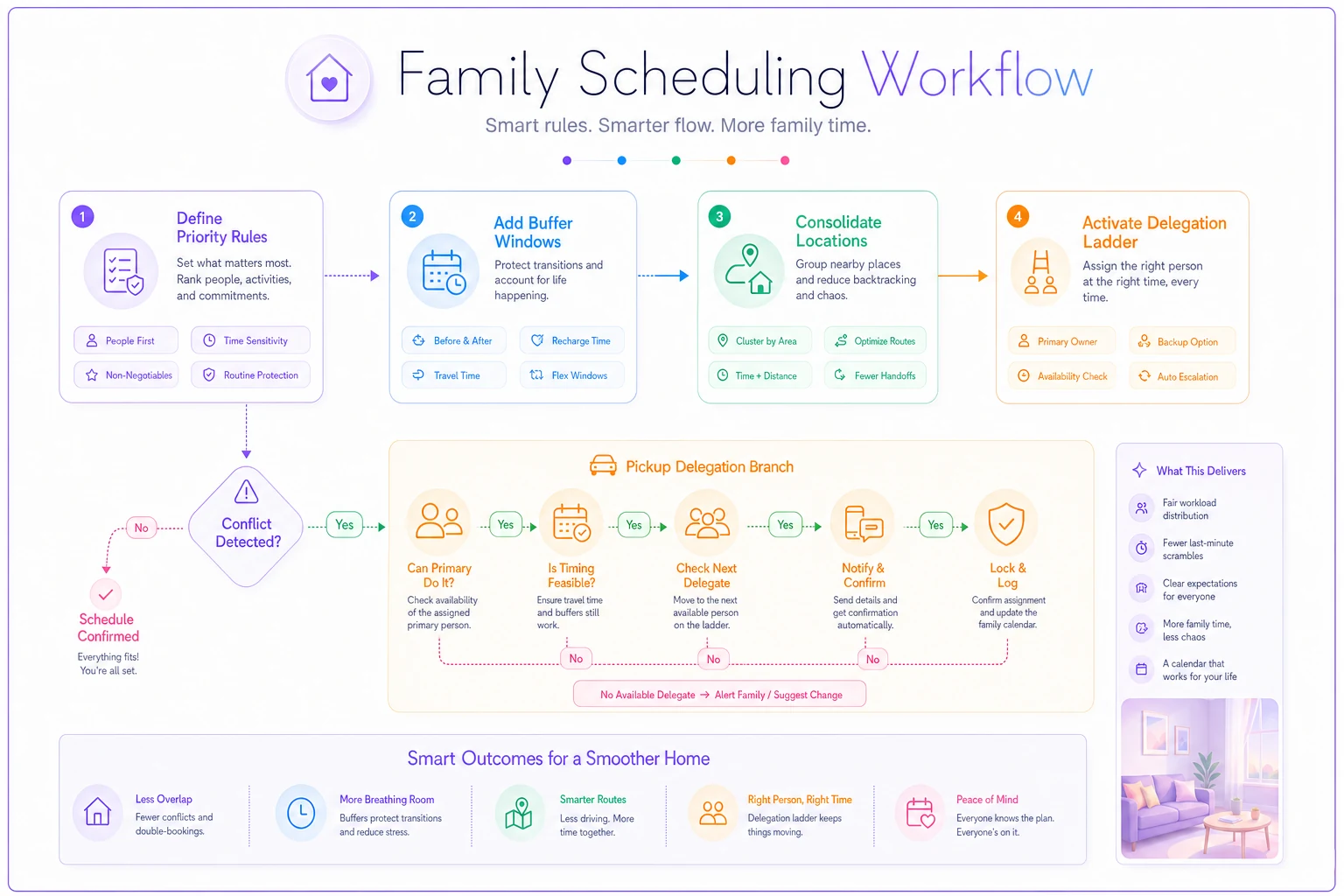
None of this requires new technology — a shared document and one honest planning conversation covers most of it.
What it requires is moving the decisions out of the 4:10 scramble and into a calmer moment when you can actually think. Do that, and most weekly conflicts either disappear into the buffer or resolve themselves in about ten seconds by rule. The ones that remain are the ones actually worth your attention.
Ready to simplify your household management?
Join thousands of families using Famioly to save time, reduce home management stress, and keep the household running smoothly.