
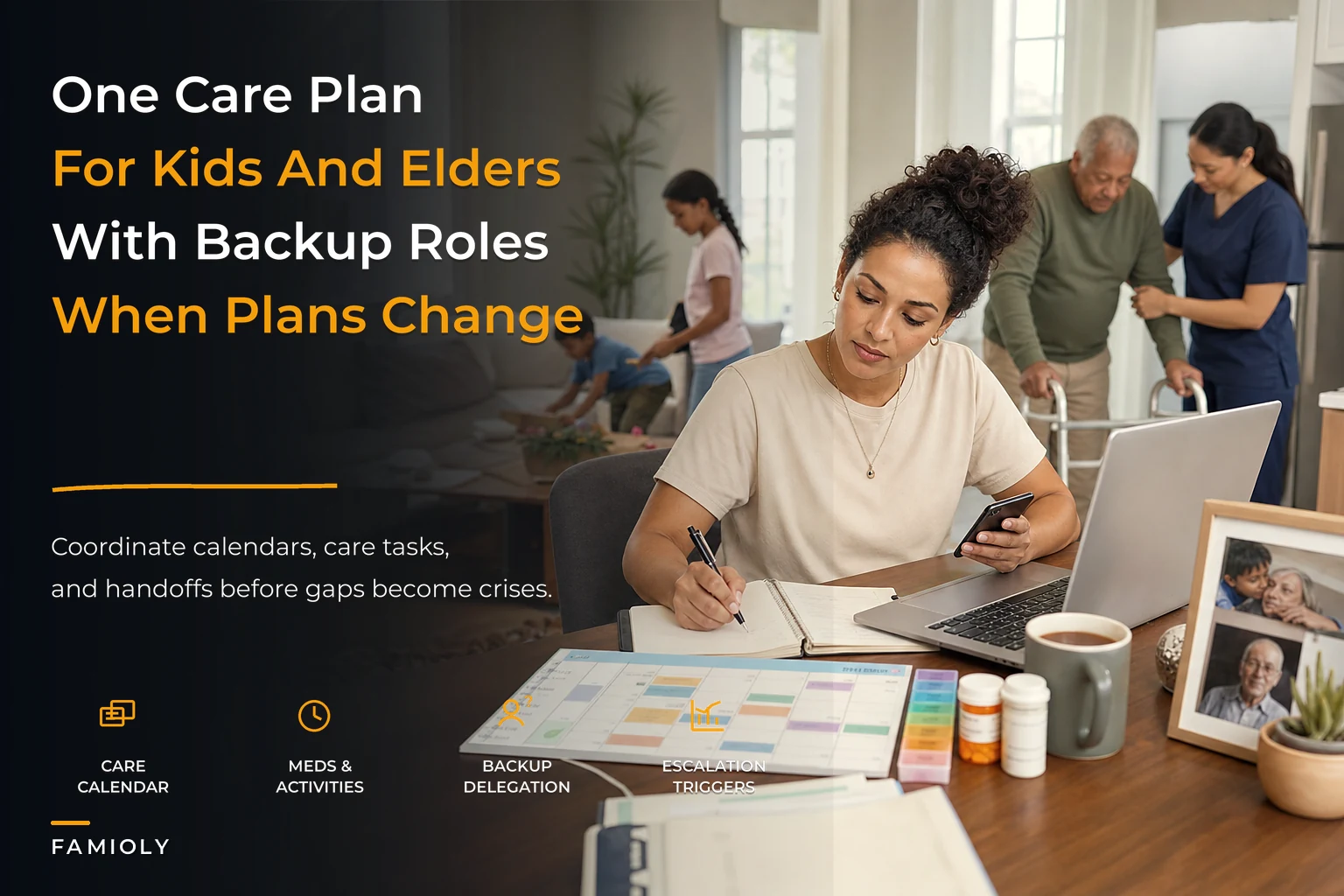

Most families think they have a scheduling problem. What they actually have is a handoff problem — and it gets brutal when the same household is caring for both a 7-year-old and an 82-year-old at the same time.
The kid's world runs on its own logic: school pickup, soccer, homework, a birthday party invite that arrives with 48 hours notice. The elder's world runs on a completely different rhythm: a Tuesday cardiology appointment, a medication that can't be doubled up, a caregiver who shows at 9 but leaves at 1, a "good day / bad day" variability that no calendar app was ever built to model.
Individually, each is manageable. The failure happens at the intersection — when the same adult is the only person who knows both systems, and both systems demand attention at the same hour. That's the mixed-care household. And what quietly wrecks it isn't a lack of effort. It's the absence of a shared operating layer that lets anyone pick up any thread without a five-minute phone call to reconstruct context.
Why mixed-care households break in ways single-care households don't
A house with only young kids can survive on a shared Google calendar and a group text. A house managing only an aging parent can often lean on one primary caregiver and a pill organizer. Mixed-care breaks both of those shortcuts because it stacks two incompatible failure modes on top of each other.
Kid schedules are high-frequency, low-stakes-per-event. Miss one, it's annoying. Elder care is often low-frequency, high-stakes-per-event. Miss a medication timing or a specialist appointment and the consequences compound for weeks. When you try to run both through the same mental to-do list, the brain deprioritizes the quiet, high-stakes elder tasks in favor of the loud, urgent kid tasks. Nobody decides to skip Grandpa's blood pressure log. It just gets crowded out by a screaming 4pm carpool.
There's a pattern worth naming: in mixed-care homes, the bottleneck is almost always a single "keeper of context." One person holds the medication list, the caregiver's cell number, the school's early-dismissal calendar, and the knowledge that Aunt Rita can cover Thursdays but not before 10. When that person gets sick, travels, or burns out, the whole thing seizes. There's no redundancy because the system lives in one head.
This is the same structural weakness covered in contingency plans for caregiver absence — except in mixed-care households, you're not backing up one care system, you're backing up two that are tangled together.
The four templates that hold a mixed-care household together
If you strip away the apps and the good intentions, a functioning care continuum runs on four connected artifacts. Not tips — artifacts. Things that exist, that other people can read, that survive when the keeper of context is unavailable.
Stop losing track of household duties.
Famioly helps you organize, assign & complete family tasks efficiently.
- Centralized task management
- Shared family calendar
- Budget & expense tracking
No credit card required
-
A shared care calendar that separates the two care streams visually but overlaps them in one view
-
Medication and activity pipelines that track state, not just time
-
A delegation ladder that says who covers what, in what order, when the default person can't
-
Contingency triggers — pre-written "if X, then activate Y" rules so nobody has to improvise during a bad hour
The value isn't in any one of them. It's in the seams.
1. The shared care calendar: two streams, one surface
The mistake almost everyone makes is one giant undifferentiated calendar where a piano lesson and a nephrologist appointment look identical. Under stress, they read as equally skippable — which is exactly wrong.
A better structure uses color or lane separation so the elder-care stream is instantly distinguishable, and flags immovable events differently from flexible ones. A dentist cleaning for a kid is flexible. A dialysis session is not. When a conflict hits, you want to see in two seconds which event has to hold and which can slide.
The other thing a real care calendar tracks that a normal one doesn't: coverage gaps. Not "here's an appointment," but "here's a two-hour window where the paid caregiver has left and school hasn't let out and nobody is assigned." Those gaps are invisible on a standard calendar because they're defined by absence, not events. Marking them explicitly is what prevents the 3pm panic.
2. Medication and activity pipelines: track state, not just time
A reminder that says "3pm meds" is a to-do. A pipeline tracks whether the thing actually happened, who confirmed it, and what the fallback is if it didn't.
Think of each recurring care task as moving through stages: Due → Administered → Confirmed → Logged. The gap between "Administered" and "Confirmed" is where most eldercare errors hide. Someone thinks the evening dose was given. Nobody logged it. The next caregiver either double-doses or skips it to be safe. Both are bad.
The same pipeline logic applies to kids, just with lower stakes — did the homework get checked, did the allergy meds go to school, was the permission slip signed. Running both care streams through the same "did it actually close?" discipline is what stops the quiet misses.
Here's a simple version of what the state view looks like:
| Task | Stream | Due | State | Owner | Fallback |
|---|---|---|---|---|---|
| Morning BP meds | Elder | 8:00 | Confirmed | Day caregiver | Text primary |
| Insulin log | Elder | 12:30 | Administered (not logged) | Day caregiver | Call at 1:15 |
| School pickup | Child | 15:10 | Assigned | Parent B | Neighbor carpool |
| Evening meds | Elder | 19:00 | Due | Parent A | Sibling on-call |
The value of the table isn't the columns. It's that the "not logged" row jumps out — that's the thing that needs a nudge before it becomes a mistake.
3. The delegation ladder: who covers, and in what order
A delegation ladder is different from a chore chart. A chore chart assigns tasks. A ladder assigns fallback order — first choice, second choice, third choice — so when the default person is unavailable, there's no debate about who steps in.
For a mixed-care household, ladders need to exist per domain, because the person who's great with the kids' logistics may be useless for the elder's medical decisions, and vice versa. A typical structure looks like this:
-
Medical decisions (elder) Primary → Sibling with health POA → Family doctor's nurse line
-
Daily elder supervision Day caregiver → Neighbor → Adult child
-
Child pickup/dropoff Parent A → Parent B → Carpool parent → Grandparent (if mobile that day)
-
Overnight coverage Primary → Backup caregiver → Sibling flying in
The insight most families miss: a ladder only works if the second and third rungs have actually been briefed. A name on a fallback list who has never seen the medication pipeline isn't a backup — they're a future emergency. Delegation that holds up under pressure comes from the same principles covered in the household operating system template: clear roles, clear triggers, and a cadence that keeps everyone current.
4. Contingency triggers: decide before the bad hour, not during it
The whole point of contingency triggers is to remove decision-making from moments when your judgment is worst — 6am with a sick kid and a caregiver who just called out.
Good triggers cover the predictable disruptions in a mixed-care home:
-
Caregiver no-show or late arrival
-
Kid sick day (which pulls a parent out of elder coverage)
-
Snow day or school closure with no notice
-
Elder "bad day" requiring extra supervision the schedule didn't budget for
-
Primary keeper of context traveling or ill
A trigger is a pre-written rule: "If the day caregiver cancels before 7am, then Parent B works from home and the morning elder routine shifts to the printed checklist on the fridge." No debate, no scramble. The decision was made on a calm Sunday, not a chaotic Monday.
How the four parts actually connect
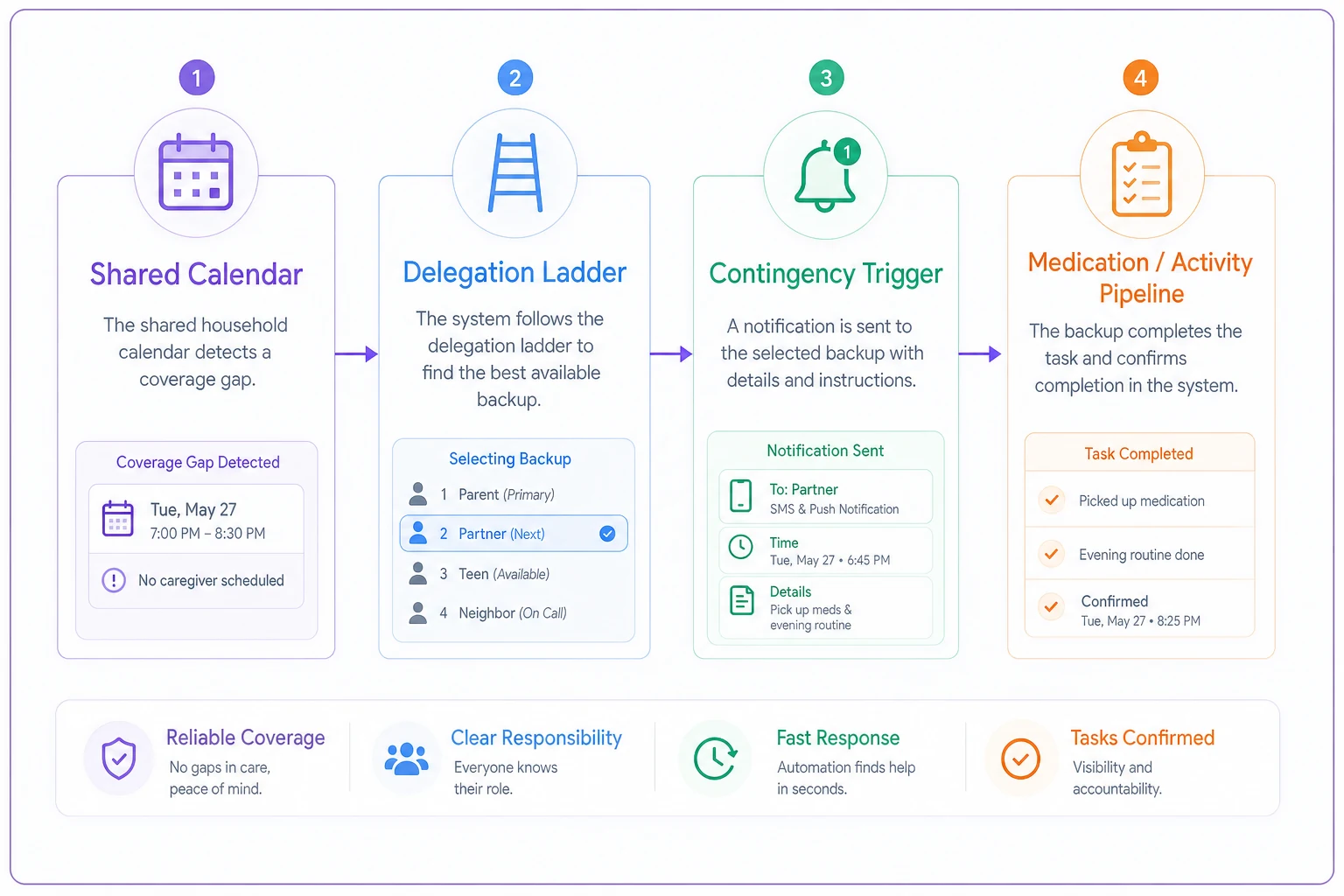
The calendar surfaces a conflict or a coverage gap. That gap points to a delegation ladder — who's next in line for that specific domain. If the ladder can't fill it, a contingency trigger fires the pre-planned fallback. And throughout, the medication/activity pipeline keeps confirming that the high-stakes recurring tasks are still closing regardless of who's covering.
A concrete run-through: the day caregiver texts at 6:40am that she's out sick. That fires the "caregiver no-show before 7am" trigger. The trigger says Parent B goes remote and the elder morning routine switches to the printed pipeline checklist. Parent A is still on the hook for the school run per the child-pickup ladder. Nobody has to think. The system already thought.
Here's a quick visual of the flow.
Compare that to the default experience in most mixed-care homes: the 6:40 text kicks off twenty minutes of phone calls, a missed medication because nobody confirmed the switch, and a parent showing up late to a work meeting resentful and frazzled. Same disruption, wildly different outcome. The difference is entirely whether the artifacts existed before the disruption hit.
A real scenario: the sandwich household that stopped losing Thursdays
Consider a household of two working parents, two kids (ages 6 and 11), and a live-in grandmother recovering from a hip replacement with a paid caregiver three days a week.
Before they built a shared system, the mother was the sole keeper of context. She was fielding somewhere around 15–20 coordination texts a day, and Thursdays — the one day without paid coverage — were a recurring disaster. Over about two months they missed two specialist appointments, double-dosed an evening medication once, and had one afternoon where the 6-year-old sat at school for 40 minutes because both parents assumed the other had pickup covered.
They didn't buy anything fancy. They built the four artifacts on a shared calendar and a simple tracking board:
-
Separated elder and child streams by color, flagged immovable medical events
-
Moved all recurring meds into a Due → Confirmed → Logged pipeline the caregiver updated
-
Wrote delegation ladders for each domain and actually briefed the backups
-
Set six contingency triggers for the predictable disruptions
The change over the next quarter was noticeable rather than dramatic — which is the honest version. Coordination texts dropped by roughly half because people could just check the board. The missed-appointment problem essentially went away. Thursdays stopped being a crisis because the "no paid coverage" gap was now visible on the calendar and pre-assigned days in advance. The mother later said the biggest win wasn't time saved — it was that she could finally get the flu without the whole house tipping over.
When this level of system makes sense — and when it's overkill
Not every household needs all four artifacts fully built out.
This makes sense when:
-
You're genuinely running two care streams with different rhythms
-
More than one adult needs to be able to cover
-
The elder care involves medications or appointments where errors are costly
-
The keeper of context is showing signs of burnout or is a single point of failure
This is overkill when:
-
Care is short-term (a few weeks of recovery, then done)
-
One person can comfortably hold everything and has reliable backup
-
The elder is fully independent and it's really just occasional check-ins
One group that should not start here: families in acute crisis this week. If you're in the middle of a hospitalization right now, don't try to build a full operating system. Grab a single handoff document and stabilize first — the structured version can come once the smoke clears.
Keeping the system alive: the cadence that prevents drift
The quiet killer of every household system isn't a bad design — it's decay. Templates that don't get touched go stale. A delegation ladder with an outdated phone number is worse than none, because it creates false confidence.
The fix is a short, boring, recurring review. Fifteen to twenty minutes, weekly or biweekly, where someone confirms the calendar reflects reality, the pipeline logs are clean, and the fallback contacts are still valid. This doesn't have to be a formal meeting — the mechanics of running one that actually closes loops are covered in the weekly coordination cadence and task-splitting playbook. A care continuum is a living system, not a document you build once and frame on the wall.
Schedule a 15–20 minute weekly or biweekly review to confirm the calendar, pipeline logs, and fallback contacts.
A care continuum is a living system, not a document you build once and frame on the wall.
The families who survive mixed-care with their sanity intact aren't the ones who work hardest or love the most. They're the ones who moved the household out of one person's head and into a shared, readable system that anyone can operate.
Two care streams, different rhythms, high stakes on one side and high volume on the other — held together not by heroics but by four connected artifacts: a calendar that shows the gaps, pipelines that confirm the critical stuff actually happened, ladders that answer "who's next," and triggers that make the hard decisions before the hard moment arrives. Build those, keep them alive, and the household stops being one bad Tuesday away from collapse.
Ready to simplify your household management?
Join thousands of families using Famioly to save time, reduce home management stress, and keep the household running smoothly.