


Most families put real effort into the pre‑trip sprint. Bags packed, boarding passes saved, someone assigned to water the plants. Then the trip happens, everyone comes home exhausted, and the whole system just... stops. Nobody planned re‑entry. The pet sitter left a note that nobody read. The mail pile is a fire hazard. Two people both assumed the other one restocked the fridge. Sunday night arrives and you're staring at a dead-battery car and a kid with no clean uniform for Monday.
That gap — between "trip is over" and "household is running again" — is where most of the actual damage happens. Not the flight delay. The recovery.
A family travel OS that only covers the pre‑trip timeline is solving half the problem. The clean handoff you built for the pet sitter means nothing if there's no return handoff. This post is about building that missing half: delegated care scripts that actually get followed while you're gone, and a post‑trip reset that gets the house back to baseline without a chaotic Sunday.
If you haven't set up the front end yet, the pre‑trip family timeline with delegated owners is the natural starting point. What follows assumes you've got departure covered and now need the return — and the middle — to hold together.
Why the recovery gap exists in almost every household
Pre‑trip has natural urgency. There's a deadline (the flight) and a visible consequence (missing it). That pressure organizes people. Recovery has neither. There's no hard deadline for "get the house back to normal," so it drifts, and drift is where things rot.
There's also a coordination problem specific to the return. Before a trip, one person usually owns the planning. After a trip, everyone's tired, everyone assumes shared responsibility, and shared responsibility with no named owner means nothing gets done. Five people mildly responsible for the mail means the mail just sits there.
The delegated care piece breaks for a different reason. Most families hand off pet and home care as a verbal brain‑dump the morning they leave. "Feed her twice a day, the litter's in the garage, oh and the back door sticks." The sitter nods. Nothing gets written down. Three days in, the sitter has a question at 9pm and now you're troubleshooting cat medication from an airport in a different time zone.
The front end gets a system, the middle gets improvised, the back end gets ignored. All three need to be one connected flow.
The three failure zones, and what actually breaks in each
Think of a trip as three operational windows. Each one fails differently.
Stop losing track of household duties.
Famioly helps you organize, assign & complete family tasks efficiently.
- Centralized task management
- Shared family calendar
- Budget & expense tracking
No credit card required
| Window | What people plan for | What actually breaks | Root cause |
|---|---|---|---|
| Departure | Packing, transport, docs | Usually fine — deadline forces it | N/A |
| While away (delegated care) | Verbal instructions to sitter | Missed feedings, ignored meds, "the alarm went off and I didn't know the code" | No written script, no escalation path |
| Return (recovery) | Nothing | Mail, laundry, food, mental load pile up for days | No owner, no deadline, no template |
The middle and the back are where the money and stress actually live. A sitter who doesn't know your vet's number turns a minor issue into a $400 emergency clinic visit. A return with no reset plan turns into a week of catch-up that eats into the rest you supposedly just went on vacation to get.
Building the delegated care script (the middle window)
The goal here is a document your sitter or house‑watcher can run without you. If they need to text you to function, the handoff failed. The bar is simple: could a competent adult who has never been in your house keep your pet alive, your home secure, and your routines intact using only this document?
-
It's written for someone unfamiliar, not for you. "Feed the dog" means nothing. "Feed Cooper 1 cup of the green‑bag food from the pantry, 7am and 6pm. He'll act starving at 3pm — ignore it, he's fine" means something.
-
It has an escalation ladder. Who does the sitter call first for a pet issue? What counts as "call us immediately" vs. "handle it and text us"? Without this, sitters either bother you constantly or make expensive solo decisions.
-
It separates daily tasks from conditional ones. Daily
feeding, litter, letting the dog out. Conditional: "if the sump pump alarm sounds," "if a package needs a signature," "if the WiFi drops and the security cameras go offline."
Here's a workable structure for the care script:
-
Access + codes — door code, alarm code and the disarm window, WiFi password, where the spare key is.
-
Daily animal care — exact amounts, exact times, medication with photos of the actual pills and bottles.
-
Daily home tasks — mail, plants, trash/recycling day, thermostat range.
-
The "weird stuff" list — the sticky door, the toilet that runs, the breaker that trips if you run the microwave and space heater at the same time.
-
Escalation ladder — vet (with account/pet name on file), a nearby neighbor, the 24hr emergency clinic, and finally you, with a note on your time zone.
-
Money authority — "you're pre‑authorized to spend up to $150 on a pet emergency without reaching us first." This single line prevents both dangerous hesitation and unwanted surprise bills.
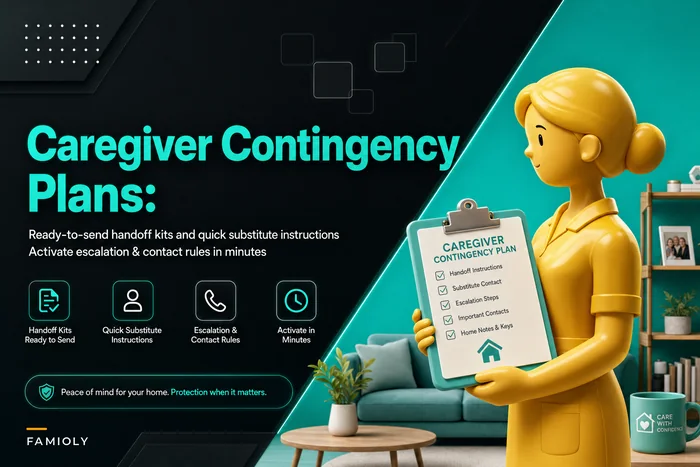
That escalation and authority logic is the same discipline behind a good caregiver handoff kit with minute‑to‑activate instructions — a trip is just a scheduled, lower‑stakes version of the same problem. If you already have that kit built, the travel care script is a light adaptation, not a new build.
Include photos of medications and note exact dosing so sitters don't have to guess.
If you already have that kit built, the travel care script is a light adaptation, not a new build.
A real scenario from the middle window
A family of four goes away for eight days over spring break. Two cats, one on daily thyroid medication. First trip, they left verbal instructions. The sitter guessed on the pill dosage, the cat threw it up, the sitter panicked, and an after‑hours vet visit ran about $260 for something that wasn't actually an emergency.
The next trip, they built a one‑page care script: a photo of the pill, the exact half‑tablet dose noted right on it, the vet's direct line with the cat already listed on the account, and a $150 pre‑authorization line. Same sitter, same length of trip, zero panic texts, no emergency visit. The fix wasn't a better sitter — it was giving the same sitter something she could actually run.
The post‑trip reset (the window everyone skips)
Recovery works like a reversed departure countdown. Instead of 30/7/2/day‑of before, you build a compressed timeline after: day‑of return, next morning, 48 hours, one week. The point is to assign owners and deadlines before re‑entry turns into a week of low‑grade chaos.
Day of return. This is not the day to deep‑clean anything. Everyone's tired. The only jobs are: get the perishables sorted, confirm the pet is fine and thank the sitter, and check that nothing urgent broke while you were gone — leaks, spoiled food, dead plants, a full mailbox signaling "empty house" to the neighborhood. Assign one person to a five‑minute walkthrough and leave it at that.
Next morning. Now the real reset starts. Handle the two things that snowball fastest: laundry and food. A pile of vacation laundry that isn't started on day one becomes Thursday's problem. Same with an empty fridge — if nobody plans the first grocery run, dinner becomes takeout for three nights and the budget takes the hit.
Within 48 hours. Restore routines. Kids back on sleep schedule, the family calendar reviewed for what's coming this week, and trip‑related admin closed out — receipts logged, the sitter paid, any subscriptions or holds you paused turned back on.
Within one week. The slow stuff. Photos backed up before someone's phone dies, gear that needs cleaning or repair dealt with, and a two‑minute debrief: what to change on the next trip's script. That debrief is what makes your travel OS improve instead of resetting to chaos each time.
Here's a simple visual to keep the compressed timeline clear.
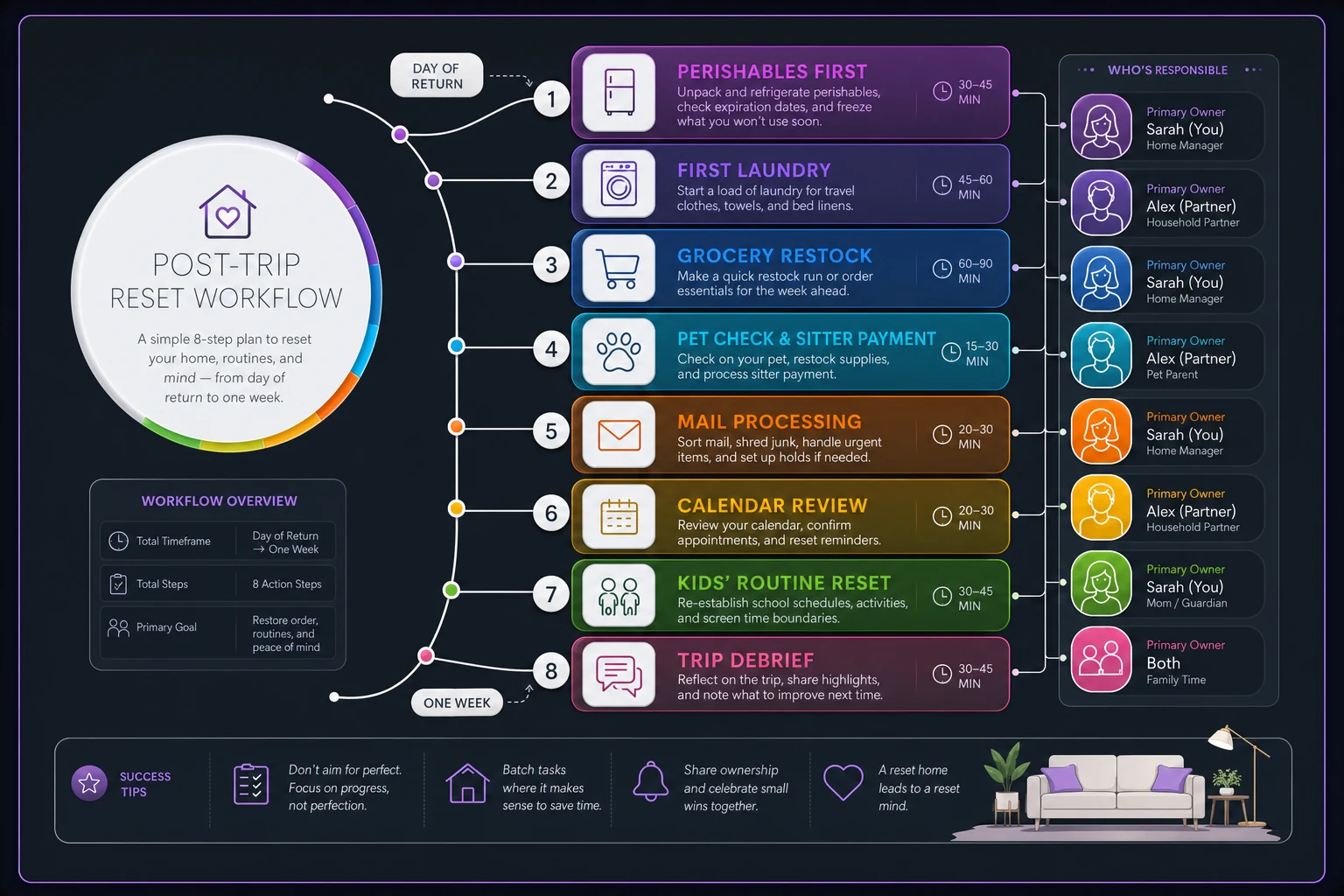
The reset checklist, delegated
-
Perishables sorted — day of return — owner
whoever unpacks the car
-
First laundry load started — day of return or next AM — owner
rotating
-
Grocery restock (or delivery ordered) — next morning — owner
meal planner
-
Pet check + sitter paid + thank you — day of return — owner
pet lead
-
Mail/packages processed — within 48h — owner
whoever handles bills
-
Calendar reviewed for the week — within 48h — owner
household manager
-
Kids back on routine — within 48h — owner
bedtime parent
-
Trip debrief
update the script
— within a week — owner: trip planner
The owner column matters more than the tasks. A checklist with no names is just a wish list.
How this changes as the family (and the trips) scale
For a couple with no kids and no pets, this is honestly overkill — a mental note gets you through. The system starts earning its keep the moment you add dependents that can't self‑manage: young kids, pets on medication, aging parents you check on, or a house with enough systems (sump pump, security, irrigation) that something can genuinely go wrong while you're gone.
The bigger the household, the more the coordination is the actual work. With one traveler, you carry it all in your head. With two working parents and three kids, the failure mode is duplicated effort and dropped balls — two people restocking the same thing, nobody handling the other. That's when a written, delegated flow stops being nice-to-have.
Frequency matters too. Travel once a year and you'll rebuild from scratch each time — that's fine. Take four or five trips a year — weekend visits to family, a longer vacation, a work trip — and the payoff is in reuse. You build the care script and reset flow once, then each trip is a five‑minute edit of amounts and dates instead of a fresh scramble.
This is where keeping everything in one place rather than scattered across texts, sticky notes, and someone's memory actually pays off. A shared household system that stores the care script, the escalation ladder, and the reset checklist as reusable templates — with owners and due dates that populate off your return date — means the seventh trip runs on muscle memory you built during the third. You're not solving the same problem again; you're running a flow that already works.
When this is worth it, and when it isn't
When it makes sense: you have pets or kids, you travel more than a couple times a year, and re‑entry reliably eats your first few days back. If the week after every trip feels like it undoes the vacation, that's the signal.
When it's a bad idea: you're over‑engineering for a household that doesn't need it. A solo traveler with a low‑maintenance apartment and a neighbor who grabs the mail does not need an escalation ladder. Building a formal reset flow for a two‑night trip is busywork — match the system's weight to the trip's actual complexity.
Who should skip most of this: anyone whose trips are short and dependent‑free. The delegated care script only matters when you're leaving something behind that needs active management. If nothing at home needs a human while you're gone, this whole layer collapses down to "stop the mail" and you're done.
The point of all of it
A trip isn't a single event you plan for and then survive. It's three connected windows — leaving, being away, coming home — and most families only build a system for the first one. The care script keeps the middle from turning small issues into expensive ones. The reset flow keeps the return from swallowing the rest of your week.
Build both once, name an owner for every line, and let each trip be a quick edit instead of a reinvention. The version of your family that comes home rested — and stays rested through Monday — is the one that planned the ending as carefully as the beginning.
Ready to simplify your household management?
Join thousands of families using Famioly to save time, reduce home management stress, and keep the household running smoothly.