



Most household budgets don't break because of one big expense. They break quietly, through a bunch of small increases that each feel reasonable on their own. The cleaner adds $15 to the visit. Groceries creep up another 4%. The after-school sitter mentions gas is killing her, and could you do $22 an hour instead of $20. None of these are outrageous. But stacked together over a few months, they rearrange your whole financial picture without anyone sitting down to decide that it should happen.
That's the situation a lot of families are walking into right now. According to a recent Reuters report, U.S. manufacturing held roughly steady in September while input prices climbed again — which is the upstream signal that cost pressure hasn't actually let up, even if headline numbers look calm. When the raw materials and wholesale costs that feed into products and services go up, those increases don't stop at the factory. They flow down to the grocery shelf, the landscaping company, the childcare provider who subcontracts help. And they usually show up in your household budget a month or two later, which is exactly why fall is the wrong time to be caught flat-footed heading into winter and holiday spending.
So instead of reacting invoice by invoice, this is a 30/60/90 approach to getting in front of it — protecting your budget, repricing paid help without blowing up relationships, and keeping your routines mostly intact.
Why This Round Feels Different From Normal Price Creep
There's something families tend to miss: cost increases that originate upstream behave differently than demand-driven ones. When prices rise because everyone wants something, you can often wait it out or substitute. When prices rise because the inputs got more expensive, the increase is stickier. Your landscaper isn't charging more because they're greedy — their fuel, equipment, and labor all cost more, so the new price is the actual floor, not a negotiating position.
That matters for how you respond. Aggressively haggling a vendor down below what their costs now require usually backfires — either they quietly cut service quality or they drop you for a client who pays. The smarter move is deciding which services are worth the new price, which you can restructure, and which you can absorb back into household labor.
Worth noticing: the households that struggle most aren't always the ones with the tightest budgets. They're often the ones who never built a clear picture of what they're actually paying across all their recurring help. When each expense lives in a different place — one on autopay, one in Venmo, one in cash every other Friday — nobody sees the total moving until it's already moved.
Day 1–30: Build the Picture Before You Touch Anything
The first month isn't about cutting. It's about seeing. You can't reprice help or reprioritize spending if you don't have a clean list of what's happening right now.
Stop losing track of household duties.
Famioly helps you organize, assign & complete family tasks efficiently.
- Centralized task management
- Shared family calendar
- Budget & expense tracking
No credit card required
Start by pulling every recurring household outflow into one place. Not the mortgage and insurance — those are a separate conversation. The operational spend: paid help, groceries, fuel, subscriptions tied to the house, lawn, pool, pest, cleaning, tutoring, anything on a repeating cadence.
Here's a simple way to categorize what you find:
| Category | Examples | Flexibility | Priority to Protect |
|---|---|---|---|
| Essential paid help | Childcare, eldercare support | Low | High |
| Convenience services | Cleaning, landscaping, meal kits | Medium | Medium |
| Variable consumables | Groceries, fuel, household supplies | High | High (but reshapeable) |
| Discretionary recurring | Niche subscriptions, premium tiers | High | Low |
The flexibility column is where the real decisions live. Essential paid help is high priority but low flexibility — you're not cutting childcare, so savings have to come from elsewhere. Groceries are high priority and high flexibility, which makes them the biggest lever most families underuse. Discretionary recurring charges are where the quiet waste usually hides.
A quick audit move that surfaces real money: look at every service that auto-renewed in the last 90 days and ask whether you'd actively re-sign it today at a 10% higher price. If the answer involves any hesitation at all, flag it. You're not canceling yet — you're building a list of what's genuinely worth defending.
Here's a simple visual to keep the sequence clear.
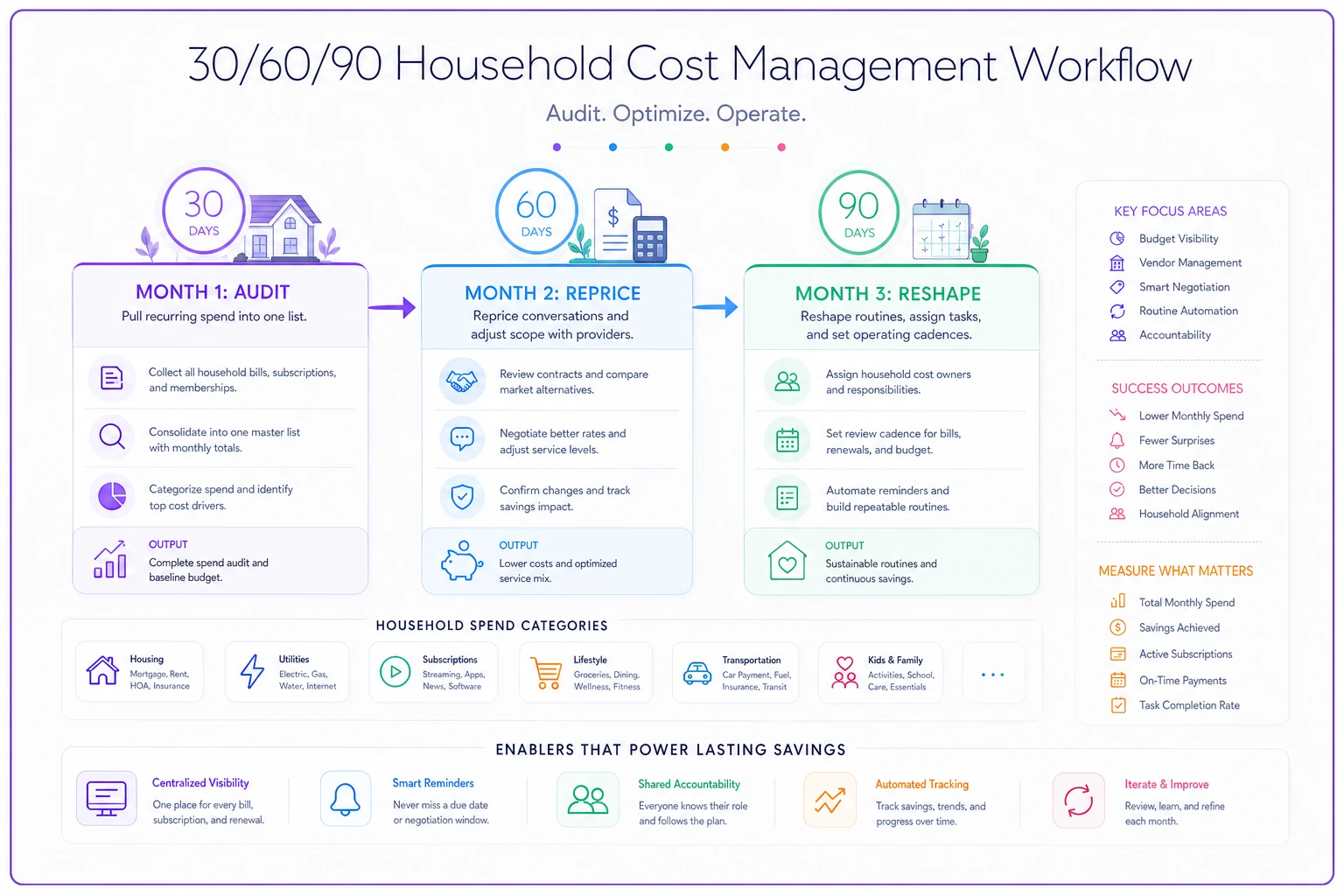
By the end of month one, you want a single document with your total monthly operational spend, each line sorted by category, and an honest note on each about whether it's protected, reshapeable, or droppable.
Day 31–60: Reprice Paid Help Without Damaging Relationships
This is the part families avoid, and the avoidance is expensive. When a cleaner or sitter raises their rate, the instinct is either to silently accept it or feel resentful and let the relationship sour. Both are bad moves.
The better frame: treat a rate increase as a conversation about scope, not just price. If your cleaner needs to go from $120 to $140 per visit, that's a 17% jump — but you may not need the same scope anymore. Maybe you move from weekly to every-ten-days, or drop the deep-clean rooms you rarely use and keep the core. Now the increase is cushioned, the relationship stays intact, and the person keeps their hourly rate.
-
Change frequency, not price. Biweekly instead of weekly often saves 30–40% while keeping the same provider.
-
Reduce square footage covered. Exclude the guest room, formal dining, or basement that barely gets used.
-
Batch tasks to cut trip charges. If your landscaper charges partly for showing up, consolidate visits.
-
Shift seasonal cadence. Lawn care every two weeks in slow-growth months instead of weekly.
-
Trade flexibility for rate. Some providers will hold their price if you give them a consistent, predictable slot.
The script that tends to land well sounds something like: "I completely understand the rate change — costs are up for everyone. I want to keep working with you. Can we talk about adjusting the scope so it still works on my end?" That's a very different conversation than negotiating someone down, and providers remember which clients treated them like partners when their own costs were rising.
One mistake worth flagging: families who reprice everyone at once, in a panic, and end up losing two reliable providers in the same month. Sequence it. Start with the service where scope is easiest to adjust, get one win, then move to the next.
When absorbing the increase is actually the right call
Sometimes the smartest move is to just pay more and protect the arrangement. If you have a childcare provider who's genuinely good and reliable, trying to squeeze them is penny-wise and catastrophe-foolish — the replacement cost, in both money and family stress, dwarfs the few hundred dollars a year you'd save. Know which relationships are irreplaceable and stop optimizing those.
Day 61–90: Reshape Routines So Household Labor Absorbs What Paid Help Doesn't
By month three, you've seen your spend and repriced your help. Now comes the part that actually determines whether this sticks: deciding what work comes back in-house and making sure it doesn't all land on one person.
The trap is predictable. When families cut a service, the tasks don't disappear — they migrate, usually to whoever already carries the most. Cut the cleaner from weekly to biweekly, and someone's now doing the in-between tidy. If that someone is already the default household manager, you haven't saved money; you've converted dollars into resentment and burnout.
-
List every task that came back in-house after your repricing decisions.
-
Estimate the real time each one takes — not the optimistic version.
-
Assign owners explicitly, including kids where age-appropriate, instead of letting tasks default.
-
Set a cadence so recurring tasks don't require re-negotiation every week.
-
Build one fallback rule per task for the weeks life gets chaotic.
A realistic example: a family drops their weekly cleaning from $120 to biweekly, saving around $240 a month. That freed-up money is real, but the in-between cleaning is now roughly 90 minutes of work every other week. Split across two adults and two kids with assigned zones, it's about 20 minutes each — manageable. Left to default on one parent, it's a resentment time bomb that usually ends with the service quietly coming back three months later and the savings evaporating.
That's the underlying problem rising input costs expose: most households don't have a clear, visible system for who does what. When budgets were loose, you could paper over it by buying help. When they tighten, the lack of structure becomes the actual constraint. Families who already run their home with defined roles and cadences adapt in weeks. Families running on vibes and one overloaded manager tend to cycle through cuts and re-adds without ever stabilizing.
Groceries: the lever hiding in plain sight
Worth its own note because it's the single most reshapeable high-priority category. Most families underestimate how much their grocery spend drifts without anyone noticing. A few things that move the number without anyone feeling deprived:
-
Plan the week's meals before shopping and build the list from the plan, not the aisle.
-
Track your three or four most-wasted items and simply stop buying them for a month.
-
Shift one or two meals a week toward cheaper protein and pantry-based cooking.
-
Consolidate trips — fewer "quick runs" means fewer impulse add-ons and less fuel.
None of this is dramatic. But trimming 8–12% off a grocery bill that's already a few hundred dollars a week adds up faster than cutting most services, and it doesn't require firing anyone.
Keeping the System Visible (So It Doesn't Quietly Fall Apart)
The hardest part of any household rebalance isn't the first month. It's month four, when the urgency fades and everyone drifts back to old habits. The cuts erode. The reassigned chores quietly return to the default person. The repriced vendor slowly adds scope back.
What keeps it from unraveling is visibility — having the plan, the owners, and the spend somewhere everyone can actually see rather than locked in one person's head. Some families do this with a shared whiteboard and a monthly check-in. Others use a shared household management tool where recurring tasks, vendor terms, and the monthly spend picture all live together, so changes are visible and nothing silently creeps back. The tool matters less than the principle: a plan nobody can see is a plan that expires.
Put the plan on a shared whiteboard or digital tool and do a 20-minute monthly check-in.
A monthly review earns its keep here. Twenty minutes, once a month, to glance at the spend list and ask three questions: Did anything creep back up? Is any task consistently falling on one person? Is any service now clearly worth re-adding or cutting? That rhythm is what turns a one-time scramble into something that actually holds.
A Real Scenario: Two Incomes, Three Kids, and a 15% Cost Wave
Consider a dual-income family of five with a cleaner, a landscaper, after-school care two days a week, and the usual grocery and fuel load. Over one fall, their recurring help and consumables crept up by roughly 12–15% — call it an extra $380ish a month before anyone noticed.
-
Month one They pulled everything into one list and found two forgotten subscriptions and a premium meal-kit tier they'd stopped using — about $70/month gone with zero lifestyle impact.
-
Month two They moved cleaning to biweekly (kept the same person, adjusted scope) and consolidated landscaping to twice a month in slow-growth season. Combined, around $260/month saved, without losing either provider.
-
Month three They reshaped groceries around weekly meal planning and trimmed the most-wasted items, pulling the bill down roughly 10%, and reassigned the in-between cleaning across the two older kids and both parents with defined zones.
Net, they more than offset the increase and ended up slightly ahead, with after-school care — the irreplaceable, high-stress-if-lost service — fully protected.
The point isn't the exact dollars. It's the sequence: see it, reprice what's flexible, reshape what comes home, and protect what can't be replaced.
The Bigger Picture
Rising input costs for households aren't really a budgeting problem — they're an organization problem wearing a budgeting costume. The families who handle this well aren't the ones who cut the most. They're the ones who had, or quickly built, a clear picture of their spend, their help, and their household labor, and made deliberate trade-offs instead of absorbing increases on autopilot.
If you want a deeper framework for the budget side specifically, this pairs well with the approach in rebalancing household budgets and routines as costs bite, which goes further on the money mechanics. The core move, though, is the one above: get ahead of the next wave of price increases now, while it's still a 30-day project and not a mid-winter crisis. The pressure upstream isn't going away this quarter — so the households that treat this fall as a planning window, rather than waiting for the invoices to force the conversation, are the ones who'll head into the holidays with their routines, relationships, and budgets still intact.
Ready to simplify your household management?
Join thousands of families using Famioly to save time, reduce home management stress, and keep the household running smoothly.