



Last week I watched a mom at Costco completely reorganize her cart three times as she did real-time math on whether bulk paper towels made sense when gas to get there now costs far more than last year.
Reuters reported that consumer confidence dropped in late May as families watched grocery bills climb and gas prices stay stubbornly high heading into summer.
That mom left without the paper towels and texted her husband to cancel their youngest's extra swim lessons for June. Family budget inflation plays out in dozens of micro-decisions that cascade through the household system.
The hidden operational crisis nobody talks about
Most families don't realize they're running a complex operation until inflation forces them to see it: recurring payments at different times, variable costs that fluctuate, multiple people spending independently, and kids who don't understand sudden "we'll see" answers.
One family I worked with was effectively operating three separate financial systems: mom's mental grocery tracking, dad's credit card for gas and hardware, and a near-forgotten checking account. When costs jumped, that informal system collapsed.
Most household systems were built for stability. They assume gas and groceries stay predictable and that summer plans made in March will still be affordable in June.
When grocery and fuel costs rise, coordination becomes a math problem: doing two-store runs burns more gas, kids' activity schedules collide, and the household division of labor suddenly no longer makes sense.
When you scale back paid cleaning, lawn care, or meal services, that work doesn't vanish — it shifts into the household. Map repatriated tasks into a structured matrix with owners, frequency, time budgets, and review checkpoints.
| Task | Primary | Secondary | Frequency | Est. time/week | Training notes | Review date |
|---|---|---|---|---|---|---|
| Deep bathroom cleaning | Parent A | Teen | Weekly | 1.5 hrs | Review surface cleaners and microfiber color coding | July 15 |
| Lawn mowing & trimming | Teen | Parent B | Biweekly | 2.0 hrs | Walk through mower safety, fuel shut-off, and perimeter route | July 15 |
| Grocery run & pantry audit | Parent B | Parent A | Weekly | 2.5 hrs | Verify pantry inventory before the Monday errand loop | July 22 |
| Dinner prep & kitchen reset | Parent A | Teen | 4x / week | 3.0 hrs | Standardize on 15 reliable budget recipes and dishwasher routine | July 22 |
| Errand batching & vehicle fuel | Parent B | Parent A | Weekly | 1.0 hr | Consolidate route with errands to minimize fuel use | July 22 |
| Daily pet care & trash haul | Younger child | Teen | Daily | 1.0 hr | Post visual checklist on the pantry door | July 30 |
Stop pretending this is temporary
Families often treat inflation as a temporary hiccup and make ad-hoc cuts that create operational chaos over months instead of building durable systems.
Stop losing track of household duties.
Famioly helps you organize, assign & complete family tasks efficiently.
- Centralized task management
- Shared family calendar
- Budget & expense tracking
No credit card required
-
Week 1
"We'll just eat out less this month"
-
Week 2
Someone forgets a lunch, grabs takeout, feels guilty
-
Week 3
Overcorrect by buying a huge bulk haul that doesn't fit actual meals
-
Week 4
Give up, order pizza, promise to start fresh next month
Sustained high gas prices mean every trip needs reconsideration — not just vacations but quick weekday errands and multiple-store runs that used to feel trivial. See current regional gasoline trends at https://gasprices.aaa.com/2026/06/.
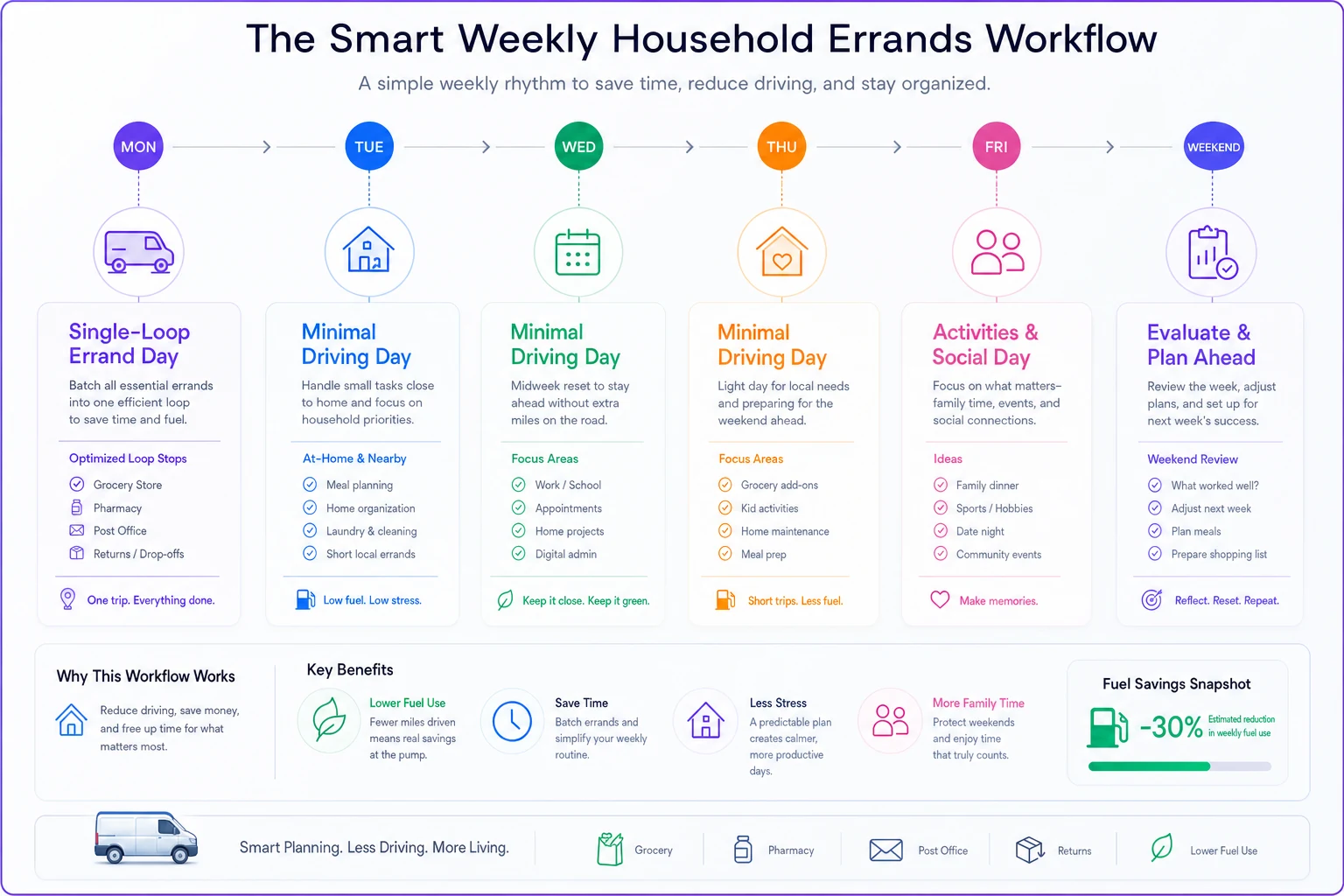
Build new systems, don't patch old ones
Restructuring weekly routines around fuel and errands reduces negotiation and saves money. One family made Monday the consolidated "errand day" and cut monthly gas from about $280 to $195.
More importantly than the dollar savings, they eliminated daily car-usage negotiations and stress by creating one predictable loop for errands.
The three-account solution most families need right now
A single shared account where "everything goes in and bills come out" fails when costs spike. Split money into three purpose-driven accounts to stabilize operations.
-
Account 1 — Fixed costs only
mortgage/rent, insurance, car payments, subscriptions; fund exactly what's needed plus 5%
-
Account 2 — Variable operations
groceries, gas, utilities, kids' immediate needs; fund weekly and adjust week by week
-
Account 3 — Discretionary buffer
eating out, entertainment, non-essential activities; this shrinks first and is visible in real time
Tracking week-by-week clarifies timing of income and outflows. See the Consumer Financial Protection Bureau's cash flow budgeting guidance for practical tips: Get Money Smart 25 Tips Improve Your Financial Well Being.
One family that moved to this three-account cadence reported daily money stress disappeared within three weeks even though costs hadn't yet fallen.
Renegotiate everything (here's the script that works)
Nearly every recurring charge can be adjusted if you ask operationally. Use this framing instead of an emotional plea.
"Hi, I'm reviewing our household services for the next quarter. We've been customers for [timeframe] and pay [amount] monthly. I need to either reduce this to [target amount] or put the service on hold for July and August. What options can you offer to keep us active?"
-
Lawn service
switched to biweekly, saved $110/month
-
Internet
downgraded speed tier, saved $30/month
-
Streaming services
paused three for summer, saved $45/month
-
Kids' tutoring
moved to every-other-week, saved $200/month
That's often hundreds recovered without canceling relationships permanently.
Talk honestly with individual vendors about temporary schedule changes. Many prefer keeping some income rather than losing clients entirely.
Create your 72-hour spending freeze protocol
Short tactical pauses stop the bleeding without turning into month-long austerity. The 72-hour freeze is a simple circuit breaker families can run quickly.
-
Hour 0–24
No spending except true emergencies
-
Hour 24–48
List everything you wanted to buy but didn't and total it
-
Hour 48–72
Evaluate the list and buy only true needs
One family found their 72-hour "wanted but didn't buy" list totaled $340; after evaluation they spent $87 on real needs and avoided impulse purchases.
The summer schedule shuffle that saves thousands
Summer changes the household tempo and inflates costs. A deliberate week-classification pattern reduces paid activities while preserving key experiences.
-
A weeks
One major paid activity or camp
-
B weeks
Free activities only (library, park, playdates)
-
C weeks
Work-from-home weeks where kids entertain themselves
| Scenario | Approx. cost |
|---|---|
| Traditional summer (most weeks in camps/activities) | $4,200 |
| Shuffle system | $1,400 |
| Savings | $2,800 |
This pattern gives families three weeks of paid camps distributed across summer, reducing overall cost while keeping variety.
Make kids part of the operation by giving them simple budgets and ownership of choices appropriate to their age.
-
8-year-old
$200 for all summer activities; choose from a provided price list
-
12-year-old
$75/month for activities and wants; they manage it
-
16-year-old
$100/month gas card; when it's empty they find alternatives
The meal planning system that actually survives inflation
Rigid meal plans fail when protein prices spike. Build flexibility and rules that change behavior without constant recalculation.
-
Under $3/lb protein
stock-up week
-
$3–$5/lb protein
normal purchases
-
Over $5/lb protein
switch to vegetarian week
Maintain a realistic list of reliable, low-cost meals the family will actually eat and rotate them based on sales and inventory.
-
Spaghetti with meat sauce (~$9)
-
Bean and cheese quesadillas (~$7)
-
Breakfast for dinner (~$8)
-
Tuna noodle casserole (~$8)
-
Grilled cheese and tomato soup (~$6)
Build your financial fire drill protocol
Practice, don't panic. Run a financial drill quarterly so decisions during real shocks are muscle memory, not emotional improvisation.
-
Day 1
Cut spending to absolute essentials and track everything
-
Day 7
Compare actual spending to a normal week
-
Day 8
Decide what cuts were painful and what nobody missed
-
Nobody missed paused streaming services
-
Skipping Starbucks saved $47 in a week
-
Cooking every meal saved $130 but caused burnout
-
Kids didn't notice when name-brand snacks became generic
When automation becomes essential, not optional
Manual tracking and ad-hoc coordination break under volatile inflation. Use simple automation to remove decision fatigue and reduce daily negotiation.
-
Automatic bill pay for true fixed costs only
-
Spending trackers that alert when categories exceed limits
-
Shared calendars that show when major expenses hit
-
Shopping lists that update based on pantry inventory
The objective is reducing negotiation and mental overhead so your system handles basics and you focus on strategic decisions.
Your next 48 hours
Before next week's bills arrive, take these immediate operational steps to stabilize cash flow and reduce decision friction.
-
Run the three-account setup and move money today
-
Call three service providers and use the operational script
-
Schedule your first 72-hour spending freeze this weekend
-
Give each kid their summer budget number
-
List your fifteen reliable meals
The families succeeding now aren't the richest; they're the ones who adapted their household operations fastest. Build systems that match reality, not the reality you wish existed.
That mom from Costco now shops at 6 AM on Tuesdays with a focused list, no kids, and one efficient trip. She saved time and money by changing operational timing.
Resilience requires systems, not hope. The squeeze is real, but with operational intelligence your household can thrive instead of just surviving.
Ready to simplify your household management?
Join thousands of families using Famioly to save time, reduce home management stress, and keep the household running smoothly.