

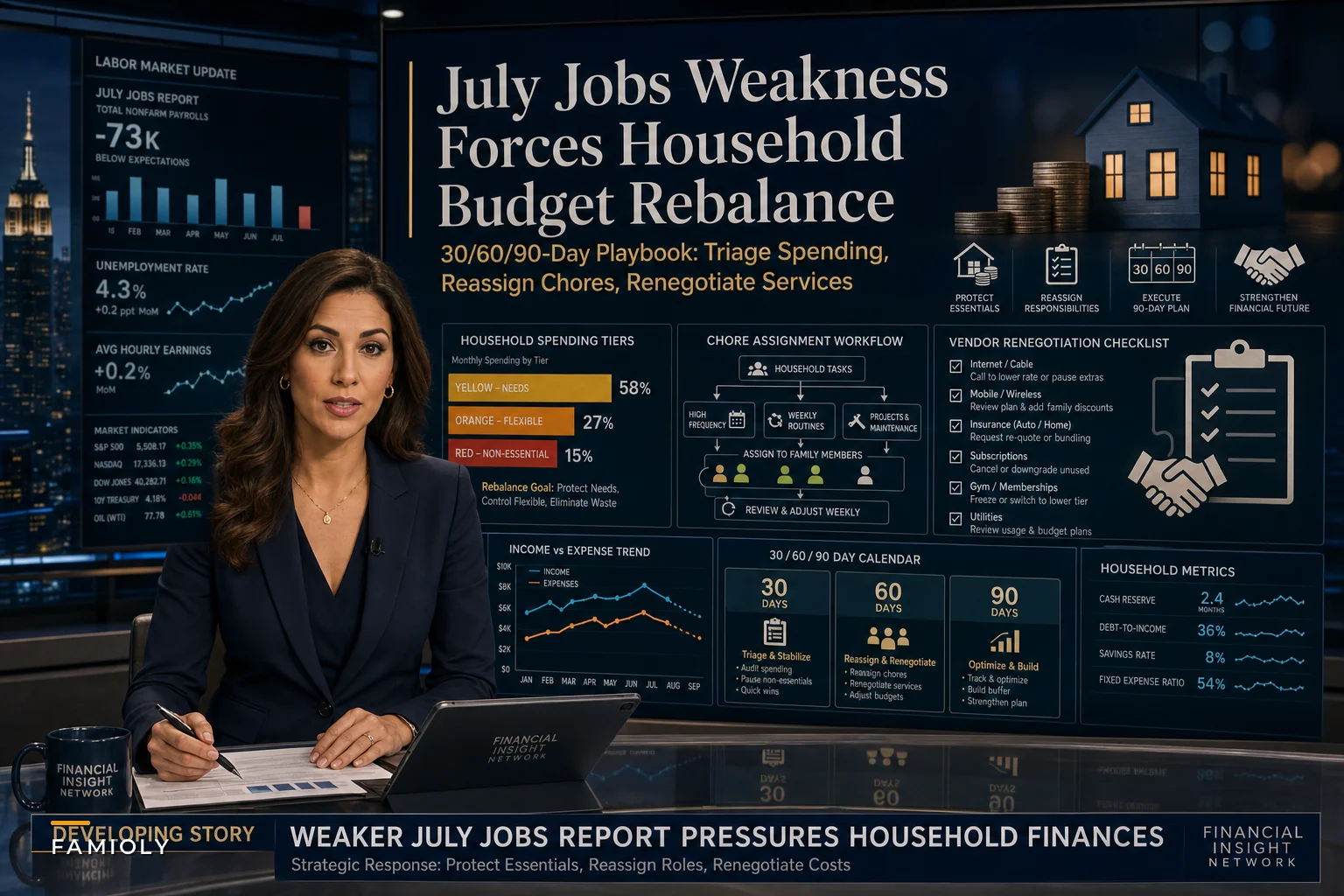

The July numbers surprised almost everyone. U.S. nonfarm payrolls fell by 23,000, and even though the unemployment rate eased to 4.1% according to Reuters, a net decline in payrolls is the kind of signal that makes household managers sit up. It's not a crash. But it's the first real crack in a labor market that had felt stable, and it's landing right as families are locking in back-to-school costs, fall activity fees, and the last of summer help schedules.
Most budgeting advice gets this wrong when a report like this drops. It treats the problem as a spreadsheet problem—cut this, trim that, find $200 somewhere. But a softening job market doesn't just threaten a number in a budget. It threatens the structure your household is running on: who does what, which services you're paying for, and how fast you can adapt if one income actually takes a hit. That's the part nobody really preps for.
So this isn't a "here are 15 things to cancel" post. It's about restructuring your household's operating logic so that if income drops, you're reallocating instead of scrambling.
Why a payroll dip hits households harder than the number suggests
A 23,000-job decline sounds abstract until you map it onto what households actually do with income risk. The BLS summary noted little overall change in payroll employment, and that framing matters—this is a warning shot, not a collapse. Warning shots are exactly when restructuring is cheap and low-stress. Wait until an actual layoff, and every decision gets made under pressure, which is when families make the expensive mistakes.
The underlying problem this exposes is that most households have almost no slack in their operations—only slack in their emotions. When money gets tight, people react by feeling stressed and cutting randomly, rather than working through a pre-decided sequence of what changes and in what order. There's a real difference between "we're worried about money" and "we know that if income drops 20%, we pause the cleaning service, shift lawn care in-house, and freeze the two subscriptions we already flagged."
A household that has mapped its costs and its labor before a shock can adjust in an afternoon. One that hasn't will spend three weeks arguing about whether the streaming bundle is really the problem. It isn't.
The two levers most families forget they have
When income tightens, families instinctively reach for one lever: spending. But there are actually two.
Stop losing track of household duties.
Famioly helps you organize, assign & complete family tasks efficiently.
- Centralized task management
- Shared family calendar
- Budget & expense tracking
No credit card required
Lever one is money out. Subscriptions, contracts, discretionary purchases, paid help. This is where everyone looks first.
Lever two is labor in. The hours of paid help you're buying that a household member could absorb—cleaning, yard work, some childcare, meal prep, pet care, tutoring. This lever is bigger than people think, and it's the one that protects your lifestyle rather than just shrinking it.
The pattern worth noticing: when a family cuts only spending, the house still needs the same amount of work done, and now nobody's being paid to do it, so it silently lands on whoever has the least capacity to say no—usually one overloaded parent. That's not a budget fix. That's a burnout transfer.
When you plan labor shifts, name swap-in tasks that match people's existing routines to reduce friction—e.g., whoever cooks dinner also handles kitchen tidy-up.
The stronger move is to pull both levers deliberately, at the same time. Decide which paid work moves in-house, and who's actually taking it on, and what gets dropped entirely. Otherwise you've quietly created a second unpaid job for someone.
A tiered response plan you can build in one sitting
The most useful thing you can do this week isn't cut anything. It's build a tiered response ladder—a pre-decided sequence of what changes at each level of income stress. That way, if a shock actually comes, you're executing a plan instead of negotiating one at the worst possible time.
| Tier | Trigger | Money-out moves | Labor-in moves |
|---|---|---|---|
| Yellow | Income uncertain / one earner nervous | Freeze new subscriptions, pause 1–2 low-use services, renegotiate one contract | None yet—just plan assignments |
| Orange | Income down ~15–25% | Pause cleaning/lawn services, cut discretionary categories, downgrade plans | Shift cleaning + yard in-house, split via rotation |
| Red | Income down 30%+ or job lost | Cancel all non-essential recurring costs, renegotiate major bills | Absorb most paid-help tasks, restructure weekly schedule fully |
The value here isn't the specific numbers—your household's tiers will look different. The value is that the decisions are pre-made. When people are calm, they make good tradeoffs. When they're panicked about a lost paycheck, they either freeze or overcut. A ladder written in advance takes both failure modes off the table.
Here's a realistic example of how this plays out. A dual-income family paying roughly $520 a month for biweekly cleaning and lawn service had one earner's hours cut in late summer. Because they'd sketched an Orange-tier plan two weeks earlier, they moved lawn care in-house immediately—saving around $140/month—kept cleaning at a reduced monthly cadence instead of biweekly, and reassigned the freed-up chores through a simple weekend rotation. The whole adjustment took one Saturday conversation instead of a month of tension. They didn't feel poorer. They felt organized.
How the ladder flows in practice
For households building this for the first time, it helps to see the sequence laid out as a process rather than just a table:
-
Audit current paid services — list everything you pay for monthly that involves someone else doing household work.
-
Tag each by tier — decide which ones pause at Yellow, which pause at Orange, and which are the last to go.
-
Map the labor shift — for each service you'd eventually drop, write down who absorbs it and what that actually looks like week to week.
-
Identify the renegotiation candidates — flag providers you'd call before cancelling.
-
File it somewhere both partners can find it — a shared note, a folder, whatever. The plan needs to be accessible when things feel urgent.
That's the whole build. It doesn't need to be a formal document. It just needs to exist somewhere outside of one person's head.
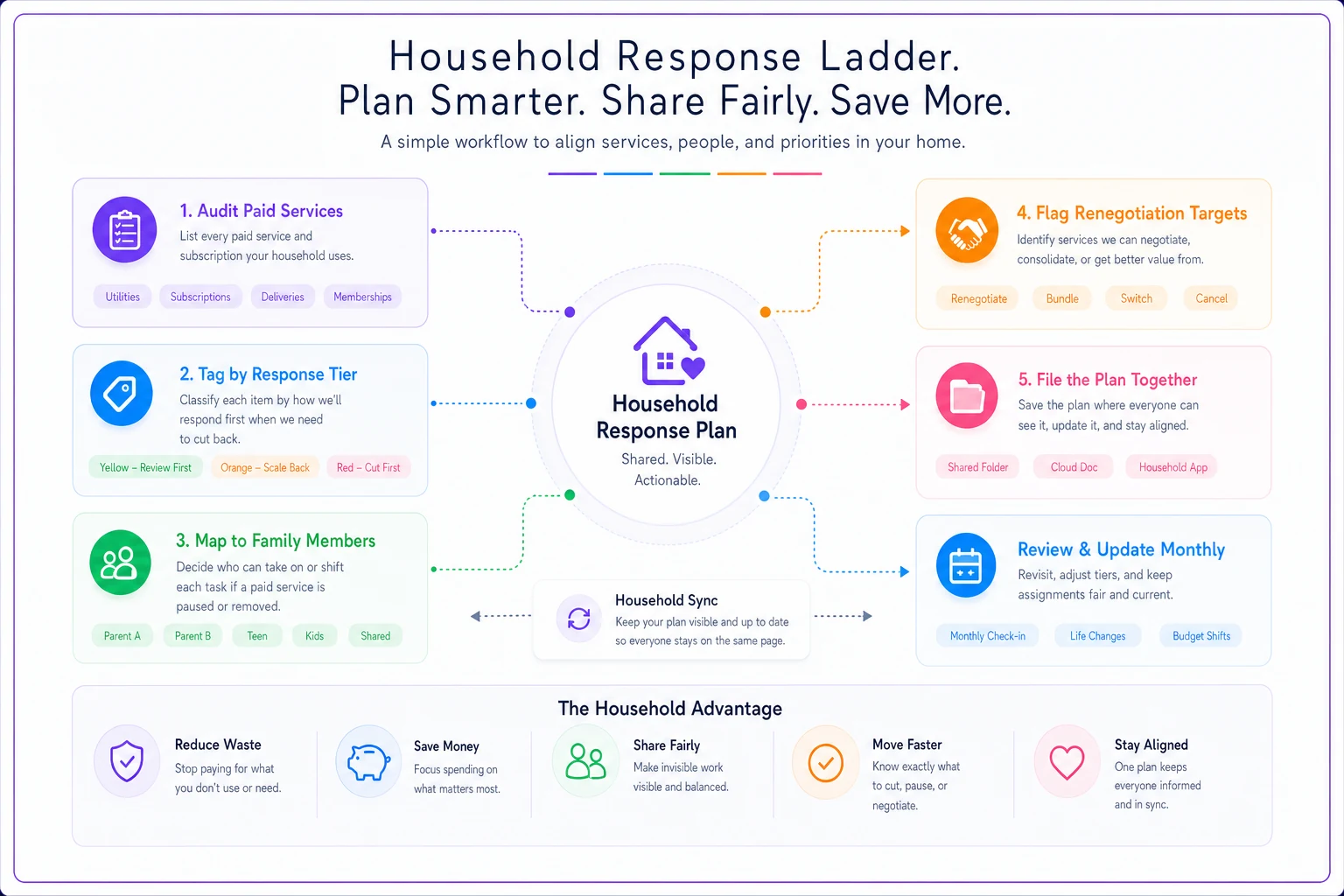
A simple visual like this helps partners run the steps quickly when stress rises.
Renegotiate before you cancel
This is the step families skip, and it's the one with the best return. Before cancelling a service or contract, try to restructure it. Most local providers—cleaners, lawn crews, tutors, even some gyms and activity programs—would rather keep you at reduced frequency than lose you entirely.
> "We really value your work and want to keep it going. Money's a little tighter for a few months, so instead of stopping completely, could we move to [monthly instead of biweekly / a smaller scope / a lower tier]? I'd rather keep working with you than start over later."
Providers will often offer a reduced rate or flexible scheduling you didn't know existed, simply because you asked and framed it around continuing the relationship. Cancelling burns the relationship and the re-onboarding cost when things recover. Renegotiating preserves both.
The chore reallocation nobody plans for
This is where households consistently fall apart: they decide to bring work in-house, but they never actually assign it. "We'll just clean it ourselves" is not a plan. It's a hope. And hope defaults to whoever notices the mess first.
-
List the specific tasks you're bringing in-house, not the categories. Not "cleaning" but "bathrooms, kitchen floors, vacuuming main level."
-
Assign each task to a named person, including kids where age-appropriate.
-
Set a day and a rough time block, so it has a home in the week instead of floating.
-
Define "done" so you're not re-litigating whether the bathroom counts as clean.
-
Pick one person who owns the overall standard, so nobody has to nag.
This is genuinely the difference between a household that absorbs a labor shift smoothly and one where resentment quietly builds until someone blows up over dishes. The tasks were always going to exist. The only question is whether they're assigned or ambient.
For families juggling this on top of everything else, keeping the whole picture visible—who owns what, on which day, at what standard—matters far more than any particular tool you use. A shared household board, a simple app, a whiteboard—whatever gets the assignments out of one person's head and into a shared space. That's the actual failure point: when the plan lives only in the household manager's memory, it collapses the moment they get sick or overwhelmed.
When restructuring is the right call—and when it isn't
When this makes sense: Income feels uncertain but hasn't actually dropped yet. This is the ideal window. You can plan calmly, renegotiate from a position of stability, and test-run in-house chores before you need them.
When to move faster: An income hit has already happened. Skip straight to your Orange or Red tier, but still avoid the panic-cancel spiral—work your ladder in order.
When this is a bad idea: Don't strip your household to the bone based on one soft jobs report if your own income is genuinely secure. Over-cutting has real costs too—burned relationships with good providers, exhausted family members, and the hassle of rebuilding everything when things recover. A single monthly payroll number is a reason to prepare, not necessarily to slash.
Who should skip most of this: Households with a solid emergency buffer and stable, recession-resistant income. For you, the useful move is just building the response ladder and filing it away. You may never use it, and that's fine—it cost you an hour.
Protect the core, trim the edges
One principle keeps families from making things worse under stress: distinguish between the services that keep your household functioning and the ones that just make it nicer. Cutting the wrong thing to save $60 can cost far more in lost time or stress down the line.
Childcare that lets both parents work is almost never the first thing to cut, even though it's often the biggest line item—because cutting it can reduce income more than it saves. The same logic applies to anything that directly protects an earner's ability to earn. Trim from the edges inward: entertainment, convenience purchases, redundant subscriptions, and "nice-to-have" services come well before the load-bearing ones.
This same rebalancing logic—protecting core routines while trimming the discretionary layer—shows up any time costs climb, not just when jobs data wobbles. If you want a deeper walkthrough of adjusting both spending and daily routines under pressure, the approach in rebalancing household budgets and routines when costs bite pairs directly with the response ladder above.
Build it now, while it's boring
The honest reason to do this work this week is that it's easy right now. Nothing's on fire. You can have the household conversation calmly, sketch your tiers, flag the two services you'd renegotiate first, and figure out who'd take on which chores if it came to that. Twenty minutes of calm planning beats a full weekend of scrambling later.
A weaker jobs report isn't a prediction that your household is in trouble. It's a nudge to check whether your household could adapt if it needed to. Most can, far more smoothly than they expect, once the decisions are made in advance instead of under pressure. Build the ladder while it's boring. If you never climb it, you've lost an hour. If you do, you'll be glad it was already there.
A weaker jobs report isn't a prediction that your household is in trouble. It's a nudge to check whether your household could adapt if it needed to. Most can, far more smoothly than they expect, once the decisions are made in advance instead of under pressure. Build the ladder while it's boring. If you never climb it, you've lost an hour. If you do, you'll be glad it was already there.
Ready to simplify your household management?
Join thousands of families using Famioly to save time, reduce home management stress, and keep the household running smoothly.