



Most families don't fail at money because they overspend. They fail because nobody reconciled the shared account for six weeks, a kid's soccer refund never got tracked, and two people paid the same bill from two different accounts. The money was there. The record wasn't.
That's an operations gap, not a budgeting gap. And it's exactly the kind of thing a proper toolkit fixes — not with willpower, but with worksheets, cadences, and clear rules about who owes what and when.
This is the companion kit to the money-rules playbook. If you haven't already set your foundation for shared vs. personal accounts and a decision cadence, start there. What follows assumes you've got the basic structure and now need the actual working parts: the reconciliation sheet, the reimbursement flow, the policy text you can paste into a shared doc tonight.
The Reconciliation Worksheet (and why most families skip the one thing that matters)
A household finance toolkit lives or dies on one habit: reconciling the shared account against reality on a fixed schedule. Not "checking the balance." Reconciling — matching what the bank says against what you expected to happen.
Here's the worksheet structure. You can rebuild this in any spreadsheet in about ten minutes.
| Column | What goes here | Example |
|---|---|---|
| Date | Transaction date from bank | 03/14 |
| Description | Bank's raw label | SQ *KROGER #418 |
| Category | Your simplified bucket | Groceries |
| Expected? | Y/N — was this planned? | Y |
| Amount | Actual debit/credit | -142.67 |
| Who | Which person initiated | Dana |
| Reimbursable? | Owed by someone? | N |
| Notes | Anything odd | Coupon didn't apply |
| Running balance | Formula (see below) | 2,318.44 |
The formula for the running balance column is just the previous row's balance plus the current amount:
=I2 + E3
Where column I is running balance and column E is amount. Drag it down. That's the whole thing people somehow overcomplicate.
The one thing families skip: the Expected? column. Everyone tracks amounts. Almost nobody tracks whether a transaction was supposed to happen. That single Y/N is what catches the $9.99 subscription that renewed after a free trial, the double-charge from a gas station pre-authorization, and the "why is there a $54 charge from a store we've never been to" moment — before it becomes a fraud headache.
Make the Expected? Y/N a required column on every new row to catch unintended charges quickly.
A completed example (so you can see the pattern)
-
03/14 — Kroger — Groceries — Expected
Y — -142.67 — Dana — Running: 2,318.44
-
03/15 — Comcast — Utilities — Expected
Y — -89.00 — Auto — Running: 2,229.44
-
03/15 — Amazon — Uncategorized — Expected
N — -34.18 — ??? — Running: 2,195.26
-
03/16 — Refund
Old Navy — Reimbursable-in — Expected: N — +27.44 — Marcus — Running: 2,222.70
That 03/15 Amazon charge with "???" in the Who column is the entire point of reconciling. It sat there until someone remembered a teen had ordered phone cases. Without the worksheet, it disappears into the general fog of "we spend a lot on Amazon." With it, you catch that it should've come out of the teen's personal allowance, not the shared account — which flips it into a reimbursement.
Monthly Variance Template: spotting drift before it compounds
Reconciliation catches individual transactions. Variance catches patterns. The monthly variance sheet is dead simple:
Stop losing track of household duties.
Famioly helps you organize, assign & complete family tasks efficiently.
- Centralized task management
- Shared family calendar
- Budget & expense tracking
No credit card required
| Category | Planned | Actual | Variance | Variance % |
|---|---|---|---|---|
| Groceries | 650 | 811 | +161 | +24.8% |
| Utilities | 340 | 322 | -18 | -5.3% |
| Kids' activities | 200 | 275 | +75 | +37.5% |
| Eating out | 250 | 190 | -60 | -24% |
Variance formula: =Actual - Planned. Variance %: =(Actual - Planned)/Planned.
The insight most people miss: don't react to raw dollar variance, react to percentage variance that repeats. A one-month grocery spike of 25% during a birthday week is noise. That same 25% for three months running means your planned number is wrong, not your spending. This is usually where couples start arguing — one person thinks the other is overspending when the budget line was just set unrealistically two years ago and nobody updated it.
Set a threshold: any category over ±20% for two consecutive months gets a five-minute conversation, not a fight. That's the rule.
Copy‑Paste Household Money Policy (Shared vs. Personal)
> Shared Account covers: housing, utilities, groceries, insurance, shared transportation, kids' core needs (school, medical, essential clothing), and pre-agreed family activities. > > Personal Accounts cover: individual discretionary spending, gifts for each other, hobbies, personal subscriptions, and anything not on the shared list. > > The $75 rule: Any single shared-account purchase over $75 that isn't a recurring bill gets a heads-up message before purchase. Not permission — a heads-up. This exists so nobody's surprised at reconciliation. > > Gray-area default: If it's unclear whether something is shared or personal, it's personal until we discuss it. This prevents the shared account from quietly absorbing individual wants.
That last line — "gray-area defaults to personal" — is the single most useful policy sentence a household can adopt. Without a default, ambiguous spending always drifts toward the shared account because it's easier. Over a year, that drift is real money.
Reimbursement Workflows That Actually Get Settled
Reimbursements are where household finance quietly breaks. Someone fronts money, everyone means to settle up, and three weeks later nobody remembers the amount. Here's the workflow:
-
Log it immediately. The person who fronted money adds a row to the reimbursement tracker the same day — amount, who owes, what for.
-
Set an IOU clock. Every reimbursement gets a due-by date. Default: settled by the next reconciliation (weekly or biweekly).
-
Settle in one batch. Don't Venmo each other six times a week. Net it out at reconciliation. If Marcus owes Dana $40 and Dana owes Marcus $15, one transfer of $25 closes both.
-
Mark it closed. The row gets a "Settled" flag and a date. No flag, no closure.
Sibling and teen examples
This is where a toolkit earns its keep, because kids are genuinely the worst offenders for un-tracked money.
Teen fronting a group cost: Your 16-year-old covers movie tickets for herself and a sibling — $34 total. The sibling owes $17. Log it, set the clock to allowance day, and it comes out of the sibling's next allowance automatically. No nagging required.
The IOU timeline for kids: Kids need a visible countdown, not an open-ended debt. A simple rule works: "IOUs are due by the next allowance. Unpaid IOUs get deducted first, before you receive any new allowance." That single sentence teaches more about credit than any lecture.
The "bank of parent" loan: A teen wants a $60 item and has $40. If you front the $20, it's an IOU with a due date — same tracker, same rules. What you're teaching is that borrowed money has a settlement date, which is genuinely rare for kids to learn before they get a credit card offer at 18.
Here's a simple visual of the reimbursement workflow.
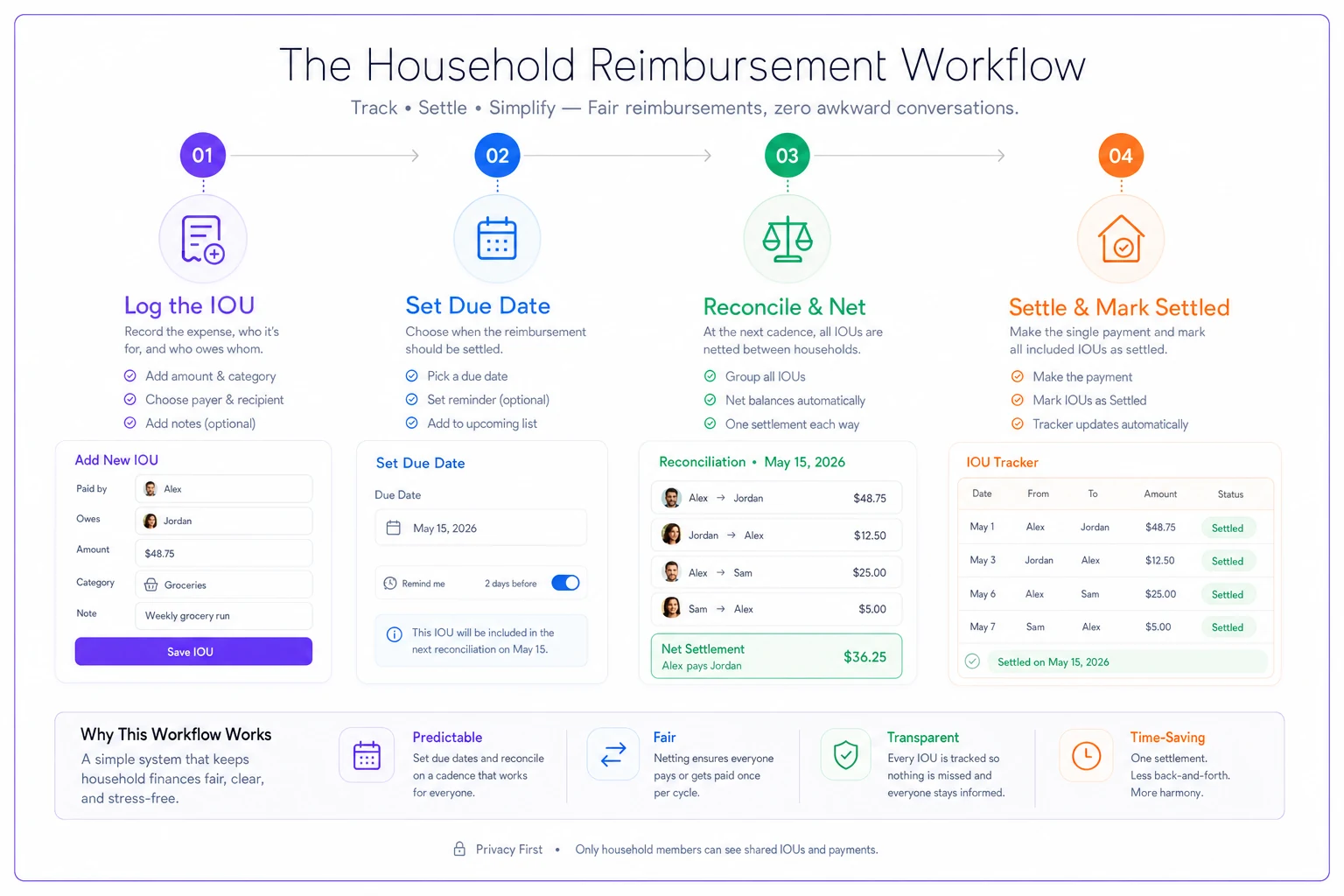
The IOU process closes when the row is flagged settled; no flag, no closure.
Reconciliation Cadence Options
Not every household needs the same rhythm. Pick based on transaction volume and how many people touch the shared account.
| Cadence | Best for | Trade-off |
|---|---|---|
| Weekly (15 min) | Multiple earners, teens with cards, high volume | More frequent but each session is short |
| Biweekly (25 min) | Two adults, moderate volume | Balance of effort |
| Monthly (45 min) | Single earner, low volume, mostly recurring bills | Errors can compound for weeks before you catch them |
Automation thresholds are the underrated part of this. Decide in advance which transactions never need review and which always do:
-
Auto-approve, no review recurring bills under a set amount that match last month within 5% (mortgage, standard utilities, known subscriptions).
-
Always review anything over $75, anything from a new merchant, anything categorized as "uncategorized."
-
Flag for discussion any category tracking over your ±20% variance threshold.
The pattern here mirrors how a small business handles accounts payable — you don't manually re-approve the electric bill every month, but you do eyeball anything unusual. Setting the threshold before you're tired on a Sunday night is what makes it stick.
Sample UI Microcopy for Approvals and Disputes
If your household uses any shared app or even a group chat convention, the wording matters more than people expect. Vague requests get ignored. Specific ones get answered.
Approval request: > "Heads-up: about to spend $92 on the shared card for [item]. Reply 👍 or hold. No reply by tonight = I'll proceed."
Reimbursement nudge: > "IOU reminder: $17 for movie tickets, due allowance day (Fri). Reply 'settled' once done."
Dispute / clarification: > "Flagging the 03/15 Amazon charge ($34.18) — whose was this and shared or personal? Marking as 'personal' if unclear."
Notice each one has a default action if ignored. That's the trick. A message without a fallback just becomes another unanswered notification. With a fallback, the process keeps moving whether or not everyone responds in time.
Implementation Notes: Banking Integration Trade-offs
At some point you'll face a choice: manually enter transactions, or connect the shared account to a tool that pulls them automatically. Both are valid options.
Manual entry takes more time but forces awareness — you feel each expense, which quietly reduces spending. It's also the most private option since nothing connects to a third party.
Automatic bank feeds save time and reduce data-entry errors, but they come with two real trade-offs. First, auto-imported categories are frequently wrong — "SQ *" transactions get miscategorized constantly, so you still need a review step anyway. Second, connecting accounts means trusting a third-party aggregator with read access. That's a genuine consideration, not a dealbreaker, but worth deciding consciously.
A reasonable middle path most households land on: auto-import for the high-volume shared account, manual tracking for personal accounts and reimbursements. You get the time savings where volume is high and keep full control where the sensitive stuff lives.
KPIs to Track Household Adherence
You don't need a dashboard. Four numbers tell you whether the system is working:
-
Reconciliation streak — how many scheduled reconciliations you've done in a row without skipping. This is the leading indicator; when it breaks, everything else drifts.
-
Open IOUs older than one cycle — should trend toward zero. Rising means your settlement step is broken.
-
Uncategorized transactions per month — high numbers mean people aren't communicating purchases in real time.
-
Variance breaches — categories that blew past ±20%. Repeat offenders signal a budget that needs re-setting, not more discipline.
The most telling one is the reconciliation streak. Households that keep it alive almost never have the "where did our money go" conversation. Households that let it break always do.
Basic Tax Guidance for Allowances and Child Earnings
Quick, practical, and not legal advice — verify specifics for your situation.
Ordinary allowances are not income. They're gifts, and there's nothing to report. Where it gets real is when a child actually earns money — a teen with a part-time job, freelance babysitting, tutoring, or reselling. Earned income can trigger a filing requirement even for minors once it crosses a threshold, and self-employment income like cash babysitting has its own lower trigger point for self-employment tax.
The practical move: if your teen earns meaningful money, keep a simple log of what they earned and when. A single tab in your finance sheet — date, source, amount — turns a stressful April scramble into a five-minute lookup. The families that get surprised are the ones who never tracked the summer job cash at all.
Accessibility Tips for Inclusive Family Use
A toolkit only works if everyone in the household can actually use it.
-
Large, high-contrast text in shared sheets — not everyone reading it has the same eyesight, including grandparents who might help with tracking.
-
Plain-language column headers — "Who owes money?" beats "Reimbursable party" for younger kids and anyone not fluent in finance-speak.
-
Screen-reader-friendly labels if you use an app — avoid color as the only signal (don't rely on red/green alone; pair it with a word like "over" or "settled").
-
A read-only version for kids so younger family members can see their allowance and IOUs without accidentally editing the shared ledger.
-
One physical fallback — a printed reimbursement sheet on the fridge for anyone who doesn't want to open an app. Inclusion sometimes means low-tech.
Inclusion sometimes means low-tech.
A Real Scenario
A dual-income household with two teens ran everything through one shared checking account and "sort of" tracked reimbursements in a group chat. Over a year, they'd accumulated somewhere around $600–$700 in un-settled IOUs nobody could reconstruct, plus two duplicate subscription charges that had been silently renewing for months.
They switched to a biweekly reconciliation using the worksheet above, added the IOU-clock rule for the teens, and set the ±20% variance threshold. Within about two months, open IOUs dropped to near zero because settlement happened in batches on a schedule. The two zombie subscriptions got cancelled — roughly $28/month recovered. And the part they didn't expect: arguments about grocery spending stopped, because the variance sheet showed the planned number had been unrealistic for over a year.
Nothing about their income changed. They just started reconciling like a small business does its books.
Putting the Kit to Work Tonight
You don't have to implement all of this at once. Build the reconciliation worksheet first, paste in the shared-vs-personal policy, and pick a cadence. Add the reimbursement tracker the first time someone fronts money. Layer in variance tracking after your first full month.
The households that stay on top of money aren't more disciplined — they've just turned money into a process with fixed steps, clear defaults, and a schedule that runs whether or not anyone feels like it that week. And if you want the reasoning behind the shared-vs-personal structure this kit is built on, the cadence and decision rules for family accounts is worth reading first.
Start with the worksheet. Everything else hangs off that one habit.
Ready to simplify your household management?
Join thousands of families using Famioly to save time, reduce home management stress, and keep the household running smoothly.