

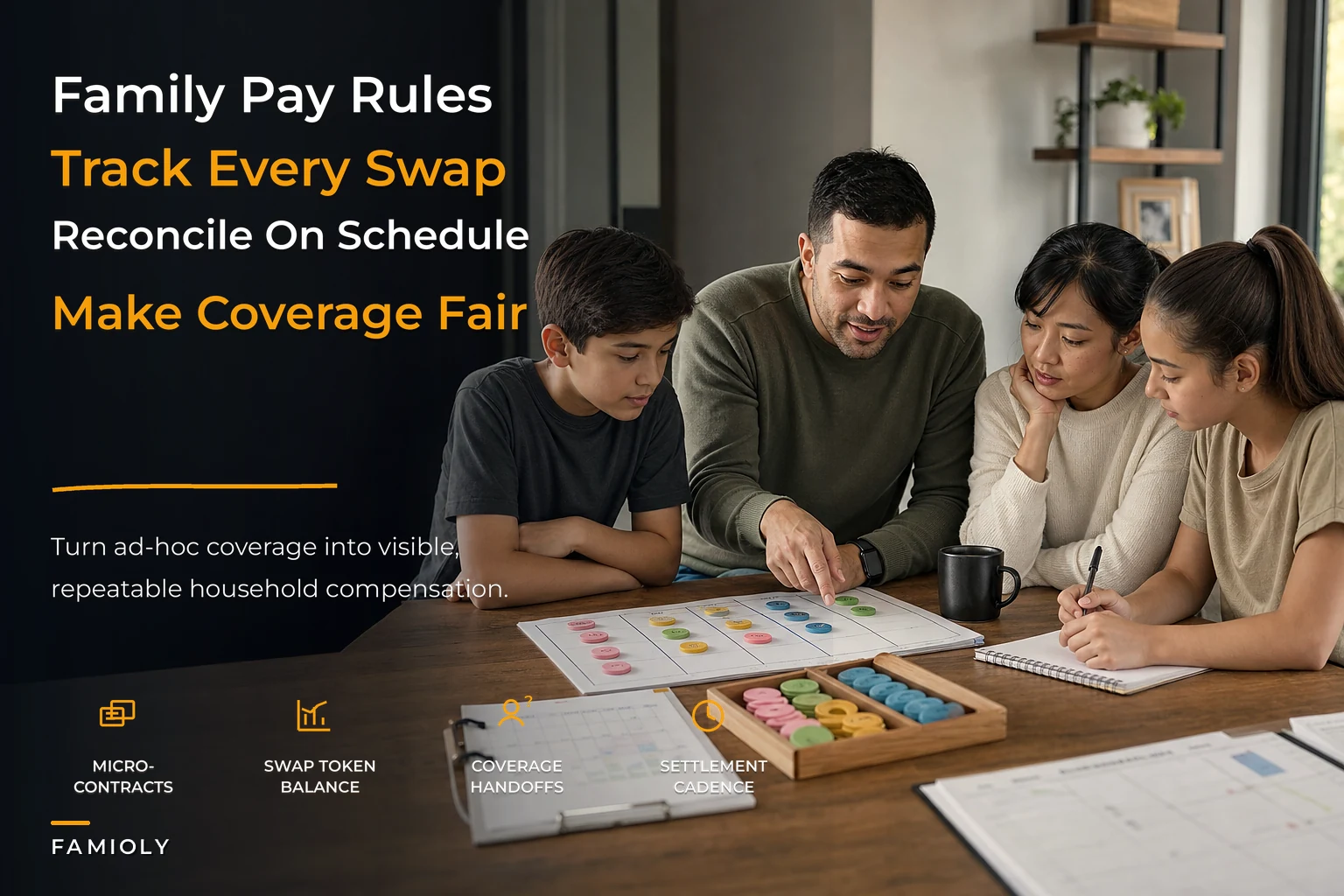

Most household coordination systems handle the planned stuff pretty well. Recurring chores, standing pickups, who cooks on Thursdays — that stuff eventually settles into a rhythm. Where families quietly fall apart is the ad‑hoc coverage: someone gets sick, a work trip runs long, a school project blows up on a Tuesday night, and suddenly one person absorbs a pile of extra work that nobody names, nobody counts, and nobody balances out later.
That uncounted work is the whole problem. It's not that people mind helping. It's that when help is invisible, it never gets reciprocated on purpose — it gets reciprocated by accident, unevenly, and usually in favor of whoever complains loudest. A family compensation charter fixes this by giving ad‑hoc coverage a unit, a price, and a settlement rhythm. Think of it as the accounting layer for the labor that normally slips through the cracks.
This isn't about turning your marriage into a spreadsheet or paying your teenager cash for every favor. It's about making the invisible visible so the balancing happens on purpose instead of resentfully.
Why ad‑hoc coverage is where fairness quietly dies
Standing responsibilities are easy to feel fair about because they're symmetric and repeated. You see them every week. If one person always does the dishes, everybody knows it, and it can be renegotiated.
Ad‑hoc coverage is different in three ways that make it dangerous:
-
It's asymmetric. Emergencies don't distribute evenly. One parent's job has more travel. One kid gets sick more. One person is simply home more during the day, so they catch every unexpected thing by default.
-
It's forgotten fast. The 90 minutes you spent handling a sick day two weeks ago has zero paper trail. By the next argument, both people remember only their own contributions.
-
It compounds. The person who catches the most ad‑hoc work is also usually the person holding the mental load — the one noticing what needs doing. So they get hit twice: they do the noticing and the doing.
Resentment rarely comes from the total amount of work. It comes from the unacknowledged portion. People can carry a heavy load happily if it's seen and balanced. They burn out fast when it's invisible.
The charter exists to convert "I always end up doing everything when things go sideways" into a number you can actually look at.
The three moving parts
A working charter has three components that connect to each other. Miss one and the whole thing drifts.
Stop losing track of household duties.
Famioly helps you organize, assign & complete family tasks efficiently.
- Centralized task management
- Shared family calendar
- Budget & expense tracking
No credit card required
-
Micro‑contracts — pre‑agreed definitions of what counts as coverage and what it's "worth."
-
Swap tokens — the unit you use to track who's owed what.
-
Reconciliation cadence — the regular checkpoint where you settle up before imbalances grow legs.
Individually, each is simple. The value is in how they feed each other. Micro‑contracts generate tokens, tokens accumulate, and the cadence clears them. Break the cadence and tokens pile into resentment. Skip the micro‑contracts and tokens get argued over. Skip tokens entirely and you're back to memory-based fairness, which always favors the loudest.
Micro‑contracts generate tokens, tokens accumulate, and the cadence clears them.
Micro‑contracts: pricing coverage before you need it
A micro‑contract is a tiny, boring, pre‑agreed rule about a specific type of ad‑hoc event. The whole point of writing them before an emergency is that you can't negotiate fairly while you're stressed and someone's throwing up.
A micro‑contract answers three questions:
-
What event triggers it?
-
What's the scope of the coverage (start and end)?
-
What is it worth in tokens?
Here's the mistake people make: they try to price by effort in the moment. That guarantees fights, because effort is subjective and everyone thinks their coverage was harder. Instead, price by category and duration bands, decided in advance. A sick day is a sick day. You don't renegotiate the rate each time.
A simple starter table might look like this:
| Coverage event | Scope | Token value | Notes |
|---|---|---|---|
| Solo sick‑kid day (WFH‑possible) | Full day, one caregiver | 3 tokens | Add 1 token if you cancel your own work |
| Solo sick‑kid day (no work flexibility) | Full day | 4 tokens | The harder version |
| Overnight solo (partner traveling) | Per night | 2 tokens | Caps at 6/week so nobody games it |
| School‑project rescue | Per event, 2+ hrs | 1 token | Under 2 hrs is "just parenting," no token |
| Emergency vendor/repair wait | Per half‑day at home | 1 token | The "wait for the plumber" tax |
| Last‑minute pickup outside normal role | Per trip | 0.5 token | Deliberately small |
Two design notes that matter more than they look:
-
Not everything earns a token. If every small favor generates currency, the system becomes petty and exhausting. The threshold ("2+ hours," "outside normal role") keeps normal family life from getting monetized. You want to capture the lumpy, disruptive stuff — not "you handed me a towel."
-
The rates should feel slightly generous to the person doing the harder thing. If the "no work flexibility" sick day is worth the same as the easy one, the person with the inflexible job silently eats the difference forever.
The rates should feel slightly generous to the person doing the harder thing. If the "no work flexibility" sick day is worth the same as the easy one, the person with the inflexible job silently eats the difference forever.
Swap tokens: the unit that makes it real
Tokens are just a shared counter. A note in a shared app, a tally on the fridge, a column in a doc — the format matters far less than the consistency of logging.
The reason tokens work where "keeping it in your head" fails is that they decouple the doing from the repaying. You don't need to swap in real time. Someone covers a sick day now; the balance sits there; it gets cleared later through the person owed picking a Saturday morning to sleep in, handing off a week of dinner cleanup, or taking a solo evening out.
-
Log within 24 hours or it didn't happen. Retroactive logging from three weeks ago is where disputes live. If it wasn't worth logging then, it doesn't count now.
-
Either person can log a token for the other. This is underrated. When you log a token acknowledging your partner covered something, it's a small act of seeing their work — which does more for the relationship than the token itself.
-
Cap accumulation. If someone's token balance climbs past 10–12, that's not a currency problem, that's a structural imbalance problem. The tokens are telling you the standing roles are broken and need renegotiating, not just settling. Tokens are a smoke detector as much as a currency.
Put the token ledger somewhere both partners actually check daily so logging becomes a small habit.
That decoupling is the whole trick. In the moment of the emergency, nobody has to negotiate repayment, which is exactly when negotiation is worst. The token gets logged and life continues.
Reconciliation cadence: settle before it rots
This is where most attempts fail. Families set up the micro‑contracts, start logging tokens with enthusiasm for two weeks, and then never actually clear the balance. Tokens pile up, one person is clearly "owed," and the resentment the system was supposed to prevent shows up anyway — now with a paper trail proving it.
The cadence is non‑negotiable. Pick a rhythm and protect it:
-
Weekly light‑touch check (5 minutes) Just confirm the token log is accurate. No settling, just "did I miss anything?"
-
Biweekly or monthly settlement (15–20 minutes) Actually clear balances. Whoever's owed picks how they want to redeem — a morning off, a skipped chore rotation, a solo outing, dinner out on the other person's dime.
The redemption side needs a menu, or it never happens. "I'm owed 5 tokens" is useless if there's no agreed way to spend them. Build a short redemption list so cashing in is frictionless:
-
2 tokens = one weekend morning off (partner handles the kids)
-
3 tokens = a full evening out, solo or with friends
-
2 tokens = a week off your normal cleaning rotation
-
1 token = the other person handles bedtime for the night
Coordinating who owes what and when to settle overlaps a lot with how you handle recurring chores. If you've already built rotation blocks for cleaning — like the ones in a distributed deep‑clean schedule with owner swaps — token redemption plugs right into it: "owed" people simply skip a rotation slot, and the swap is already tracked.
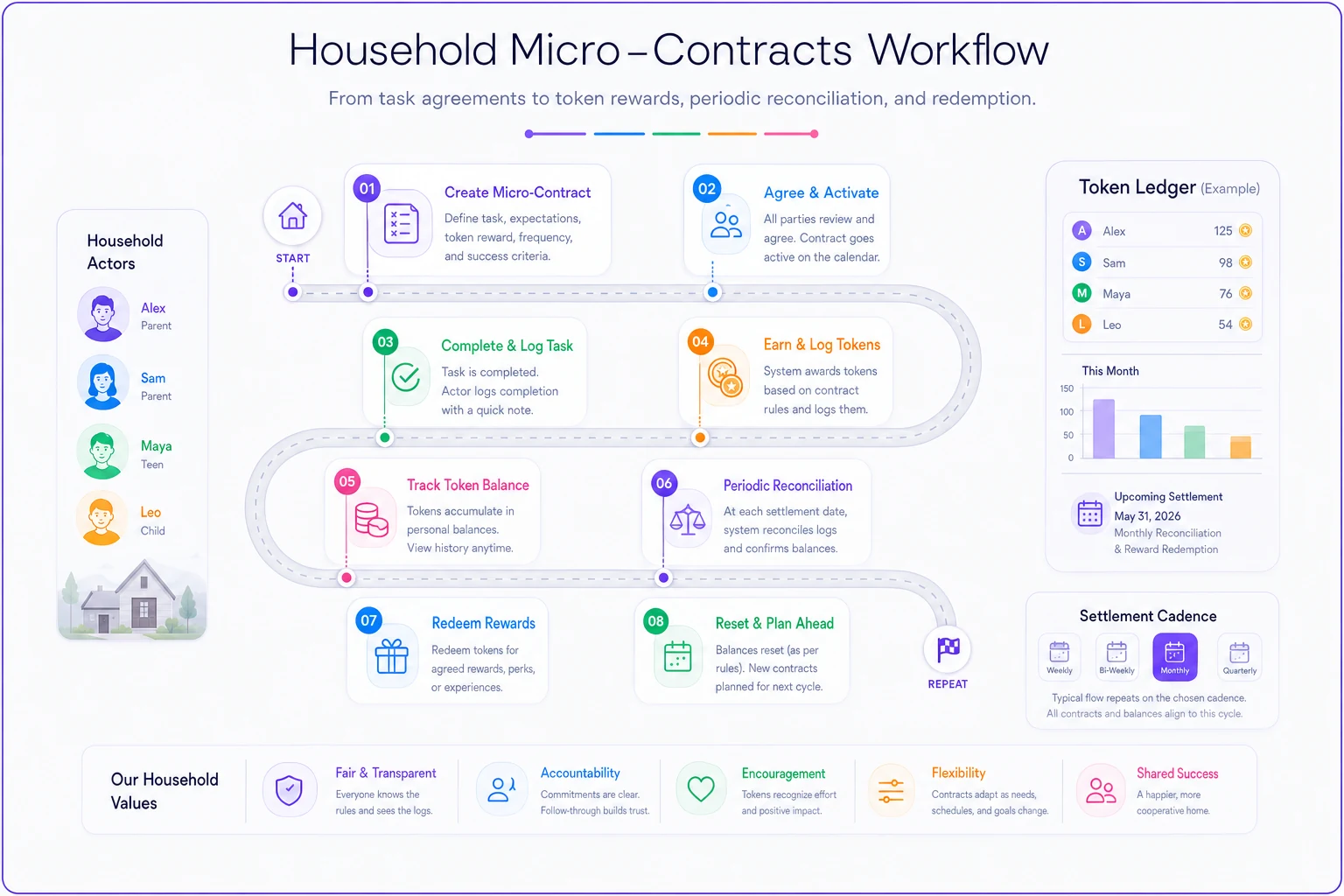
This simple flow — micro‑contract triggers → token logged → periodic reconciliation → redemption — is what keeps small imbalances from turning into long‑term resentment.
A real scenario: two working parents, unequal job flexibility
Picture a household with two full‑time jobs and two kids under ten. One parent works remote with a flexible calendar; the other commutes and has rigid meeting blocks. On paper they'd agreed to split things 50/50.
In practice, the remote parent caught nearly every ad‑hoc event — sick days, repair-guy waits, forgotten-project scrambles — because they were simply there and their calendar bent more easily. Over roughly three months, that added up to something like 18–20 disrupted days that never got counted. The commuting parent genuinely thought things were even. The remote parent was quietly furious.
They set up a charter with maybe six micro‑contracts and a monthly settlement. The first month surfaced a balance of around 9 tokens owed to the remote parent — uncomfortable to see, but useful. It wasn't a fight; it was a number.
Two things changed. First, the immediate imbalance got cleared through a couple of solo weekend mornings and the commuting parent taking over two weeks of dinner cleanup. Second — and this mattered more — that 9‑token gap made the structural lopsidedness obvious. They renegotiated: the commuting parent took over all weekend logistics permanently, since the imbalance wasn't incidental, it was baked in. By month three the monthly balance was hovering around 2–3 tokens either direction. That's basically noise, and that's the target. You're not aiming for zero; you're aiming for small and self‑correcting.
Where this connects to your wider household system
A compensation charter isn't a standalone gadget. It's an accounting layer sitting on top of your existing delegation. If your underlying assignments are fuzzy — if it's not clear who owns what in normal times — tokens will constantly get disputed because the baseline is undefined. You can't measure "coverage above normal" if "normal" was never nailed down.
That's why this works far better once you've done the unglamorous work of defining ownership, verification, and handoffs. If your delegation is shaky, fix that first — the approach in making household delegation stick with clear assignment rules and escalation is the foundation the charter sits on. Tokens then measure the exceptions to well‑defined roles, which is exactly what they're good at.
The charter also has a practical scaling benefit that's easy to miss. As the household grows more complex — more kids, aging parents in the mix, one partner switching to shift work — you add new micro‑contracts, not a new framework. The cadence stays the same. That's the sign of something durable: growth means new line items, not a complete rebuild.
When this actually makes sense
These are the situations where a charter actually earns its complexity rather than just adding overhead.
-
Two‑adult households where job flexibility is genuinely unequal, so ad‑hoc work naturally lands on one person.
-
Blended or co‑parenting setups where coverage crosses households and memory‑based fairness has already failed.
-
Any home where one person keeps saying "I do everything when things go wrong" and the other genuinely doesn't see it. The tokens make the invisible arguable in good faith.
It's worth being clear that none of this works if both people don't actually believe the problem is real. The charter gives you a shared language for imbalance — but only if both people are willing to use it honestly.
When this is a bad idea
These are examples where a charter will do more harm than good.
-
If the real problem is contempt, not accounting. A charter can't fix a relationship where one person simply doesn't respect the other's time. It'll just become another battleground.
-
If you're going to weaponize it. The moment tokens get thrown in someone's face during a fight ("I'm up SEVEN tokens on you"), the tool has failed. It's a settlement mechanism, not a scoreboard.
-
With young kids where you'd try to tokenize normal parenting. If you're logging tokens for reading a bedtime story, you've missed the point. The charter covers disruptive exceptions, not the daily work of being a parent.
A charter can't fix a relationship where one person simply doesn't respect the other's time.
Who should not run this
Households that already feel balanced and settle imbalances naturally within a few days don't need it — adding ceremony to a system that works is just overhead.
And if only one partner is bought in, don't do it. A one‑sided ledger becomes evidence in an argument rather than a shared tool. The whole thing depends on both people agreeing that invisible labor is real and worth counting.
Starting checklist
Use this checklist to get started:
-
- [ ] List the 5–8 ad‑hoc events that actually cause imbalance in your home
-
- [ ] Assign each a token value in advance — price by category and duration, not in‑the‑moment effort
-
- [ ] Set thresholds so normal small favors don't generate tokens
-
- [ ] Pick where tokens get logged and commit to the 24‑hour rule
-
- [ ] Build a redemption menu so "owed" balances can actually be spent
-
- [ ] Set a settlement cadence and defend it like any other recurring commitment
-
- [ ] Add an accumulation cap that flags structural imbalance, not just temporary debt
Use these steps to get started and adapt as needed.
The point of a family compensation charter isn't to run your home like a business. It's the opposite — it's to get the accounting out of your head so you can stop keeping silent score against each other. When ad‑hoc coverage has a name, a value, and a settlement day, the balancing happens on purpose. And the resentment that used to build up quietly in the background just doesn't have anywhere to hide anymore.
Ready to simplify your household management?
Join thousands of families using Famioly to save time, reduce home management stress, and keep the household running smoothly.