

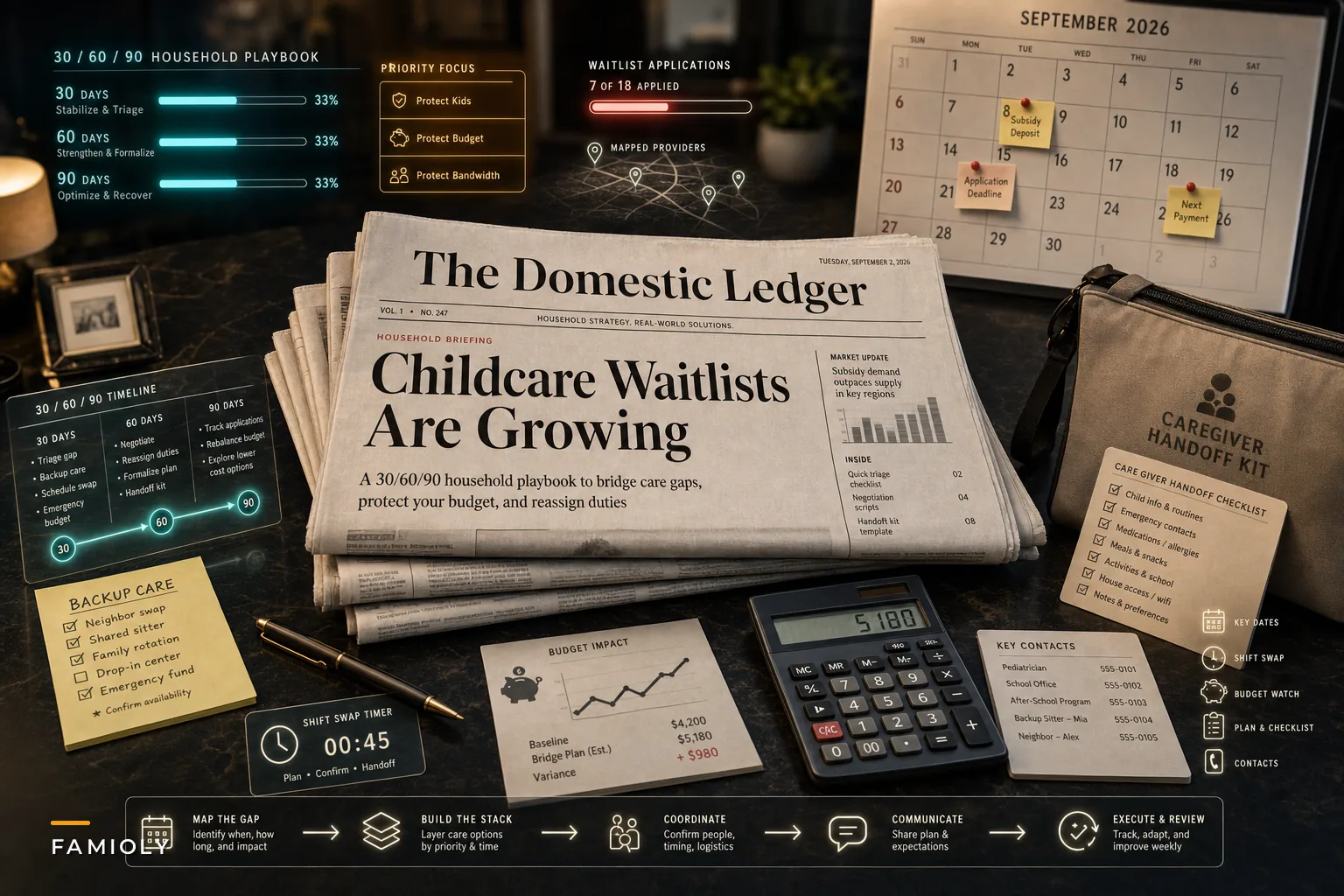

There's a specific kind of panic that hits when the childcare plan you built your whole week around suddenly isn't there. Not a snow day. Not a sick sitter. The structural kind — where the subsidy you applied for, budgeted around, and told your employer about is stuck behind a line of hundreds of thousands of other families.
That's the situation a lot of households are staring at heading into fall. NPR reported in August 2026 that more than 400,000 kids are sitting on waitlists for federal childcare assistance. Some of those families will wait months. Some will age out of eligibility before their number ever comes up. And most of them planned their income and their schedules assuming the help would arrive.
I'm not going to rehash the policy fight. What matters for your household is that a funding gap on a spreadsheet somewhere translates into a very real question at your kitchen table: who watches the kids on Tuesday, and how do we pay for it? This playbook is about answering that fast — before it quietly drains your savings and eats your work hours.
Start With the Real Problem: A Care Gap Is a Cash-Flow Event
Most families treat a childcare gap as a scheduling problem. It's actually a cash-flow problem wearing a scheduling costume.
When subsidized care falls through, you don't just lose coverage — you lose it at market rate, which is usually 2–4x what your subsidized copay would have been. A family expecting to pay a $180/month copay for a center slot can suddenly be looking at $900–$1,400/month for the same hours out of pocket. That's not a hole you patch with a rearranged calendar. That's a line-item that competes directly with rent.
The second-order damage is the part people underestimate: reduced work hours. When a parent drops from full-time to four days to cover a Wednesday gap, that's not a one-week hit. If that arrangement stretches into a full quarter, a household earning around $58k might quietly lose $2,500–$3,500 in income while also absorbing higher care costs on the days they do pay. The gap costs you on both ends.
So before you start calling sitters, get honest about the shape of the problem:
-
How many hours of coverage disappeared per week?
-
What's the cheapest reliable way to cover the highest-stakes hours (the ones tied to a paycheck)?
-
Which hours can you absorb internally without wrecking anyone's job?
You don't cover all the hours first. You cover the hours attached to income first, then triage the rest.
Triage the Hours Before You Triage the Budget
The instinct is to open a spreadsheet and start cutting spending. Wrong order. First map the hours, because the hours determine which spending is actually optional.
Stop losing track of household duties.
Famioly helps you organize, assign & complete family tasks efficiently.
- Centralized task management
- Shared family calendar
- Budget & expense tracking
No credit card required
Not all childcare hours have the same value. Some directly protect income. Some protect your sanity. Some are just habit.
| Hour type | What it protects | How to treat it |
|---|---|---|
| Core work hours | Your paycheck / job standing | Cover these first, at almost any reasonable cost |
| Commute buffer | Whether you keep the job at all | Cover, but look for cheaper options (carpool, earlier drop) |
| Enrichment / activities | Kid development, routine | Pause or downgrade temporarily without guilt |
| "Just easier" hours | Parent bandwidth | Absorb internally where possible |
When families run this exercise, they usually discover that maybe 60–70% of their "childcare need" is genuinely non-negotiable, and the rest was convenience that got baked in over time. That remaining chunk is where you find breathing room — a swim class on hold for eight weeks, a Friday half-day covered by a grandparent instead of a paid slot.
The mistake I see most: families cut the cheap enrichment hours and keep paying premium rates for the convenience hours, because the convenience hours feel non-negotiable emotionally. Run the grid. Be a little ruthless.
Build the Bridge Coverage Stack
Once you know which hours you actually need to fill, stop looking for one perfect replacement. There usually isn't one. Bridge coverage is a stack of imperfect options layered together.
A realistic stack for a two-parent household covering a 25-hour weekly gap might look like:
-
Employer flexibility — one parent shifts to a 7am–3pm schedule, absorbing 6 hours of the gap directly.
-
A shared sitter — split a nanny with one other family in the same boat, cutting the hourly rate roughly in half (10 hours).
-
Family rotation — a grandparent or aunt takes one recurring afternoon (5 hours).
-
A part-time drop-in center — the remaining 4 hours, paid at market rate but only for a small slice.
No single piece carries the whole load, which is exactly why it's more durable than betting everything on one new caregiver who might quit in three weeks.
Here's a quick visual of how you can layer those pieces into a sustainable stack.
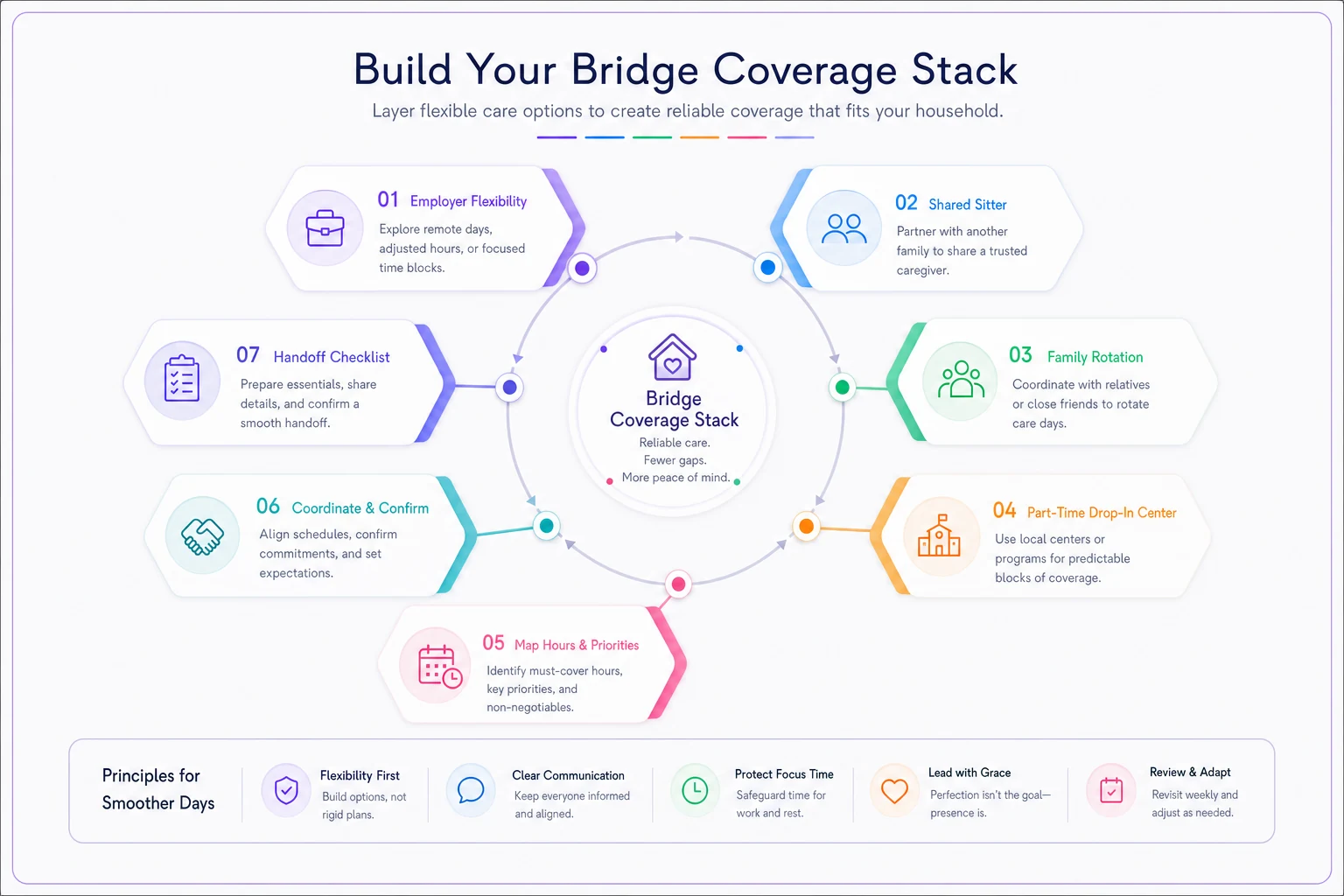
Use this to map who covers which hours and how the pieces connect when someone is out.
The shared-sitter math people miss
Splitting a caregiver is the single highest-leverage move most families skip because coordinating with another household feels like a hassle. But the numbers are hard to ignore. A solo nanny at $22/hour becomes roughly $11–$13/hour when split two ways (you usually pay a small premium per child, so it's not exactly half). Over 10 hours a week, that's a difference of about $90–$100 weekly — call it $360–$400 a month back in your pocket, for one phone call to a neighbor with kids the same age.
The catch: shared care only works if both households agree on the boring stuff upfront — pickup rules, sick-kid policy, who pays when someone cancels. Skip that conversation and it blows up by week three.
Track the Subsidy Application Like It's a Bill
Here's a quiet failure mode. Families apply for assistance, land on the waitlist, and then stop paying attention to it. Months later they've missed a recertification email, a document request, or an eligibility window — and they drop off the list entirely without realizing it.
Waitlists are not passive. Many require you to periodically confirm you're still interested, still eligible, still at the same address. Miss one of those touchpoints and you restart at the back.
-
Log the exact date you applied and any reference or case number.
-
Set a reminder to check status every 30 days, even if you expect nothing.
-
Keep a folder (physical or digital) with income docs, ID, and proof of residence ready to resend within 24 hours, because response windows are often tight.
-
Note the recertification date the moment you're accepted anywhere — this is where people lose spots.
Keep a dated screenshot of your application confirmation and case number in the same document folder for quick reference.
The families who eventually get off these lists aren't luckier. They're the ones who responded fast when the system finally pinged them.
The Underlying Problem: Your Household Was Running Without a Backup
The waitlist surge is the trigger, but it exposed something that was already fragile — most households have exactly one care plan and zero backups. Everything works until the one plan breaks, and then everyone scrambles from scratch.
The households that handle this well aren't the ones with more money. They're the ones who already had their coverage information written down somewhere other than one person's head. When care falls through, the difference between a smooth pivot and a chaotic week comes down to whether you can activate a plan or have to invent one under pressure.
This is exactly the muscle behind a good caregiver-absence contingency plan with ready-to-send handoff kits — the idea that anyone stepping in (a grandparent, a shared sitter, a neighbor) should be able to run your kid's day without a 40-minute briefing. Nap times, allergy info, pickup authorizations, the WiFi password, where the spare inhaler is. When that's already documented, a new caregiver becomes plug-and-play instead of a project.
One structural lesson from this whole mess: a childcare contingency plan isn't something you write during the crisis. It's the thing that lets you skip the crisis part and go straight to the fix.
Reassigning Household Duties Without Burning Someone Out
When a parent picks up childcare hours they didn't have before, something has to give — and it's usually the invisible household labor that quietly reshuffles onto whoever's already stretched the thinnest. Left unmanaged, this is how a temporary care gap turns into a six-month resentment spiral.
Rebalance deliberately, not by default:
-
List the recurring household jobs that happen every week (meals, laundry, drives, bedtime, bills).
-
Mark which ones the newly-busy parent used to own.
-
Reassign those specifically — to the other parent, an older kid, or a paid service — rather than letting them silently fall onto the same person.
-
Set an expiration date. "You take dinner cleanup until October when the sitter starts" lands very differently than an open-ended dump.
The temporary framing matters more than people think. Duties feel fair when they're bounded. The same chore that feels like a reasonable favor for six weeks feels like a permanent injustice when there's no end date attached.
When to bring in paid help vs. redistribute internally
Redistributing internally makes sense when the extra load is modest and short-term — a few weeks, a couple hours a day. Paying for help (a cleaner every other week, a meal service, more sitter hours) makes sense when the internal redistribution would push someone into a schedule that risks their job or health. A $140 biweekly cleaner is cheap compared to the cost of a burned-out parent dropping their own work hours.
Who should not just "power through it": single-parent households and homes where one adult is already the default for nearly everything. There's no slack to redistribute into. For these households, the paid-help conversation comes first, not last, even if it means cutting elsewhere — because the alternative is the whole system collapsing.
A Real Scenario
A household with two kids (ages 3 and 6) was expecting a subsidized center slot that would've run about $200/month in copays. The slot didn't materialize — they landed roughly 6,000 deep on the waitlist. Market rate for equivalent care was quoted around $1,300/month.
Instead of paying it or dropping a job, they built a stack. One parent negotiated a 7:30–3:30 shift, which covered afternoons for the 6-year-old who was in school part of the day anyway. They split a sitter with a neighbor two streets over for the 3-year-old, landing at roughly $12/hour instead of $24. A grandparent took Fridays.
Total new out-of-pocket landed around $520/month instead of $1,300 — still a real hit, but survivable, and neither parent cut work hours. They also kept their subsidy application active with a monthly status check and a document folder ready to go. Roughly five months later a slot opened; because they responded to the eligibility email within two days, they kept it.
The point isn't that it was cheap. It's that a stacked, documented plan turned a household-breaking number into a manageable one.
The Bridge Coverage Checklist
Before you commit to any expensive stopgap, run through this:
-
[ ] Mapped which lost hours actually protect income (vs. convenience)
-
[ ] Identified at least three coverage sources to layer, not one
-
[ ] Asked at least one same-age-kid family about splitting a sitter
-
[ ] Confirmed employer flexibility options (shift, remote, compressed days)
-
[ ] Logged subsidy application date + set a 30-day status reminder
-
[ ] Prepped a resend-ready document folder (income, ID, residence)
-
[ ] Wrote a basic handoff kit any fill-in caregiver could follow
-
[ ] Reassigned displaced household chores with an end date attached
-
[ ] Decided in advance which enrichment hours pause without guilt
Check most of these and you don't have a crisis. You have a plan running.
Closing Thought
Care gaps like this rarely announce themselves gently. One email — or one missing email — and a system you thought was solid needs a replacement by Monday.
The families getting through it aren't spending the most money or making heroic sacrifices. They're the ones who mapped the hours before the budget, stacked imperfect coverage instead of hunting for one perfect fix, and kept their paperwork alive so the subsidy line eventually paid off.
You can't control the length of a waitlist. You can control whether your household has to invent a plan from zero the day the gap appears — or just reach for the one you already built.
Care gaps like this rarely announce themselves gently. One email — or one missing email — and a system you thought was solid needs a replacement by Monday.
Ready to simplify your household management?
Join thousands of families using Famioly to save time, reduce home management stress, and keep the household running smoothly.