



The bathroom remodel was supposed to take nine days. By day twelve, the kids were brushing their teeth in the laundry room sink, dinner had been takeout for a week and a half straight, and nobody could remember whose turn it was to do... anything. The routines hadn't just slipped. They'd quietly collapsed under the weight of a project nobody planned around.
That's the part most people miss. The renovation timeline gets planned to death — quotes, materials, contractor schedules. But the family operations around the renovation get zero planning. Whose job moves where when the garage is full of drywall. Who handles bedtime when one parent is on the phone with the plumber every evening. What happens to the morning routine when the only working shower is now on a different floor.
This post is about that second timeline. Not the construction schedule — the household one running underneath it. If you want to get through a home project without everything falling apart, you need a plan for the family, not just the build.
The real failure isn't the project — it's the routines it quietly eats
What actually happens during a mid-sized home project: the project doesn't fail. It usually finishes roughly on time, give or take. What fails is everything the project was silently sitting on top of.
Think about how many normal routines depend on physical space and predictable time. The kids do homework at the kitchen table — now that table is covered in tile samples. Laundry happens Sunday night — now the machines are behind a plastic sheet. One parent usually cooks while the other does homework help — but now that parent is meeting contractors at 5pm every day.
None of these are catastrophic on their own. The problem is they all break at once, and they break invisibly. No one announces "the morning routine is now broken." It just gets worse day by day until someone snaps over who forgot to pack a lunch.
A pattern worth noticing: the households that come out of a renovation still functioning aren't the ones with the best contractors. They're the ones who treated the disruption as a temporary operating change and reassigned responsibilities on purpose instead of letting them scatter.
Map the disruption before the first hammer swings
Before anything gets torn out, walk through your normal week and mark every routine that touches the project zone. Not the project — the routines around it.
Stop losing track of household duties.
Famioly helps you organize, assign & complete family tasks efficiently.
- Centralized task management
- Shared family calendar
- Budget & expense tracking
No credit card required
A kitchen remodel doesn't just remove a kitchen. It removes:
-
The dinner routine (cooking, family meals, cleanup)
-
The homework spot (if the table's involved)
-
The "grab breakfast on the way out" morning flow
-
The dish-and-lunch-pack station
-
The informal 6pm check-in that happens while someone stirs a pot
Most people list the first one and forget the rest. Then they're blindsided when the homework falls apart during a kitchen project.
A simple way to do this: take a blank sheet and write down every routine you run in a normal week, then mark each one green (unaffected), yellow (partially disrupted), or red (completely blocked). The red ones need a temporary replacement plan. The yellow ones need a heads-up and a small adjustment. Leave the green ones alone — and protecting them matters more than people think, because they become the anchors that keep the week feeling normal.
The four phases every household project actually has
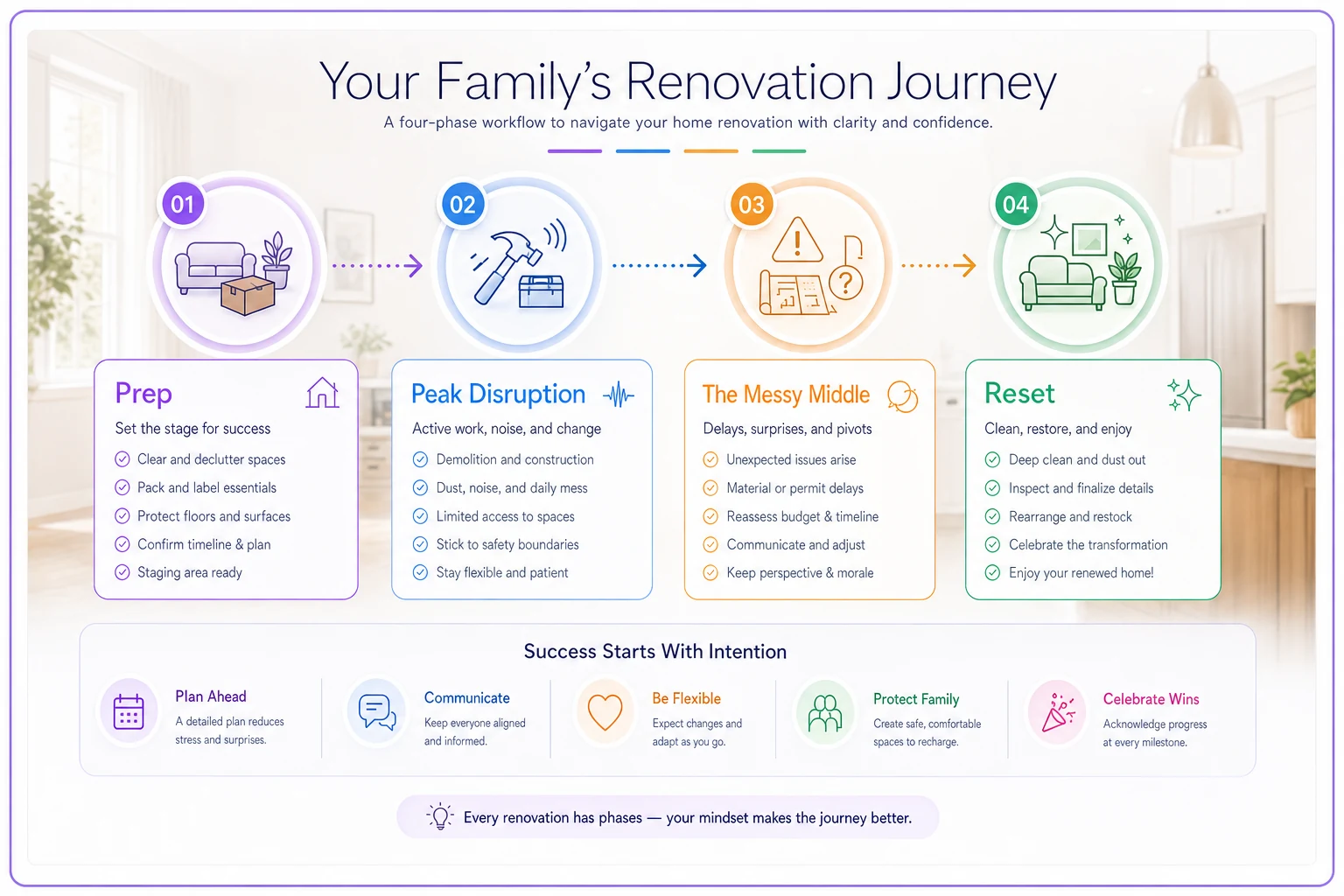
Renovation timelines are usually drawn in construction terms. But from the family's side, every project moves through four phases that have nothing to do with the contractor's Gantt chart:
| Phase | What's happening | Biggest family risk |
|---|---|---|
| Prep (days before start) | Clearing the zone, staging stuff elsewhere | Chaos from displaced belongings, lost items |
| Peak disruption (active work) | Space unusable, noise, workers present | Routines collapse, tempers flare |
| The messy middle (delays, surprises) | Timeline slips, "one more thing" | Fatigue, resentment, decision fatigue |
| Reset (project done, life resumes) | Cleanup, putting things back | Routines don't restart on their own |
The one almost everyone underestimates is the reset phase. People assume that when the project ends, normal life snaps back automatically. It doesn't. After three weeks of takeout and improvised bedtimes, the old routines have to be rebuilt deliberately — otherwise the family just drifts along in the new chaotic pattern because it's become the habit.
Here's a quick visual of the family's four-phase workflow.
Plan a "return to normal" day the way you planned the project start. Restock the pantry, put the homework table back, and actually announce that routines resume Monday. Otherwise you'll be eating takeout for a month after the kitchen works fine.
Role splits and temporary responsibility transfers
Here's the core move: during a project, one adult gets pulled into a temporary role — the project point person. They handle contractor communication, decisions, scheduling, and the constant small interruptions. That role is real work, and it comes out of their normal load.
The mistake is pretending nothing changed. If the point person normally handles dinner and homework and bedtime, and now they're also fielding six contractor texts a day, something's going to drop. Usually it's the kids' stuff, and usually nobody decided to drop it — it just fell.
So make the transfer explicit. For the duration of the project:
-
Project point person takes
all contractor comms, decisions, daily site check, budget tracking
-
Other adult (or backup) absorbs
whatever the point person normally did — dinner, pickups, bedtime, whatever's on their plate
-
Kids (age-appropriate) pick up
keeping their own displaced stuff organized, simple tasks that free up adult time
Write it down somewhere both people can see it. The single most common source of renovation-week fighting isn't the money or the mess — it's the unspoken assumption that the other person will "just handle" whatever fell through.
A quick example: a family doing a two-and-a-half-week bathroom remodel found the point-person parent was spending roughly 45–60 minutes a day on contractor coordination they hadn't budgeted for. That's an hour, every day, that used to go to homework help. Once they formally shifted homework to the other parent for those weeks, the friction basically vanished. Nothing about the project changed — just who owned what.
Family‑impact mitigations that actually hold up
Mitigations are the small pre-planned swaps that keep a disrupted routine functional instead of dead. The key is deciding them before you're exhausted, because decision fatigue during the messy middle makes everyone default to "screw it, order pizza again."
-
Set up a "mini station" for the blocked function. Kitchen out? A folding table with a microwave, kettle, paper plates, and a bin of snacks in another room. It's not pretty, but it turns "we have no kitchen" into "we have a small kitchen."
-
Pre-decide the food plan for the whole project. Not "we'll figure it out." An actual rotation: two nights takeout, two nights slow-cooker meals prepped ahead, one night at grandma's. Decision made once, not fifteen times.
-
Protect one non-negotiable routine. Pick the single routine that keeps the family feeling grounded — for a lot of households it's bedtime, or Sunday breakfast — and defend it fiercely. It becomes the stable point everyone leans on.
-
Create a temporary "stuff lives here now" rule. Displaced belongings cause more daily friction than the construction itself. Assign one clear spot for everything that got moved so nobody spends ten minutes hunting for a hairbrush every morning.
-
Give kids a heads-up with a visible countdown. A simple wall calendar marking "loud days," "no kitchen days," and the finish date reduces the constant "when will it be over" and helps everyone pace themselves.
Put the food rotation on the fridge so everyone sees it and you avoid nightly renegotiation.
The pattern across these: they all convert an ongoing negotiation into a decision made once. That's the whole game during a disruptive project — you have less mental bandwidth, so you front-load the decisions.
A real scenario
A family of four ran a partial kitchen renovation — new cabinets, counters, floor — quoted at about two weeks. It ran closer to three because the countertop supplier slipped.
The first week was rough. Both parents were improvising nightly, the kids' homework routine fell apart, and they'd blown somewhere in the $200–$300 range on last-minute takeout in a single week — food they hadn't planned for at all.
Before week two, they sat down for maybe twenty minutes and did three things: named one parent the point person, formally moved dinner and homework to the other parent, and set a fixed food rotation for the rest of the project. They also set up a card-table "kitchen" with a microwave and kettle in the dining room.
The change wasn't dramatic on paper, but the household stopped feeling like it was in crisis mode. Food spending dropped back toward normal. The kids' routine held. And when the project finally finished, they'd already blocked a "reset Saturday" to restock and put the house back — so normal life actually resumed instead of drifting.
Nothing about the construction changed. The difference was entirely in how the family operations were planned around it.
When this level of planning makes sense — and when it's overkill
This approach makes sense when:
-
The project blocks a core routine (kitchen, only bathroom, primary living space)
-
It runs longer than about three or four days
-
One adult will absorb significant coordination work
-
There are kids whose routines depend on the affected space
This is overkill when:
-
The disruption is contained to a rarely-used space
-
It's genuinely short and low-mess
-
No daily routine actually depends on the zone
Who should be extra careful: single-parent households and homes where one adult already carries most of the operational load. There's often no obvious "other adult" to transfer responsibilities to, which means the mitigations — pre-decided meals, mini stations, leaning on outside help for a few weeks — matter even more, because there's less slack in the system to absorb the hit.
Keeping the plan somewhere it won't get lost
The plan only works if everyone can see it during the chaos. A note on someone's phone that nobody else can access defeats the purpose. Whether it's a shared calendar, a whiteboard on the fridge, or a shared household board where you keep the role splits, food rotation, and the finish-date countdown — the temporary arrangement needs to be visible to the whole family, not living in one person's head.
Households that already run some kind of shared system for chores and responsibilities have an easier time here, because temporarily reassigning a task is just a matter of moving it, not inventing a whole new process mid-renovation. The infrastructure's already there; you're flipping a few switches for a few weeks and flipping them back when it's done.
A renovation is two projects running at once: the one the contractor is doing, and the one your family is doing to stay functional while it happens. Almost everyone plans the first and ignores the second — then wonders why three weeks of construction left everyone frayed.
Map the routines the project will touch. Split the roles honestly and write them down. Pre-decide the food, the mini stations, and the one routine you refuse to lose. And plan the reset as deliberately as the start. Do that, and even a project that runs a week over won't take the whole household down with it.
Ready to simplify your household management?
Join thousands of families using Famioly to save time, reduce home management stress, and keep the household running smoothly.