


The 7:00–8:00 hour in most homes isn't a routine. It's a series of collisions. One parent thinks the other packed lunches. A kid can't find shoes that were "right here yesterday." Someone realizes the permission slip is due today while pouring cereal. And by the time everyone's in the car, at least two people are irritated and one is running back inside for something.
The usual fix people reach for is a chore chart or a laminated "morning routine" poster. Those fail for a specific reason: they list tasks but never assign ownership, and they have zero plan for the moment things go sideways — which is every single morning.
What actually works is treating the school morning like a small operation. Timed zones instead of a vague hour. Persistent role assignments instead of "whoever gets to it." And — this is the part almost nobody builds — explicit handoff and fallback rules for when someone oversleeps, gets stuck, or a kid melts down over sock seams.
Why the standard morning routine collapses
Most morning systems break in the same three places. Worth naming them precisely because each one needs a different fix.
1. Ownership is implicit. "We" pack the backpacks. "We" make sure teeth get brushed. When a task is owned by everyone, it's owned by no one. The default owner becomes whoever notices the failure last — usually at the door, usually the parent already carrying the most.
2. There's no time structure inside the hour. A routine that says "get ready for school" gives no signal about whether you're behind. Zones fix this. If breakfast is supposed to be done by 7:25 and it's 7:35, everyone knows instantly, without a parent playing timekeeper and villain.
3. There's no plan for the exception. Exceptions aren't rare — they're the norm. A kid wakes up sick. The car won't start. One parent has a 7:15 call that ran long. Systems that only work when everything goes right aren't systems. They're wishes.
In real households, the third problem is the killer. You can have perfect roles and perfect timing, but the first time Dad's flight gets rescheduled and he's the one who usually does drop-off, the whole thing falls apart because there was never a rule for who covers his zone.
The structure: timed zones, not a vague hour
Break the morning into zones with hard end-times. The end-time matters more than the start-time — it's the checkpoint that tells you if you're on track.
Stop losing track of household duties.
Famioly helps you organize, assign & complete family tasks efficiently.
- Centralized task management
- Shared family calendar
- Budget & expense tracking
No credit card required
Here's a workable frame for a two-kid household leaving at 8:00. Adjust the clock to yours.
| Zone | Window | Ends by | Primary owner | What "done" looks like |
|---|---|---|---|---|
| Wake & wash | 6:50–7:15 | 7:15 | Kids (self) | Dressed, faces washed, out of bedrooms |
| Fuel | 7:15–7:35 | 7:35 | Parent A | Breakfast eaten, dishes in sink |
| Pack & prep | 7:35–7:50 | 7:50 | Parent B | Backpacks by door, lunches in, forms signed |
| Launch | 7:50–8:00 | 8:00 | Parent A | Shoes on, in car, phones/keys accounted for |
The point of the end-times isn't military precision. It's that when 7:35 hits and cereal bowls are still full, you've caught the delay 25 minutes before it becomes a late arrival — while you still have room to adjust.
One pattern worth noticing: households that assign a whole zone to one parent do far better than households that split within a zone. "You do lunches, I do backpacks" sounds efficient but creates a handoff seam every few minutes. Owning a full zone end-to-end removes those seams.
Persistent role assignments (and why they must be boring and permanent)
The single biggest upgrade you can make is deciding roles once and keeping them stable for weeks at a time — not renegotiating every morning based on who feels less tired.
Persistent roles do two things. They kill the morning negotiation ("can you do drop-off, I did it yesterday"), which is honestly a bigger source of friction than the tasks themselves. And they let each person build muscle memory, so the pack-and-prep parent eventually does it half-asleep without a checklist.
-
Owner of Fuel + Launch — runs breakfast and gets everyone out the door
-
Owner of Pack & Prep — handles bags, lunches, forms, weather-check
-
Floating checker — whoever is not mid-task does a 60-second door check before launch
Kids get real roles too, scaled to age:
-
Ages 5–7
dress self, bring dishes to sink, put shoes by the door
-
Ages 8–10
pack own backpack, check the visual weather cue, fill water bottle
-
Ages 11+
own their entire morning; a parent only verifies, never does
The mistake most families make with kid roles is quietly re-absorbing them the moment the kid is slow. If your eight-year-old "packs the backpack" but you repack it every day because they forget the reading folder, you don't have a role — you have a performance. Better to let the folder get left once, let the teacher's note come home, and let the natural consequence do the teaching. It's cheaper than doing it forever.
Handoff rules: the part that saves the whole morning
A handoff rule answers one question: when a role owner can't do their job, who takes it, and how do they know?
Without this, a single disruption cascades. Parent B has an early meeting → nobody packs bags → kid gets to school with no lunch → someone drives it over at 11:30. That's the whole failure chain, and it starts with a missing handoff rule.
Good handoffs are specific and low-communication. They shouldn't require a five-minute discussion at 7 AM.
Standing handoff rules that work:
-
If a zone owner is unavailable, the other adult absorbs the next zone's start by 5 minutes and covers the gap. Kids' zones don't change — only adult coverage shifts.
-
A handoff must be spoken or signaled before the zone begins, not during. "I've got launch today, you take fuel" said at 6:45 is fine. Discovered at 7:50 is chaos.
-
The person handing off names the state, not the task. "Lunches are done, backpacks aren't" tells the receiver exactly where to pick up. "I didn't finish" doesn't.
Here's a simple workflow to visualize the handoff and fallback flow.
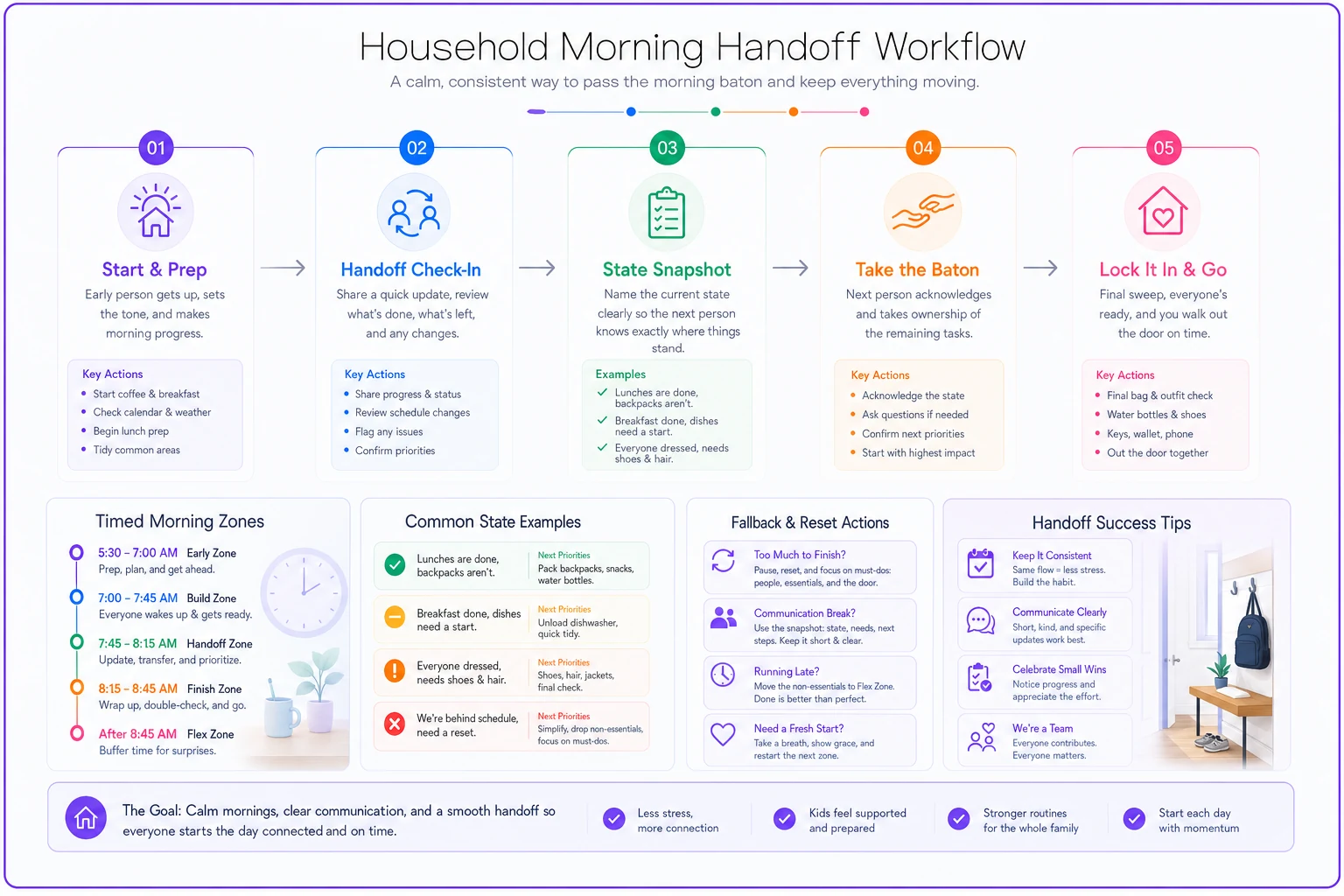
That third rule is small but it's the difference between a smooth handoff and a re-do. Communicating state instead of effort is a habit worth drilling once and reusing forever.
Fallback rules and failure-mode checklists
Handoffs cover "a person is missing." Fallbacks cover "the plan is missing." These are the pre-decided answers to the mornings that go genuinely wrong, so nobody has to think creatively while stressed.
Write these down once. The value is that they're decided before the bad morning, when you're calm.
-
Overslept 20+ minutes → skip cooked breakfast, grab-and-go pouches from the "emergency shelf," and one adult drives instead of the bus.
-
Kid won't get dressed / meltdown → the other kid and adults proceed on schedule; the stuck kid's adult sets a 3-minute timer and offers exactly two clothing choices, no debate. If still stuck at launch, they go in what they can.
-
Missing item (shoes, folder, water bottle) → 90-second search max, then leave without it. No morning gets sacrificed hunting for one thing.
-
Car won't start / weather delay → the pre-saved backup ride list (neighbor, second car, rideshare) is on the fridge, not in someone's memory.
-
Forgotten form due today → the parent doing drop-off photographs it and emails the teacher from the pickup line; it does not derail the launch zone.
The "emergency shelf" deserves a mention because it's underused. Keep a small, restocked stash of shelf-stable breakfast items and a spare pair of the youngest kid's shoes by the door. It converts a five-minute crisis into a ten-second reach.
Households that keep one rarely have a truly catastrophic morning — the fallback is just right there.
Visual cues for kids (so you stop being the human alarm)
The goal with kids is to move the checking off you and onto the environment. Verbal reminders don't scale — you end up repeating yourself, which trains kids to wait for the repeat.
Visual cues work because they give the kid the information a nagging parent would, without the nagging.
-
A magnetic weather cue by the door. A simple sun/cloud/rain/snow card set. Kids check it and grab the matching jacket. Removes the "you need a coat" fight entirely.
-
Zone-colored checklists at kid height. Each zone gets a color; the kid's tasks for that color live on a small board they can see and touch. A picture-based version for pre-readers works fine.
-
A "door row" of hooks and a mat. One hook per kid for backpack, one square on the mat per pair of shoes. Empty hook = not packed. It's a visual pass/fail with no words.
-
A physical "ready token." Some families use a small object each kid moves to a bowl when their zone is done. The empty bowl slot at launch time tells you exactly who's behind — silently.
The pattern behind all of these: make the undone state visible. A poster that lists tasks tells kids what to do but not what they've missed. A door with an empty backpack hook screams what's missing. Design for the gap, not the task.
A real scenario
A household with three kids (ages 6, 9, and 12) and two working parents was routinely leaving 10–15 minutes late two or three mornings a week. The 12-year-old missed the bus often enough that one parent was doing an unplanned 20-minute drive roughly twice a week — around 40 minutes of lost time on those days, plus the stress tax on everyone.
They changed three things. They assigned full zones to each parent instead of splitting tasks. They put an "unavailable owner absorbs coverage by 5 minutes" handoff rule in writing. And they added a door row with hooks and a weather cue for the two younger kids.
Nothing was perfect after. But within about three weeks, the late-departure mornings dropped to roughly one a week, and the emergency drives mostly stopped because the 12-year-old's backpack was visibly packed the night before or it wasn't — no ambiguity to argue about. The bigger change was quieter: the 7 AM negotiations basically ended. When roles are fixed, there's nothing to argue about.
When this level of structure makes sense — and when it doesn't
It makes sense when: you have two or more kids, both adults work on tight schedules, or your mornings already feel adversarial. The more moving parts and the tighter the clock, the more the zones and fallback rules pay off.
It's overkill when: you've got one easygoing kid, a flexible start time, and mornings that already run fine. Don't install machinery to solve a problem you don't have. A single shared checklist is plenty.
Skip the full system if your real issue is bedtime, not morning. A surprising number of "morning chaos" problems are actually "everyone went to bed too late" problems, and no amount of zone design fixes a household running on too little sleep. Fix the input first.
How to actually roll this out
Don't launch the whole thing on a Monday. It'll collapse and you'll blame the system.
-
Week 1 Just add the timed zones with end-times. Say them out loud. Don't change roles yet — you're only teaching the clock.
-
Week 2 Assign persistent zone ownership to the adults. Let the kids keep doing what they do.
-
Week 3 Add kid roles and the visual cues. Resist re-doing their work.
-
Week 4 Write the handoff and fallback rules and post them. Test one on purpose — pretend a parent is "out" and run the coverage.
By the fourth week you'll have a morning that survives disruption instead of amplifying it. And on the mornings it still falls apart — because some will — you'll have a written fallback to reach for instead of improvising while everyone's shoes are missing.
The families who win the morning aren't the calm ones with agreeable kids. They're the ones who decided, in advance and in writing, exactly who owns what and exactly what happens when that plan breaks. Make those decisions once, and you stop making them at 7:12 AM for the rest of the school year.
Ready to simplify your household management?
Join thousands of families using Famioly to save time, reduce home management stress, and keep the household running smoothly.