

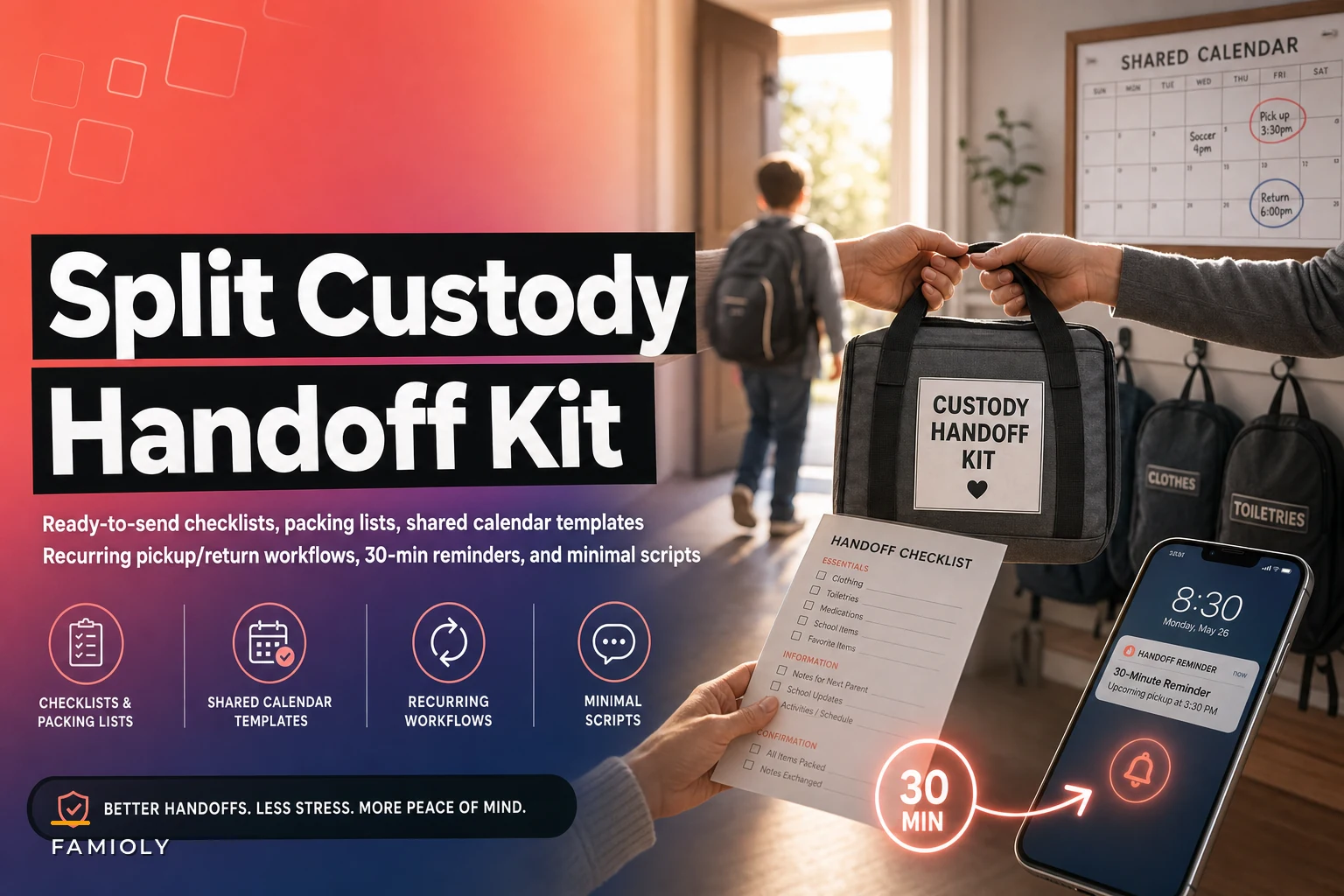

The Wednesday pickup was supposed to be simple. Dad arrives at 5:30, kids transition, done. Instead, my neighbor's ex-husband stood at her door for 25 minutes while she scrambled through the house looking for soccer cleats, permission slips, and the inhaler their son needs for practice. The kids watched from the car as their parents descended into their usual argument about "basic preparation."
This scene plays out in thousands of driveways every week. Not because parents don't care, but because split custody coordination logistics create a complexity multiplier that most families never properly address.
After watching families navigate custody transitions for years, the pattern becomes clear: successful handoffs aren't about better communication or being more organized. They're about building systems that function even when communication breaks down and nobody feels particularly organized.
The real cost of chaotic handoffs
A poorly managed custody transition affects everyone differently. Kids arrive at activities without equipment. Parents spend evening hours driving back to retrieve forgotten items. Step-parents get pulled into logistics they didn't sign up for. Even extended family members find themselves mediating disputes about who forgot what.
The financial impact sneaks up on families. Those emergency pharmacy runs when medication got left behind. The duplicate purchases of school supplies because nobody tracks what's where. The missed work when handoff delays cascade into schedule conflicts. One family I worked with calculated they spent roughly $2,800 annually on duplicate items and emergency purchases directly tied to transition chaos.
But what really matters is how every chaotic handoff erodes the limited goodwill between co-parents. Each forgotten item becomes ammunition. Each miscommunication reinforces negative patterns. The operational failure creates emotional damage that makes future coordination even harder.
Why traditional coordination fails
Most split families try to solve handoff problems with more communication. They create detailed schedules. They send long texts about upcoming needs. They hope that enough information will prevent problems.
Stop losing track of household duties.
Famioly helps you organize, assign & complete family tasks efficiently.
- Centralized task management
- Shared family calendar
- Budget & expense tracking
No credit card required
It rarely works.
The fundamental issue isn't information flow – it's that split custody coordination logistics require managing two separate operational systems that must seamlessly interconnect multiple times per week. Each household has different routines, storage systems, and communication styles. Trying to force alignment through willpower alone guarantees frustration.
Consider what actually happens during a typical handoff window. Parent A is finishing work, thinking about dinner, managing other children, and trying to remember everything for the transition. Parent B is coordinating pickup timing, dealing with traffic, and preparing their home for the kids' arrival. Neither has the mental bandwidth for complex coordination in that moment.
The stress compounds when you factor in common complications. Schedule changes due to activities. Items that need to travel between houses. Medical needs that require specific handling. School events that require coordinated responses. Each addition increases the chance something gets missed.
Building your operational handoff kit
The solution isn't perfect organization – it's creating systems that function despite imperfection. Start with a physical handoff kit that lives by your door.
The core kit components
Your physical kit should contain five categories of items. First, the always-travel essentials: medications in labeled containers, copies of medical cards, emergency contact sheets. Second, the activity-specific gear organized by day: soccer bag for Tuesday/Thursday, dance shoes for Saturday. Third, the school rotation items: homework folder, library books, permission slips in a designated envelope. Fourth, comfort transitions: the special stuffed animal, the bedtime book, the blanket that helps with adjustment. Fifth, the parent communication folder: printed schedules, expense receipts, notes that require signatures.
Everything needs a designated container that makes sense to a stressed parent at 6 PM on a Friday. Clear plastic bins work better than bags. Labels matter more than you think. Color coding by child prevents mix-ups.
Label containers and color-code by child to prevent mix-ups during stressful handoffs.
One divorced dad in Colorado revolutionized his handoffs by creating "launch bags" – mesh laundry bags pre-packed for each activity. Soccer practice? Grab the green bag. Piano lesson? Blue bag comes too. This system survived even when his ex-wife remarried and a step-parent handled transitions.
The digital backup system
Physical organization only solves half the problem. You need digital systems that both parents can access without direct communication. Shared calendars form the backbone, but the setup matters.
Create three separate shared calendars. The first tracks kid locations – who's where, when transitions happen, any changes to standard schedule. The second manages activities and appointments – soccer practice, dentist visits, school events. The third handles logistics – when library books are due, which parent handles birthday party gifts, who's buying winter coats.
Set calendar alerts 24 hours before handoffs with a checklist of items needed. Add 2-hour warnings for activity prep. Include 15-minute transition reminders. These automated prompts reduce the mental load and prevent scrambling.
Minimum viable communication scripts
The most successful split custody families master something counterintuitive: communicating less, but more effectively. They use templates and scripts that remove emotion from logistics.
The weekly preview message
Send this every Sunday, regardless of how the week looks:
-
Standard schedule applies / Changes
[list]
-
Items needed from your house
[list]
-
Appointments/activities I'm handling
[list]
-
FYI items
[anything notable but not urgent]
No response needed unless you see an issue.
This format provides information without requiring engagement. The "no response needed" line prevents unnecessary back-and-forth.
The handoff transition text
"Heading your way, ETA [time]. Kids are [fed/need dinner]. [Child] has [specific need/all set]. Bags are [ready/list what's missing]."
Notice how this covers the essential questions without creating openings for conflict.
The emergency change request
"Need to adjust [day/time]. Options that work for me: [Option A] or [Option B]. Let me know by [deadline] so I can arrange coverage."
Creating recurring workflows that stick
The families who master split custody coordination logistics don't rely on memory or goodwill. They build workflows that run automatically.
Start with the Sunday reset ritual. Every Sunday at 2 PM, spend 20 minutes preparing for the week's transitions. Check the calendar. Pack the handoff bags. Review the kids' needs. Send the weekly preview message. This single habit prevents most coordination failures.
Establish the transition eve protocol. The night before each handoff, run through a five-point checklist. First, gather tomorrow's activity items. Second, pack medications and daily essentials. Third, collect school materials. Fourth, prepare comfort items. Fifth, place everything by the door.
The return routine matters equally. When kids come back, immediately unpack bags, check for school communications, update the shared calendar with any new information, and reset supplies for the next transition. This 10-minute investment prevents accumulating chaos.
A quick visual of the weekly routines can help.
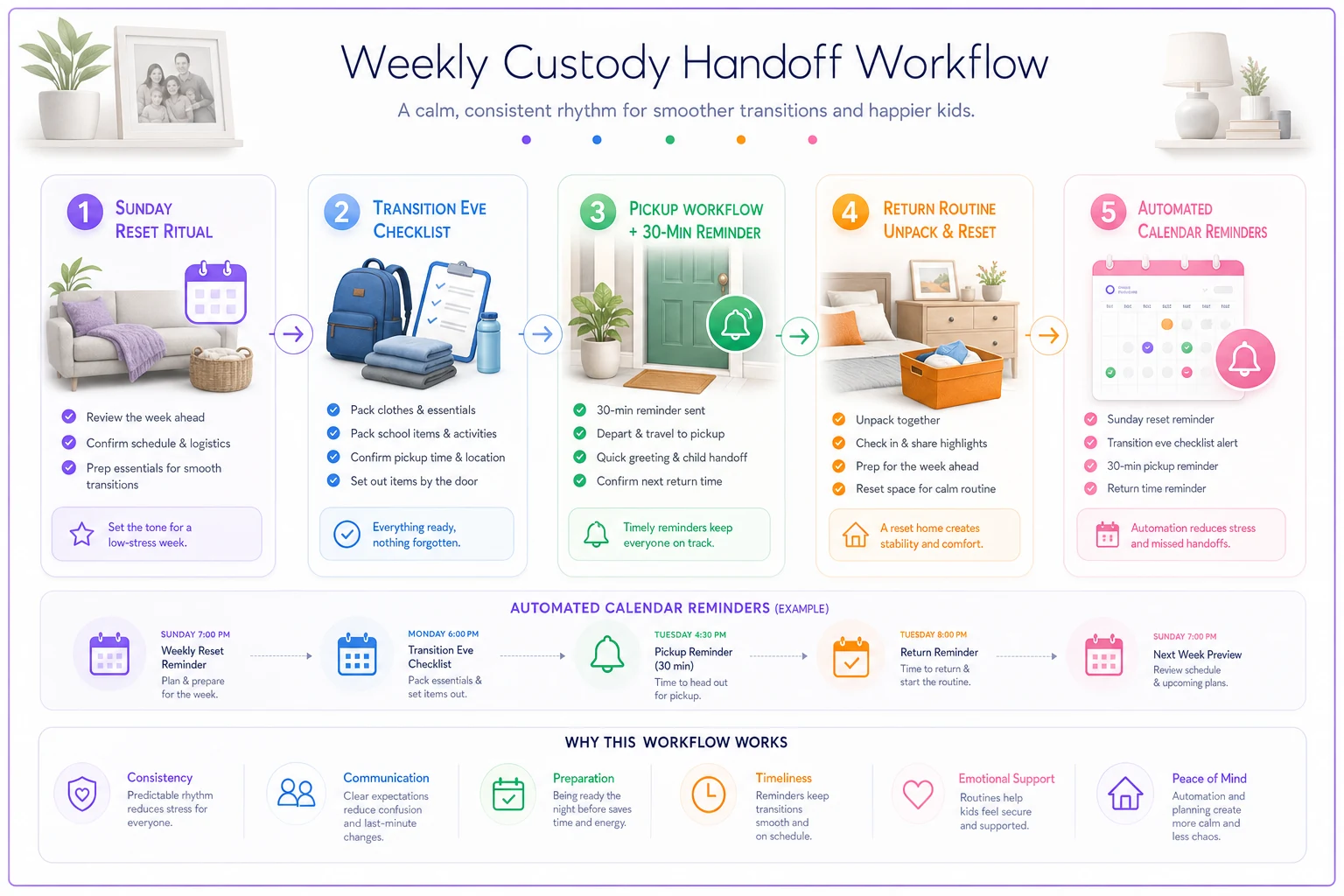
This flow highlights the recurring steps and automated reminders.
Consider how one split family in Michigan handles sports seasons. At season start, they create a gear checklist, photograph it, and share it to both phones. Each parent maintains duplicate basic items (cleats, water bottles) but specialized equipment (team uniform, expensive gear) follows the kid. Before each game, both parents get an automated reminder with the photo checklist. No discussions needed, no items forgotten.
Common handoff failures and system fixes
Common handoff failures usually follow predictable patterns. Below are typical failure points, the traditional responses families use, and system fixes that reduce effort and conflict.
| Failure Point | Traditional Response | System Fix | Effort Reduction |
|---|---|---|---|
| Forgotten medications | Angry texts, emergency delivery | Duplicate prescriptions at both houses | 90% fewer emergencies |
| Missing sports equipment | Blame, rushed shopping trips | Activity-specific bags that travel | 3 minutes vs 30 minutes |
| School forms not signed | Email arguments, deadline stress | Friday folder protocol with photos | Eliminates follow-up needs |
| Schedule confusion | Long text debates | Shared calendar with automated confirmations | No discussion required |
| Dietary restrictions forgotten | Medical scares, trust erosion | Laminated cards in handoff kit | Visual reminder every time |
| Homework left behind | Academic consequences, parent guilt | Cloud storage + homework photos | Accessible from anywhere |
The table shows how small systems reduce both effort and emotional escalation. Implementing even a few of these fixes will cut down on the most common crises.
Advanced strategies for complex situations
Some families face additional layers that standard systems can't address. Blended families with step-siblings. Long-distance handoffs requiring air travel. Special needs requiring medical equipment. High-conflict situations where direct communication isn't possible.
For blended families, create separate handoff kits for each household's children, even if they're not traveling. This prevents step-siblings' items from getting mixed into bio-kids' transitions. Use different colored bags for each family unit. It sounds excessive until you've watched a handoff delayed because step-siblings' soccer gear got packed in the wrong car.
Long-distance families need documentation systems. Create a travel binder with medical authorizations, custody agreements, emergency contacts for both locations. Use tracking apps so both parents know flight status without texting. Ship non-essential items ahead via a recurring monthly box to avoid luggage chaos.
Special needs situations require medical handoff protocols. Beyond medications, create laminated instruction cards for any equipment. Record short videos showing proper administration techniques. Maintain duplicate supplies when insurance allows. One family dealing with Type 1 diabetes created a shared glucose log accessible to both houses, eliminating dangerous information gaps.
High-conflict handoffs benefit from neutral exchange locations. Many families default to police stations, but consider alternatives: library parking lots, busy grocery stores, even fast-food restaurants with play areas. Choose locations with natural time limits and public accountability.
When professional coordination makes sense
Some families reach a point where DIY coordination isn't enough. Maybe work schedules make consistent handoffs impossible. Perhaps the conflict level makes any direct communication toxic. Sometimes the complexity simply overwhelms both parents' capacity.
Professional coordination services range from basic scheduling apps to full family management platforms. The investment often pays for itself in reduced duplicate purchases and eliminated emergency trips. More importantly, it removes the emotional labor from operational tasks.
Modern platforms handle the mundane beautifully. Automated reminders about library books. Expense splitting for shared activities. Document storage for medical records. Calendar sync across unlimited devices. These tools transform coordination from a source of conflict into background operations.
The resistance usually comes from feeling like "we should be able to handle this ourselves." But managing split custody coordination logistics while maintaining careers, potentially new relationships, and your own sanity isn't a character test. It's an operational challenge that deserves operational solutions.
Building your implementation timeline
Don't try to revolutionize everything at once. Start with the highest-pain handoff and build from there.
Week 1: Create your physical handoff kit. Just the basics – medications, one activity bag, essential documents.
Week 2: Set up shared calendars with basic schedule information. Add one automated reminder as a test.
Week 3: Implement one communication script. The weekly preview usually generates immediate improvement.
Week 4: Add the Sunday reset ritual. Twenty minutes that will save hours throughout the week.
Month 2: Expand the system. Add activity-specific bags. Create backup supplies. Develop the transition eve protocol.
Month 3: Refine based on what's actually working. Some families need more structure, others need less. Adjust accordingly.
Making peace with imperfection
No system prevents all handoff problems. Kids will still forget to mention the science project due tomorrow. Parents will still occasionally send the wrong sports bag. The goal isn't perfection – it's reducing friction enough that small mistakes don't cascade into major conflicts.
The families who thrive with split custody share one trait: they've separated operational efficiency from emotional processing. They handle logistics like a business partnership, saving emotional energy for actually parenting their children.
This shift typically happens when parents realize their kids watch every handoff. They see the stress, absorb the conflict, internalize the chaos. Creating smooth transitions isn't just about parental convenience – it's about modeling problem-solving for the next generation.
Your handoff kit won't fix the emotional complexity of divorce or separation. But it will remove unnecessary friction from an already difficult situation. When transitions become boring and predictable, everyone can focus on what actually matters: helping kids thrive across two homes.
The path forward isn't about becoming super-organized or achieving perfect co-parent communication. It's about building systems robust enough to function when you're neither organized nor communicating well.
That's when you know you've truly solved split custody coordination logistics – when the system works better than the people running it.
Ready to simplify your household management?
Join thousands of families using Famioly to save time, reduce home management stress, and keep the household running smoothly.