


The classic pantry failure isn't running out of stuff. It's running out of some stuff while simultaneously owning four bottles of soy sauce because nobody knew the other person already bought one. Two people shop. Neither checks. You end up overstocked on the fun impulse buys and bone-dry on the boring essentials nobody wants to be responsible for.
This is a coordination problem wearing a grocery costume. And it's fixable with a surprisingly small amount of structure — no app subscription required unless you want one.
Why duplicate buys actually happen (it's not forgetfulness)
No shared source of truth. The inventory lives in one person's head. The moment a second person shops independently, duplicates are inevitable because they're guessing.
No restock trigger. People restock based on vibes — "feels like we're low on coffee." Vibes are wildly inconsistent. One person panics at half a bag, another waits until the literal last scoop.
No owner per category. When everyone is responsible for paper towels, nobody is. Shared responsibility with no assigned owner is the single most reliable way to run out of the thing everyone assumed someone else was watching.
A typical example looks like this: a four-person household where the parent who does Costco runs buys in bulk on a 3-week rhythm, and the other parent does midweek top-ups. Without a shared list, the midweek shopper buys rice because the pantry looks low — not knowing 20 pounds of it is arriving Saturday. Now there's 28 pounds of rice and still no dish soap.
The pattern is almost always the same: overstock on visible items, stockout on invisible ones. Dish soap, trash bags, batteries, dog food — the usual casualties, because they live out of sight.
The three pieces that make a shared pantry inventory system work
You don't need to track every single item. Tracking everything is why most inventory systems die within two weeks — it becomes a chore nobody maintains. You track the restock-sensitive items and ignore the rest.
Stop losing track of household duties.
Famioly helps you organize, assign & complete family tasks efficiently.
- Centralized task management
- Shared family calendar
- Budget & expense tracking
No credit card required
-
A shared list everyone can see and edit (the source of truth)
-
Restock triggers (the rule that decides when something goes on the buy list)
-
An owner per category (one name responsible for each zone)
That's it. Everything else is decoration.
Here's a simple workflow for the system.
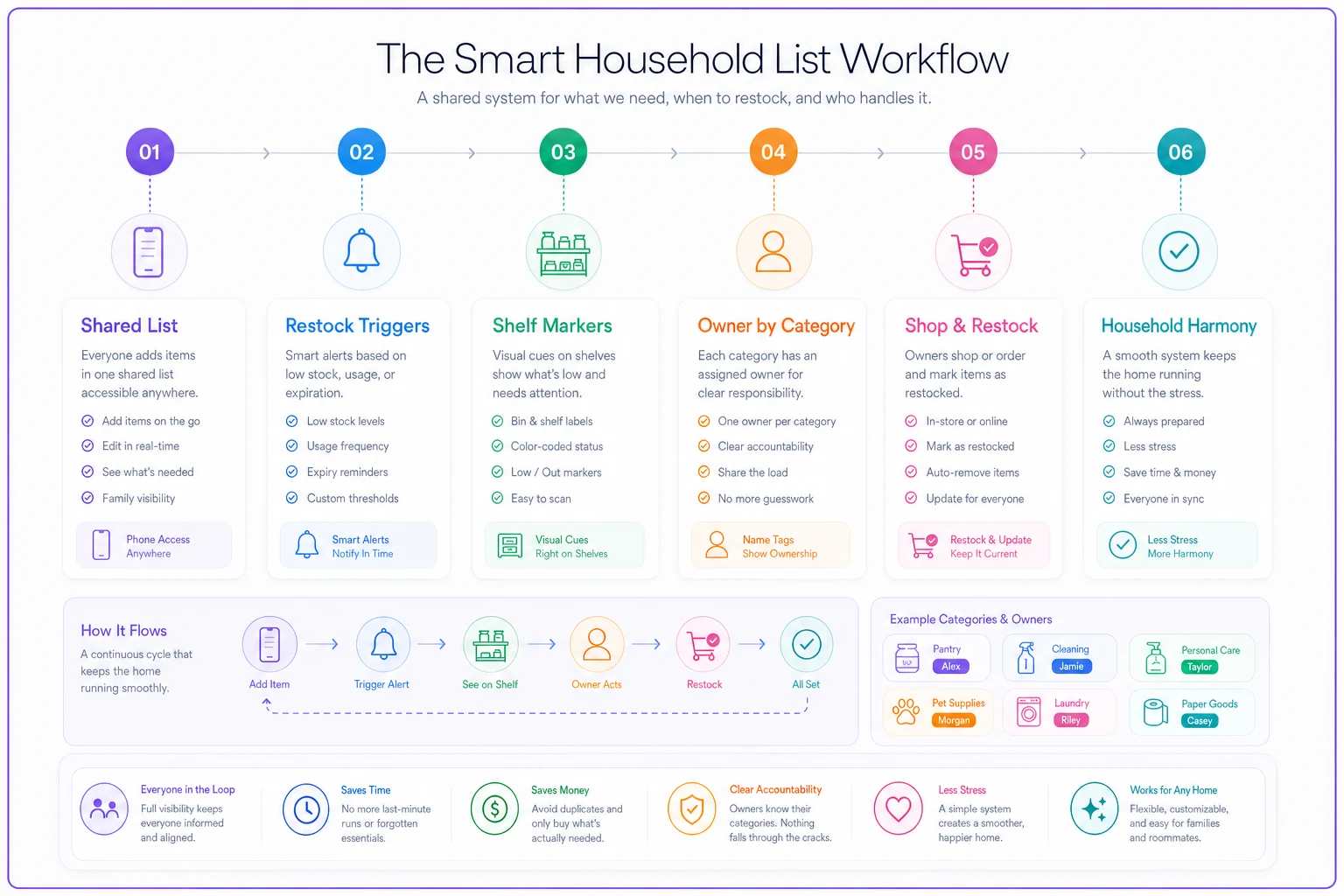
Piece 1: The shared list
The list should live somewhere both shoppers can reach from their phone in a store aisle. A shared note, a Google Sheet, a family app — the tool matters far less than the discipline of one list, not five.
Here's the minimum structure. Don't add columns until you've felt the pain of missing one.
| Item | Category | Owner | Restock trigger | Par level | On list? |
|---|---|---|---|---|---|
| Coffee beans | Breakfast | Dad | 1 bag left | 2 bags | Yes |
| Dish soap | Cleaning | Mom | 1 bottle left | 2 bottles | No |
| Paper towels | Cleaning | Mom | 2 rolls left | 6 rolls | No |
| Kids' snack bars | School | Mom | 1 box left | 3 boxes | Yes |
| Dog food | Pets | Dad | 1 week supply | 1 bag backup | No |
| Olive oil | Cooking | Dad | Opening last bottle | 2 bottles | No |
The par level is your target "full" amount. The restock trigger is the point where it goes on the list. The gap between those two is your buffer — big enough that you never hit zero, small enough that you're not hoarding.
Piece 2: Restock triggers that remove the guessing
A trigger converts "feels low" into "is on the list." The best triggers are physical and obvious so anyone in the house — including a teenager — can act on them without making a judgment call.
Good triggers look like:
-
"Open the backup = add to list." The moment you crack open your last sealed bottle of olive oil, it goes on the list. You're never actually out.
-
"Below the line." Draw a literal marker line on a bin or shelf. Below the line, add it.
-
"Count rule." Two rolls of paper towels left = add. Not one. Two.
-
"Time rule" for predictable burn items. Dog food gets added every 3 weeks regardless, because consumption is steady.
The mistake people make is setting the trigger at zero. If your trigger is "we're out," you've already failed — now someone makes an emergency trip or pays convenience-store prices. Every trigger should fire while you still have a comfortable buffer.
Piece 3: One owner per category
Assign a human name to each category. Not "whoever notices." A name.
The owner isn't necessarily the one who buys it — they're the one accountable for making sure it never hits zero. They watch the triggers for their zone. If paper towels run out, that's a known person's miss. That sounds harsh, but it's exactly what makes the system hold. Accountability with a name attached gets maintained. Shared accountability evaporates.
A clean split for a two-adult household might look like:
-
Mom cleaning supplies, kids' school snacks, bathroom stock
-
Dad cooking staples, coffee/breakfast, pet supplies
-
Rotating/kid chore checking the fridge produce and flagging what's going bad
This maps onto the broader idea of visible ownership that keeps household mental load from collapsing onto one person. When the same person silently tracks everything, they burn out and the system has no backup.
Setting cadences: weekly vs. monthly restock rhythms
Not everything moves at the same speed, and forcing one cadence onto all items is where systems get clunky. Split your inventory into two buckets.
Weekly cadence — fast-burn, perishable, or school-driven items:
-
Milk, bread, produce, eggs
-
Kids' lunch/snack supplies
-
Fresh proteins
These get a 5-minute check before the main weekly shop. Walk the fridge and the snack shelf, glance at triggers, update the list.
Monthly (or ~3-week) cadence — bulk and slow-burn items:
-
Paper goods, cleaning supplies
-
Pantry staples (rice, pasta, oil, canned goods)
-
Pet food, batteries, light bulbs
-
Toiletries and bathroom stock
These get one slightly longer check per month, timed to the bulk-store run.
The part people miss: the two cadences should share one list but fire at different times. You don't want your monthly paper-goods check cluttering your weekly produce run. Tag each item with its cadence so the weekly shopper only sees weekly items.
-
Sunday (weekly) 5-minute fridge + snack check. Weekly triggers go on the list.
-
Shop Monday off that list.
-
First Saturday of the month (monthly) 10-minute pantry + cleaning + pet check. Monthly triggers go on the list.
-
Bulk run that weekend off the monthly list.
-
Midweek top-up (as needed) whoever shops only buys what's on the list. Nothing else gets restocked on a hunch.
Rule five is the one that kills duplicate buys. If it's not on the list, you don't buy a backup — even if it looks low. If it looks low and isn't on the list, the trigger hasn't fired yet, which means you still have buffer. Trust the system over the eyeball.
A quick checklist to set this up in one sitting
You can stand this up in about 30–40 minutes on a weekend:
-
- [ ] List the 15–25 items your household actually runs out of or over-buys. Ignore everything else.
-
- [ ] Assign each a category (cleaning, breakfast, cooking, school, pets, bathroom).
-
- [ ] Give each category a single owner by name.
-
- [ ] Set a par level (your "full" target) for each item.
-
- [ ] Set a physical restock trigger for each — a count, a line, or an "open-the-backup" rule.
-
- [ ] Tag each item weekly or monthly.
-
- [ ] Put the list somewhere both shoppers can edit from a phone.
-
- [ ] Agree on the one hard rule
not on the list = not bought.
You're only tracking 15–25 items, not your whole kitchen. Trying to inventory everything is the fastest route to abandonment. The 20 items that cause 90% of your duplicate-buy and stockout pain are the only ones worth the effort.
A real scenario
A blended household of five — two working parents, three kids across elementary and middle school — was spending noticeably more on groceries than the size of their family explained. Two adults shopped independently: one did a big weekend run, the other grabbed things midweek on the way home from work.
The damage showed up in both directions. Duplicates piled up on condiments, pasta sauce, and snack bars — stuff easy to grab "just in case." Meanwhile they'd run out of dish soap and trash bags often enough that someone was making corner-store runs at roughly double the price a couple times a month.
They set up the three-part system over a Sunday afternoon: a shared sheet, triggers on about 20 items, and a clean owner split — cleaning and school snacks to one parent, cooking, pet, and breakfast to the other. The hard rule — nothing bought off-list — was the part they almost skipped because it felt too rigid.
Within a couple months the duplicate pile basically disappeared, and the convenience-store runs dropped to nearly none. Their rough estimate was somewhere around $60–90 a month in avoided waste and markup. Not life-changing, but a steady leak they'd been paying for years. The quieter win was no more mid-week "do we have…?" texts, because the list answered it.
When this is worth it — and when it isn't
This makes sense when:
-
Two or more people shop for the same household
-
You've caught yourself with duplicates and stockouts in the same week
-
Someone is quietly carrying all the mental tracking and it's getting old
This is overkill when:
-
You're a one-person household with a single shopper — the list already lives in one consistent head, and a simple running note is enough
-
Your household genuinely doesn't run out of or over-buy anything, in which case your current system is fine and you should leave it alone
Who should skip the full version: anyone whose instinct is to track all 200 pantry items. You'll build an elaborate spreadsheet, maintain it for ten days, and quit. Start with the 20 painful items only. Add more once the habit sticks.
Keeping it alive
Most pantry systems don't fail at setup. They fail at maintenance — the triggers stop getting checked, the list goes stale, and within a month you're back to guessing in the aisle.
Two things keep it going. First, the checks have to be fast and scheduled — 5 minutes weekly, 10 minutes monthly, tied to a time you're already shopping. Second, the owner-by-name structure means a stockout has a clear place to land, which keeps people honest about their zone.
If you want to automate the reminders — low-stock alerts, a recurring pantry-check nudge, or a shared list that updates for everyone at once — a lightweight household app with shared lists and recurring triggers can carry the checking cadence so you're not relying on memory. But that's a convenience layer, not the system itself. The system is three things: one shared list, clear triggers, and a name on every category. Get those right on a free spreadsheet and you've already solved the duplicate-buy problem.
Ready to simplify your household management?
Join thousands of families using Famioly to save time, reduce home management stress, and keep the household running smoothly.