


The clothing swap sneaks up on every family the same way. One morning your six-year-old's pants stop at the ankle, the mornings turn cold, and suddenly you're pulling bins out of the garage that haven't been touched since March. Nobody remembers what's in them. Half of what's in there doesn't fit anymore. And the "keep for the little one" pile from last year has somehow migrated into three different closets.
Kids wardrobe seasonal rotation is one of those household tasks that looks trivial and turns into a five-hour ordeal twice a year — not because folding clothes is hard, but because there's no system underneath it. The bins aren't labeled in a way that survives a year of memory decay. Sizes get mixed. The hand-me-down flow between siblings is undocumented, so clothes that should have moved down a kid instead get donated or lost. This piece is about building the small amount of structure that makes the swap boring and fast instead of a whole project.
Why the swap balloons into a weekend
The core problem isn't the clothes. It's that a seasonal swap quietly bundles together four separate decisions, and most families try to make all four at once, on the floor, surrounded by piles.
-
Does this still fit this kid?
-
If it doesn't fit, does it go down to a younger sibling, get stored, sold, or donated?
-
Where does it physically go, and how do I find it again in six months?
-
What's now missing from the current-season wardrobe that I need to buy?
When you tackle all four at once, every single garment becomes a fresh decision. Multiply that by two or three kids and a couple hundred items, and you've built yourself a full afternoon of micro-decisions. The mental fatigue is real — by hour two, people start making sloppy calls, tossing keepers, or worse, shoving everything back "to deal with later," which means the whole thing repeats next season.
Families who breeze through the swap have quietly separated these decisions in advance. The fit check happens in one pass. Storage happens in another. Shopping gaps get written down, not decided emotionally in the moment. The system does the sorting so the person doesn't have to.
The labeling rules that actually survive a year in storage
Most storage labels fail because they describe the bin at the moment you packed it, not the moment you'll open it. "Winter clothes" tells you nothing useful in October. You need labels that answer the question you'll actually be asking when you're standing in the garage at 7am: which kid, what size, what season.
Stop losing track of household duties.
Famioly helps you organize, assign & complete family tasks efficiently.
- Centralized task management
- Shared family calendar
- Budget & expense tracking
No credit card required
-
Size first, not name. Label by size range (e.g., "3T–4T") rather than by child. Sizes flow down to younger siblings; names don't. A bin labeled "Ethan's stuff" is useless once it's Nora's turn.
-
Season second. "Cold" vs. "Warm" is enough. Don't overthink shoulder-season items — put them wherever the kid will reach for them first.
-
A one-line contents note. Not an inventory. Just the outliers worth remembering: "3T–4T Cold — incl. snow bibs + 2 heavy coats." The coats and boots are what you'll be hunting for.
-
Date packed. A small thing that saves you later — if a bin's been sealed for two years untouched, that's your signal it's donation material.
Masking tape and marker labels fall off or fade in garage humidity. The families whose systems last use either laminated index cards zip-tied to the handle, or a plastic label slot on the bin. It sounds fussy until you've re-opened four mystery bins looking for one pair of snow boots.
Zip a laminated index card to the handle or use a plastic label slot so labels survive garage humidity and handling.
One more rule that quietly prevents chaos: one size range per bin, never mixed. The temptation to combine "the last of the 2T and the start of the 3T" into one bin feels efficient in the moment and destroys the whole system. When a bin holds two sizes, you have to open and re-sort it every single rotation. Keep them clean.
The hand-me-down flow, written down as an actual path
The reason hand-me-downs get lost isn't sentiment — it's that the flow lives entirely in one parent's head. There's a mental map of "this goes down to the middle kid, this we're saving in case, this we promised to my sister" and none of it is documented. So when the swap happens under time pressure, the map gets ignored and everything defaults to either "keep" or "donate."
A hand-me-down flow is just a small set of routing rules decided once, not per-garment:
| Item condition / type | Default destination |
|---|---|
| Good condition, will fit a younger sibling within ~2 years | Storage bin, sized + labeled |
| Good condition, no younger sibling or gap too big | Sell / gift pile |
| Worn but functional (play clothes, stained tees) | Keep as a small "messy play" reserve, then donate |
| Damaged, stretched, pilled | Trash or textile recycling — not donation |
| Sentimental / milestone items | Separate keepsake box, capped at one box per kid |
The keepsake cap matters more than it looks. Without a hard limit, sentimental storage grows every year until half your bins are "the outfit they came home in." One box per kid, and it's full when it's full.
The part most people skip: the flow needs a trigger point, not just rules. Clothes should move out of the outgrown kid's closet the moment they're outgrown, not accumulate until the seasonal swap. A simple "outgrown basket" in each kid's room that empties into the sorting flow every few weeks means the twice-a-year event is mostly storage logistics, not archaeology.
A quick visual helps get everyone on the same page.
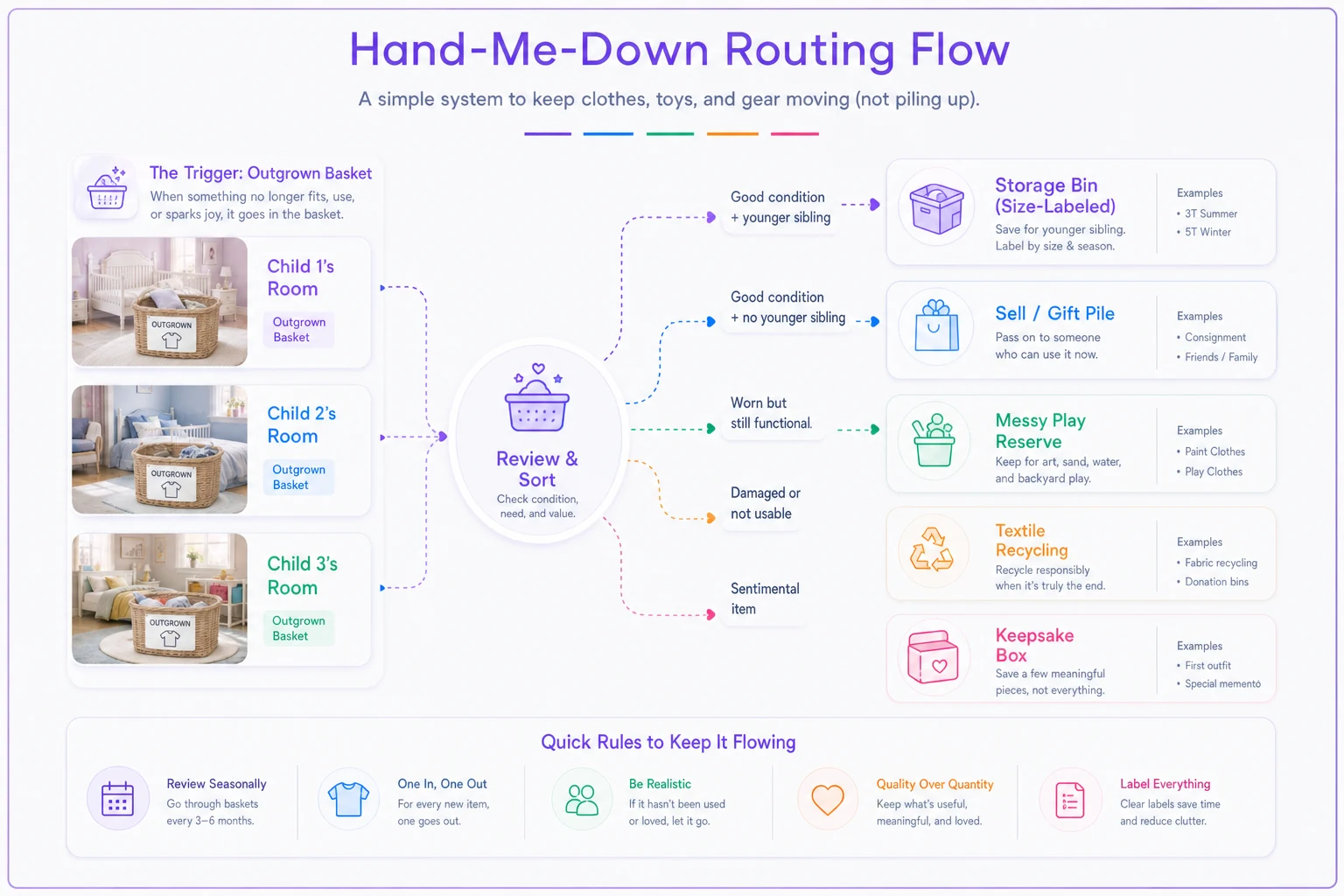
Clothes should move out of the closet as they're outgrown, not sit until the big swap — that small trigger point is what keeps the seasonal work minimal.
Assigning owners so it isn't one person's job forever
In most households the wardrobe swap silently belongs to one parent, and that person carries the entire mental load — sizes, gaps, who gets what. That's the real reason it feels heavy. It's not the labor; it's being the single point of failure for a hundred small decisions.
-
The Fit Checker does one fast pass per kid
try-on or eyeball, in-pile or out-pile. That's it. No decisions about destination.
-
The Sorter takes the out-pile and routes it using the hand-me-down table above. No emotional debate — the rules already decided.
-
The Storer labels and shelves bins, and updates wherever the family tracks what's in storage.
-
The Shopper takes the gap list (what's missing for the current season) and handles buying — ideally spread over a couple weeks, not one panicked cart.
Older kids can genuinely own the Fit Checker role for themselves by around eight or nine. "Try this on, keep or outgrown pile" is a task a nine-year-old can handle without supervision, and it removes a surprising amount of parental load.
Putting decision rights and clear roles somewhere visible rather than letting everything default to one person — that same logic applies cleanly to the clothing swap.
A real scenario: three kids, two swaps, and the weekend they got back
A household with three kids — ages 9, 6, and 3 — was losing most of a Saturday to each seasonal swap, roughly twice a year, plus a scramble of last-minute shopping when they realized the middle kid had no long-sleeve shirts that fit. Call it four to five hours per swap, plus a stressful $150-ish emergency buy each time because they had no idea what was already in storage.
The fix wasn't complicated. They set up an outgrown basket in each room, switched to size-first labeling on clear bins, and wrote the hand-me-down routing table on an index card taped inside the storage closet door. They split the roles: one parent as Fit Checker and Storer, the other as Sorter and Shopper, with the 9-year-old handling her own fit check.
The next spring swap took a little over 90 minutes. Because the outgrown baskets had been feeding storage all year, most of the work was already done — the bins just needed to move. The emergency shopping problem mostly disappeared too; they walked into the season already knowing the 6-year-old had a full stored set of cold-weather clothes waiting.
Not a dramatic transformation. Just a chore that stopped hurting.
Where a shared system beats one person's memory
The labeling and routing rules are the backbone, but they lean on one fragile thing: everyone remembering what's actually in storage. That's where most systems quietly break — the bins are labeled fine, but only one parent knows the 4T cold-weather bin exists, so the other one buys duplicates anyway.
Keeping a lightweight shared record of what's in storage — something the whole household can check before shopping — is what closes that loop. It doesn't need to be fancy. A shared note, a photo of each bin's contents, or a household management platform where the storage inventory and seasonal rotation reminders live together all work fine. The point is that the knowledge stops living in one head. When anyone can glance at what's stored before hitting checkout, the duplicate spending and the "wait, where's the snow gear" panic both go away.
When this level of system is overkill
If you've got one kid and no plans for hand-me-downs, most of this is unnecessary — a couple labeled bins and a donation pile will do. The routing table earns its keep specifically when clothes need to flow between kids over years, or when more than one adult shares the load and needs the same picture.
It's also worth not over-engineering the sentimental side. If tracking every outfit and building a detailed inventory turns into its own chore, you've recreated the problem you were solving. The whole point is fewer decisions per season, not a new hobby. Build the smallest version that survives a year in the garage, then leave it alone.
The takeaway
The seasonal clothing swap feels heavy because it stacks four different decisions into one exhausting afternoon and puts the whole thing on one person's memory.
Separate the decisions, label bins by size so clothes can flow down, write the hand-me-down routing once instead of debating it per garment, and split the roles so no single person owns it all. Do that, and the twice-a-year swap stops being a weekend event and becomes a short, boring, repeatable task — which is exactly what you want it to be.
The seasonal clothing swap feels heavy because it stacks four different decisions into one exhausting afternoon and puts the whole thing on one person's memory.
Ready to simplify your household management?
Join thousands of families using Famioly to save time, reduce home management stress, and keep the household running smoothly.