


The person running a household usually isn't exhausted because of the tasks themselves. Emptying the dishwasher takes four minutes. Booking a dentist appointment takes six. What wears people down is the tracking — the constant background hum of remembering that the field trip form is due Thursday, the dog is out of his special food, the water filter light has been blinking for two weeks, and someone needs to RSVP to that birthday party before spots fill up.
That's the mental load. And even when tasks do get delegated, the tracking rarely goes with them. You ask your partner to "handle groceries," but you're still the one who notices when the milk is low, builds the list in your head, and reminds them Saturday morning. You delegated the doing. You kept the thinking. That's not delegation — that's just handing someone a to-do item while quietly holding onto the entire management job yourself.
This article is about fixing that specific gap — using concrete rituals and visible lists to transfer the cognitive part of household work, not just the physical part. The goal around reduce household mental load delegation rituals isn't a prettier chore chart. It's making the invisible work visible enough that other people can actually own it.
Why "just ask for help" doesn't reduce the load
Most advice gets this wrong. When people say "I need more help around the house," they usually get offered labor. Their partner says "just tell me what to do." That sounds generous, but it quietly reinforces the whole problem — now you're the dispatcher. You hold the master list in your head and hand out tasks like a manager assigning tickets.
The load lives in three layers, and most families only ever delegate the top one:
| Layer | What it involves | Who usually owns it |
|---|---|---|
| Execution | Doing the actual task | Whoever's asked |
| Tracking | Noticing when it's needed, remembering it | The primary manager |
| Ownership | Deciding it's done right, catching what's missing | The primary manager |
When only the execution layer moves, the manager stays permanently on call. This is why someone can delegate half the chores in the house and still feel completely fried. The two heavier layers — noticing and owning — never actually left their head.
The fix isn't trying harder to ask for help. It's building rituals that force the tracking and ownership to transfer along with the task. That mostly comes down to two things: making the work visible so it lives somewhere other than your brain, and creating handoff moments so ownership actually changes hands on a schedule.
Make the work visible first, before you delegate anything
You can't hand off what nobody else can see. This is the step people skip, and it's why chore charts fail within a few weeks — they list execution ("vacuum living room") but not tracking triggers ("vacuum when the rug looks visibly crumby, minimum once a week, Sunday default").
Stop losing track of household duties.
Famioly helps you organize, assign & complete family tasks efficiently.
- Centralized task management
- Shared family calendar
- Budget & expense tracking
No credit card required
A visible list only works when it captures the trigger and the definition of done, not just the verb. Compare these two versions of the same responsibility:
-
Weak "Take care of the plants."
-
Actually transferable "Check soil on the six indoor plants every Sunday. Water the ones that are dry an inch down. The fern by the window dies fast, so it usually needs it. Fertilizer once a month, bottle's under the sink."
The second one moved the knowledge out of your head. That's the whole point. In practice, the trick is spending one afternoon doing a brain-dump — literally writing out every recurring thing you currently track mentally, including the annoying small stuff nobody thinks about (batteries in the smoke detector, the recycling schedule, which kid needs new shoes soon). Most households discover they're tracking somewhere between 40 and 70 recurring items that nobody ever wrote down.
Once it's written, it can live on a shared board, a shared app, a whiteboard on the fridge — the medium matters way less than people think. What matters is that it's outside your head and anyone can look at it without asking you.
The one rule that makes visible lists actually work
Every item needs a named owner. Not "the family," not "whoever's free." A name. Shared ownership is how things fall through the cracks — if the trash is "everyone's job," it's nobody's job, and you end up being the fallback for everything by default. A visible list with an unassigned item is just a list of things you'll eventually do.
The daily handoff: a two-minute ritual that stops the drip
Weekly meetings get all the attention, but the daily mental load is death by a thousand small updates. The kid mentioned a permission slip. Someone used the last of the coffee. The plumber's coming Tuesday. These land on the manager throughout the day and pile up.
A short daily handoff catches them before they become your problem to remember. Keep it stupidly short — under two minutes, same time every day, ideally after dinner or before bed. It's not a meeting. It's a status check.
-
What broke or came up today — anything new that needs tracking (a form, a low-supply item, a schedule change).
-
What's owned for tomorrow — each person states the one or two things they're carrying, out loud. Saying it is what transfers ownership.
-
What's stuck — anything someone started but can't finish alone, so it gets reassigned now instead of silently failing.
The magic isn't the information itself. It's that saying "I've got the pediatrician call tomorrow" out loud makes it theirs, and it's off your plate mentally. Families who do this consistently stop having the 9pm "wait, did anyone deal with—" conversations, because those items already got named and owned hours earlier.
Tie the handoff to an existing routine (after dinner or before bed) so it reliably happens without extra coordination.
Families who do this consistently stop having the 9pm "wait, did anyone deal with—" conversations, because those items already got named and owned hours earlier.
The weekly reset: where ownership actually rotates
The daily handoff keeps the drip under control. The weekly reset is where you rebalance the bigger load and prevent slow drift back to one person carrying everything.
Pick a consistent 15–20 minute slot — Sunday evening is common because it sets up the week. A structure that holds up:
-
Review last week's list — what actually got done, what slipped. No blame, just facts. Slipped items usually reveal where the trigger or the owner was wrong.
-
Look at the week ahead — appointments, events, anything unusual (a late work night, a visiting relative, a day off school).
-
Assign or confirm owners for the week's recurring tasks and one-offs. This is the actual handoff — ownership visibly changes hands here.
-
Swap something on purpose. Rotate at least one recurring responsibility so no single person becomes the permanent expert on any one thing.
That last step matters more than it looks. When the same person always handles the finances, or always books the appointments, they rebuild a private mental load around it — and you're right back to invisible tracking, just with a different name attached. Deliberate rotation keeps the knowledge shared. If your household leans heavily on structured meetings, a lot of these mechanics overlap with running any tight recurring family sync, and the "close the loop before you leave the table" discipline is the same skill.
A quick visual of the weekly reset workflow can make it easier for everyone to see the handoff steps.
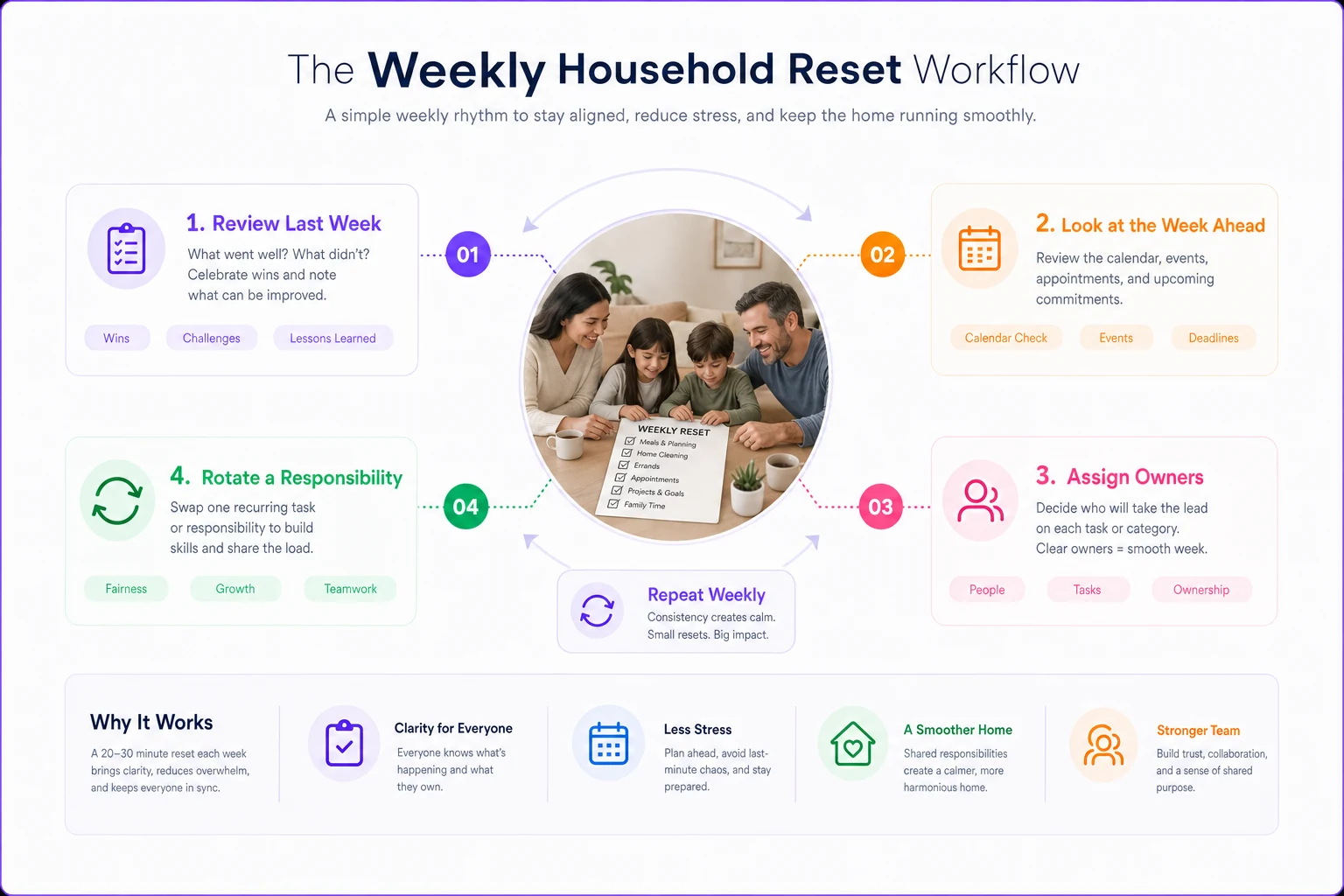
The weekly reset is where ownership visibly changes hands, and doing it consistently stops slow drift back to one person.
Delegation scripts that actually move ownership
The words matter more than people expect. "Can you help with dinner?" keeps you in charge. "You own dinner Tuesdays and Thursdays" transfers the whole thing — including deciding the menu, checking ingredients, and dealing with the kid who won't eat it.
Some scripts that transfer the full stack instead of just the task:
-
Full handoff "Starting this week, the school forms are yours. That means checking the backpack, filling them out, and getting them back by the deadline. I'm out of that loop entirely — flag me only if something's genuinely stuck."
-
Trigger-based "When the laundry basket in the hall is full, that's the signal to run a load. You don't need me to tell you. The basket tells you."
-
Escalation-only "You've got the car maintenance. I don't want updates unless it's over $400 or the car isn't drivable — then loop me in."
The through-line in all of these: you're explicitly stating "I'm out of the loop." That sentence is the actual transfer. Without it, people default to checking back with you, and checking back with you means you're still tracking. If you never say you're out, you never are.
A real scenario: the household where one parent tracked everything
A two-working-parent household with three kids (ages 6, 9, and 12) hit a wall. One parent had quietly become the operating system for the entire home — somewhere north of 50 recurring items running through her head at any given moment, from orthodontist appointments to which kid had outgrown their cleats. She wasn't doing all the work, but she was tracking all of it, and the constant low-grade overwhelm was leaking into everything else.
They didn't add more tasks to anyone. They ran the brain-dump, got everything onto a shared visible list with named owners, and started a two-minute nightly handoff plus a Sunday reset. The kids took on a few age-appropriate trackable items — the 12-year-old owned pet feeding and the recycling schedule, triggers and all.
The change wasn't dramatic on paper. The same tasks still needed doing. But within about a month, the number of things living only in her head dropped from 50-plus down to maybe a dozen genuinely shared decisions. The 9pm scramble mostly disappeared. Her partner started catching things independently because the list surfaced them without anyone having to mention it. The reported difference wasn't "more free time" — it was the mental quiet of not being the only person who knew what needed to happen next.
When this works, and when it doesn't
This works well when there's more than one capable person in the house and the real problem is tracking, not labor. It works especially well in homes where one person has drifted into being the default manager without anyone consciously deciding that.
This is a bad fit when you genuinely are the only adult and there's no one to transfer to — a single parent with young kids can't delegate ownership to a 4-year-old. In that case visible lists still help (they get the load out of your head and onto paper), but the daily handoff mostly becomes a solo planning habit, which is fine but different.
Who should skip the heavy version: households already running smoothly with informal habits. If nobody feels overloaded, don't impose ceremony on a system that works. The rituals are a fix for a specific pain, not a virtue in themselves. Over-engineering a calm household just creates a new chore — maintaining the system.
Where software fits, lightly
None of this requires an app. A fridge whiteboard and a spoken nightly check will get you most of the way there. That said, the tracking layer is exactly where a household management platform earns its keep — not by doing the tasks, but by holding the visible list, remembering the recurring triggers, and pinging the right owner automatically so nobody has to be the human reminder engine.
The useful role for AI-powered operational software here is narrow and honest: surfacing what's due to the person who owns it, catching recurring items before they slip, and keeping the master list current without one person maintaining it by hand. That handles the noticing layer — the one that's hardest to transfer between people — so the manager isn't quietly reabsorbing the tracking they just tried to hand off.
The point isn't to automate your family. It's to stop one person's brain from being the only place the household's operating knowledge lives. A platform that does that well mostly just disappears into the background, which is exactly what good operational infrastructure should do.
The real shift
Reducing the mental load isn't about doing less. It's about being the only person who knows less — spreading the knowing, the noticing, and the owning across everyone capable of carrying a piece of it. Visible lists get the knowledge out of your head. Daily handoffs keep the small stuff from re-accumulating there. Weekly resets rebalance who carries what before it silently drifts back.
Start with the brain dump. Get everything onto paper this week, assign a real name to each line, and run one two-minute handoff tonight. You're not building a system for its own sake — you're building the one thing that lets you stop being the household's memory. That's the load that actually lifts.
Start with the brain dump. Get everything onto paper this week, assign a real name to each line, and run one two-minute handoff tonight. You're not building a system for its own sake — you're building the one thing that lets you stop being the household's memory. That's the load that actually lifts.
Ready to simplify your household management?
Join thousands of families using Famioly to save time, reduce home management stress, and keep the household running smoothly.