



The hardest part of merging a household isn't dividing the dishes. It's that one person already has a running system in their head — who handles the pediatrician, when the trash goes out, which card pays the daycare bill — and the other person is walking into a machine that's already mid-cycle. Nobody wrote the rules down because nobody needed to. They just lived them.
That gap is where resentment grows. Not from laziness, not from bad intentions. It builds because the new person keeps "getting it wrong" against standards they were never told about, and the established person slowly turns into a frustrated manager correcting everything. Six weeks in, one of them is doing 70% of the work and the other feels like a tenant.
This is a 30/60/90 structure specifically for onboarding a new household member's routines — a partner moving in, or two homes becoming one — with responsibility mapping, negotiation checkpoints, and a few short scripts you can actually say out loud when something needs to be re-split without it turning into a fight.
Why "we'll just figure it out" quietly fails
The default plan for most couples merging a home is no plan. You move the boxes in, you divide the closet, and assume the rest sorts itself out because you're both adults.
Here's the pattern that actually plays out. For the first few weeks, the newer person defers. They don't know the systems, so they wait to be told, or they handle visible tasks — cooking, taking out trash — while the invisible load stays entirely with the original household manager. The dentist appointment, the kid's allergy med refill, the fact that the plumber prefers texts — none of that transfers automatically.
-
The work is invisible, so it's uncredited. The person tracking refills and renewals gets no acknowledgment because nobody can see a task that lives only as a reminder in someone's brain.
-
Standards are unspoken. "Clean kitchen" means wiped counters to one person and emptied-and-reset to the other. The gap reads as carelessness.
-
Correction replaces negotiation. Instead of agreeing on who owns something, the established person just keeps fixing it afterward — which feels like nagging to one side and like doing two jobs to the other.
None of this is a character problem. It's an onboarding problem. You wouldn't expect a new hire to run payroll on day two with no documentation, but we expect new partners to intuit a household they've never operated.
The real cost of skipping the handoff
Resentment compounds the way interest does — slowly, then all at once. A missed field-trip form here, a double-booked Saturday there, a "why am I the only one who notices the toilet paper's gone" moment. Individually trivial. Together they become the story each person tells about the relationship.
Stop losing track of household duties.
Famioly helps you organize, assign & complete family tasks efficiently.
- Centralized task management
- Shared family calendar
- Budget & expense tracking
No credit card required
Consider a realistic merge: a parent with two kids (ages 7 and 10) and a partner moving in. Before the move, the parent was handling roughly 40–45 recurring household responsibilities solo — school comms, two activity schedules, meal planning, bills, pet care, medical tracking. After the move, the partner takes over visible cooking and some cleaning, maybe 8–10 tasks. On paper, help arrived. In practice, the parent is still carrying 35 invisible items plus now coordinating and correcting the new person.
The one who was supposed to get relief feels more managed, not less. That's the trap. The fix isn't working harder at living together — it's treating the first 90 days as a deliberate handoff with checkpoints, not a vibe.
The 30/60/90 structure at a glance
The framework below breaks the merge into three phases, each with a specific goal. The phases build on each other — you can't meaningfully transfer ownership in phase two if you haven't surfaced the full list in phase one. Worth reading through before you start so the sequencing makes sense.
| Phase | Primary goal | What's being negotiated | Biggest risk if skipped |
|---|---|---|---|
| Days 1–30 | Make the invisible visible | Nothing yet — just surfacing every task and the standard behind it | New person guesses at rules and "fails" against them |
| Days 31–60 | Transfer ownership, not just tasks | Who owns each area end-to-end vs. who just helps | Help stays shallow; original manager still carries the mental load |
| Days 61–90 | Rebalance and lock in | Fairness adjustments once reality is visible | Early splits that felt fair on day 20 quietly ossify into resentment |
The key idea running through all three phases: you're not dividing chores, you're transferring ownership. "Help with laundry" keeps the mental load on one person. "You own laundry" means noticing it's piling up is now your job, not something you wait to be told about.
A good way to think about the overall arc: phase one is archaeology, phase two is transfer, phase three is calibration. Each phase has one job. Don't rush phase one to get to the assignment part — the assignment only works if the full list exists first.
Days 1–30: Surface everything before you divide anything
The mistake almost everyone makes is jumping straight to splitting tasks on week one. You can't fairly divide a list you haven't written down, and most of the list lives in one person's head.
The first 30 days have one job: get every recurring responsibility out of someone's brain and onto a shared surface — a note, a whiteboard, a doc, whatever both people will actually open. Not to assign yet. Just to see the real scope.
-
- [ ] Every recurring bill, what card or account pays it, and the due date
-
- [ ] Each kid's school contacts, portal logins, and who's the "primary contact" on file
-
- [ ] Standing activity schedules and the driving that goes with them
-
- [ ] Medical
doctors, dentists, refill cadences, insurance quirks
-
- [ ] The "I'm the only one who notices" list — refills, running low, renewals, batteries
-
- [ ] Vendor relationships and their preferences (the plumber who texts, the housekeeper's day)
-
- [ ] The weekly rhythm
trash days, laundry cadence, meal planning, groceries
-
- [ ] Standards that aren't obvious — what "done" actually looks like for the big recurring tasks
That last bullet is the one people skip and regret. If "kitchen cleaned" secretly means dishwasher run and counters reset, write it down. Unspoken standards are the single biggest source of early friction, because the new person keeps completing tasks that don't count as complete.
Negotiation checkpoint at day 30: Sit down and read the list together. No assigning yet. The goal of this meeting is for the new person to say "I had no idea you were tracking all of this" and for the established person to feel seen. That acknowledgment does more for preventing resentment than any split.
> "I'm not trying to dump tasks on you. I want to show you everything that's currently in my head so we can actually decide together who takes what — because right now you can't take anything you don't know exists."
Days 31–60: Transfer ownership, not just tasks
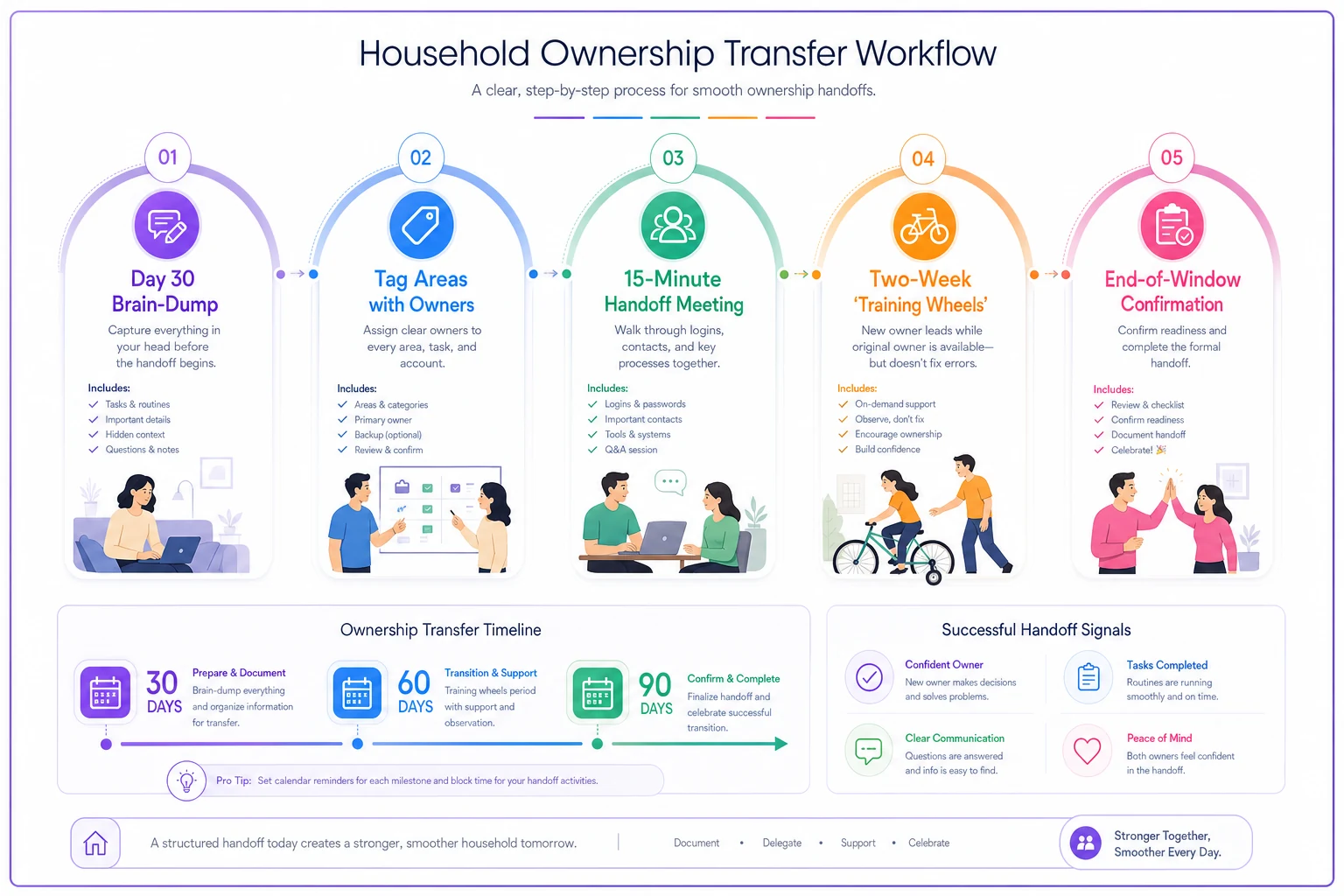
Now you assign. But the distinction that matters: an owner is responsible for the whole loop — noticing, deciding, doing, following up — while a helper only acts when asked. Resentment lives almost entirely in the gap between those two.
Go through the day-30 list and tag each item as owned by one person. Shared ownership on a single task is usually a trap — it means nobody actually owns it and it falls back on the original manager by default. Split by area, not by individual chore. One person owns "kids' school world" end to end. The other owns "bills and vendors" end to end. Clean boundaries beat tangled 50/50 arrangements on everything.
-
Pick an area the new person will fully own — start with two or three, not fifteen.
-
The current owner does a real handoff
logins, contacts, the standard, the gotchas. Fifteen minutes of that beats two months of silent correction.
-
Set a "training wheels" window of two weeks where the original owner stays reachable for questions but does not fix things quietly.
-
If something slips, the new owner handles the fallout. That's how ownership becomes real.
-
At the end of the window, the original owner formally lets go — including letting go of how it gets done, as long as the standard is met.
This process makes the handoff concrete and repeatable so everyone knows what ownership actually looks like.
That last point is where a lot of handoffs die. If you transfer trash duty but still hover over exactly when and how it's taken out, you haven't transferred anything — you've added a supervisor. Owning an area means owning the method too. The standard is non-negotiable; the technique is theirs.
Negotiation checkpoint at day 60: Each person names one thing they own that feels heavier than expected, and one thing they'd happily trade. No defensiveness, just data. This is the meeting where early mis-splits get corrected before they calcify.
> "When we split this on day 30, I didn't realize [the pickup schedule / the refill tracking] came with it. It's more than it looked like. Can we look at trading something back so it's even?"
Days 61–90: Rebalance once reality is visible
The split you agree on at day 30 is a guess. You divided the list before anyone knew what each area actually weighed. By day 90, you have real data — what took longer, what carried hidden load, what one person turned out to be much faster at.
The 60–90 window is for honest rebalancing. Not a full renegotiation from scratch — that signals the earlier agreement failed and breeds defensiveness. Just adjustments based on what you now know.
-
Which owned areas felt heavier than the task list suggested
-
Anything still falling through the cracks (usually means it has no real owner)
-
Whether any "training wheels" areas are now fully transferred or still leaning back on the original manager
-
One or two trades to even out felt load
-
What becomes a standing cadence going forward — a short monthly check so this doesn't drift
The most common finding at this stage: one area that looked small (medical coordination, or "noticing we're out of stuff") turns out to carry enormous invisible weight, and whoever owns it is quietly drowning. Another area that looked big — cooking, say — turns out to be something one person genuinely enjoys and doesn't experience as a burden. The fair split isn't equal task-count. It's equal felt load.
> "I don't want to redo everything — most of this is working. I just want to catch the one or two things that are quietly uneven before either of us starts keeping score about it."
That phrase — before either of us starts keeping score — names the actual enemy. Resentment is a scoreboard nobody admits they're keeping. Saying it out loud in a calm moment defuses it far better than letting it surface during an argument about something completely unrelated.
A short real-world scenario
A blended household — one partner with an 8-year-old, moving in with someone who'd lived alone — went through this structure because the first month had already gone badly. The parent was handling close to 40 recurring responsibilities and the new partner's contribution was mostly cooking plus whatever got explicitly requested. By week four, the parent was exhausted and the partner felt like they could never do anything right.
They ran the day-30 brain dump. The partner was genuinely shocked at the list — the school portal, the refill tracking, the three standing activity pickups nobody had mentioned. In the 31–60 window the partner fully took over "bills, vendors, and the car stuff," including noticing and deciding, not just paying when told. By day 90 they rebalanced: the medical coordination that looked tiny was eating hours, so it got traded, and cooking stayed with the partner because they actually liked it.
The measurable change was modest but real — the parent went from carrying roughly 35 invisible items to around 20, and the "why am I the only one who notices" comments basically stopped. The bigger shift was tone. Correction turned into ownership, and the low-grade score-keeping faded because the splits were things they'd agreed to, out loud, with the real list in front of them.
When a structured 90-day onboarding is overkill
This isn't always necessary. If you're both coming into a brand-new place at the same time with no established system, there's nothing to hand off — you build from zero together, which is a different and honestly easier problem. The handoff structure matters specifically when one person has a running household and the other is joining it.
It's also overkill for light households — no kids, minimal recurring coordination, two people who genuinely don't mind who does what. If nothing's piling up and nobody's keeping score, don't manufacture process for its own sake.
Who should be careful with this: anyone tempted to use "ownership transfer" language as a way to offload everything they dislike onto the new person under the banner of fairness. The checkpoints exist to catch lopsided splits in both directions. If every area the new person owns is the dreaded stuff, the day-60 meeting will — and should — surface it.
Keeping it from drifting back
A split that's fair on day 90 won't stay fair forever. Kids' schedules change, jobs change, someone's workload spikes. The reason resentment creeps back in is that the arrangement gets treated as permanent when life isn't.
Schedule a recurring 15-minute monthly check-in on the calendar so small imbalances get caught early.
A short monthly check — fifteen minutes, "anything feeling uneven lately?" — keeps small imbalances from compounding into the kind of quiet grudge that surfaces six months later over something that has nothing to do with chores. Writing the ownership map down somewhere you both can see it, rather than carrying it in one person's head again, is what keeps the whole thing from silently collapsing back onto the original manager.
Merging a household is an onboarding project, not a personality test. Surface the invisible work, transfer real ownership instead of shallow help, rebalance once you can actually see the weights, and say the uncomfortable thing in a calm moment instead of a heated one. Do that, and the person who was supposed to get relief actually gets it — which was the whole point of living together in the first place.
Merging a household is an onboarding project, not a personality test. Surface the invisible work, transfer real ownership instead of shallow help, rebalance once you can actually see the weights, and say the uncomfortable thing in a calm moment instead of a heated one. Do that, and the person who was supposed to get relief actually gets it — which was the whole point of living together in the first place.
Ready to simplify your household management?
Join thousands of families using Famioly to save time, reduce home management stress, and keep the household running smoothly.