



Starting July 1st, dozens of cities and counties across the U.S. are rolling out minimum wage increases that hit household budgets directly. According to GovDocs' latest tracking, major metros including Chicago, multiple California cities, Montgomery County Maryland, and the Portland area are seeing wage floors climb to $17–19/hour or higher.
For families with nannies, housekeepers, tutors, or part-time caregivers, the math hits fast. A family paying a part-time nanny $15/hour for 25 hours a week is suddenly looking at $200–250 more per month when rates jump to $17 or $18. Full-time household help? Closer to $400–500 extra monthly.
And it's not just absorbing higher costs. These changes are forcing families to rethink how they've structured household support entirely. Some scramble to renegotiate. Others lose providers who migrate to commercial work that offers better pay and benefits. Many end up redistributing tasks across family members in ways they'd never seriously considered before.
The ripple effects hit harder than the wage increase itself
When household help costs go up, it rarely stays contained to one budget line. Your regular Saturday babysitter who charged $15 expects $18 now—but so does everyone else in your network. The housecleaner you've had for three years gives notice because a commercial cleaning company offered benefits on top of the new minimum. Your after-school driver picks up steadier work elsewhere.
What really breaks household operations is the need to manage multiple changes at once. You're not just adjusting a number in a spreadsheet. You're reworking schedules, redistributing tasks, retraining family members, setting up new accountability systems—all while managing the friction that comes with shifting responsibilities.
The families that get through this don't just cut hours or drop services. They rebuild how household operations actually work, blending paid help with family participation in ways that hold up in practice, not just on paper.
Task segmentation: the approach that keeps costs manageable
Successful families stop treating household help as all-or-nothing and start being honest about which tasks genuinely require a professional versus what family members can realistically handle.
Stop losing track of household duties.
Famioly helps you organize, assign & complete family tasks efficiently.
- Centralized task management
- Shared family calendar
- Budget & expense tracking
No credit card required
Start by documenting everything your paid help currently does, then sort by skill requirement, time sensitivity, and family capability. One family I came across did this exercise before cutting their cleaner's hours. Their typical four-hour weekly visit broke down like this:
High-value professional tasks (keep outsourced):
-
Deep bathroom sanitization (45 minutes)
-
Kitchen appliance deep clean (30 minutes)
-
Floor mopping/proper treatment (45 minutes)
Transferable maintenance tasks (bring in-house):
-
General tidying and organizing (40 minutes)
-
Dusting surfaces (30 minutes)
-
Trash collection and disposal (15 minutes)
-
Basic vacuum of high-traffic areas (25 minutes)
By keeping the cleaner for two focused hours of deep cleaning while the family handled daily maintenance, they cut costs roughly in half without their home noticeably declining in cleanliness. The piece that made it work was a daily 10-minute tidying rotation that kept things from snowballing into a weekend disaster.
Building verification loops that prevent household chaos
Shifting tasks from paid professionals to family members almost always leads to quality dropping off—unless you build in some kind of verification structure. The families that successfully reduce paid help without constant conflict are the ones with simple accountability systems in place.
This isn't about elaborate inspection routines. It's about low-effort checkpoints that catch problems before they stack up.
One family built what they called "zone checks"—quick visual confirmations that take under 30 seconds. Their kitchen zone check happens at 8pm: dishwasher running, counters wiped, tomorrow's lunch supplies visible, coffee maker prepped. Not spotless, just operationally ready. When someone skips it, the next person immediately hits the problem, which creates natural accountability without a parent having to police anything.
Tie zone checks to daily rituals like dinner or bedtime so they become automatic and don't require extra thought.
Their bathroom check covered toilet paper stocked, hand towel not soaked, mirror reasonably clean, floor clear. Twenty seconds. Prevents the kind of moments you only discover when guests are already walking through the door.
These work because they're binary, visible, and tied to real consequences rather than rules.
Renegotiating with current providers: scripts that actually work
Before eliminating services, it's worth trying to renegotiate. A lot of providers would rather keep a steady client than go searching for new ones, even if it means adjusting how they work.
"Sarah, with the minimum wage changes, we need to adjust our arrangement to stay within budget. We value your work and want to keep working together. Could we explore either fewer hours at your current rate, or maintaining hours with some scheduling flexibility built in?"
Then offer real options:
| Option | Details |
|---|---|
| Option A | Keep current hourly rate for 3 hours of focused deep cleaning weekly instead of 5 hours of general cleaning |
| Option B | Adjusted rate of $16.50 for current hours, with 24-hour notice flexibility when we don't need the full visit |
| Option C | Monthly retainer of $340 for 5 flexible hours scheduled throughout the month |
Many providers accept structures like these because consistency matters to them too. The families holding onto good help right now are almost always the ones offering something that works for both sides.
Technology coordination without the overwhelming apps
Managing a hybrid of paid help and family labor requires some coordination, but most families go too complicated too fast and end up with apps nobody opens. What actually works is simple: task ownership, schedule visibility, and completion tracking.
A shared calendar showing who covers what, when paid help arrives, and which family member handles gaps is usually enough to start. Add recurring reminders for tasks that commonly get skipped—trash, laundry cycles, restocking supplies.
The verification piece matters more than the assignment piece. Quick photo confirmations work better than checkbox apps for most families. "Kitchen closed" with a photo of clean counters. "Bathroom stocked" with a shot of the supply shelf. Visual proof eliminates the endless "I thought you did it" conversations.
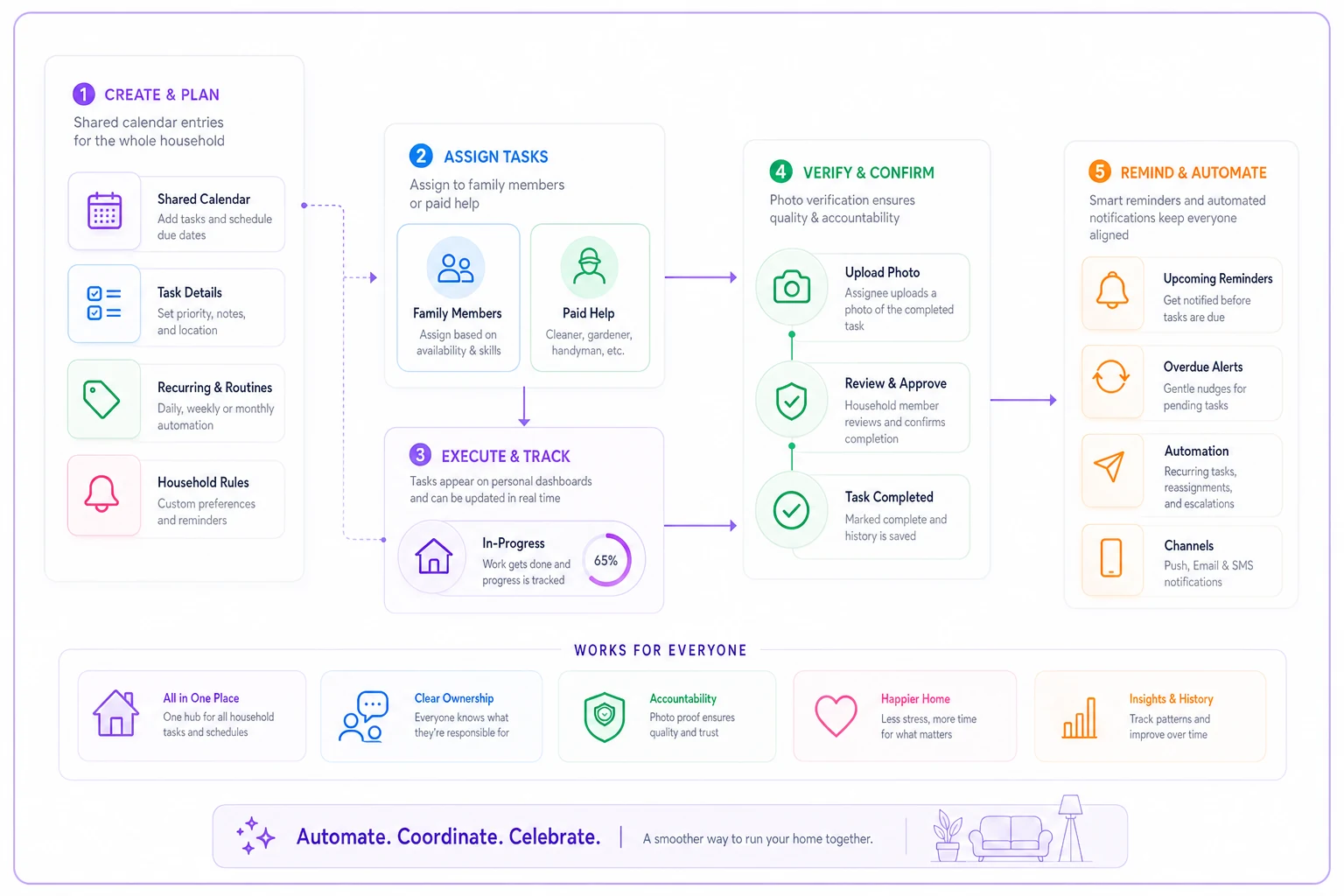
This sketch shows how tasks move from assignment to photo verification and automated reminders.
For families managing more complexity, AI-powered household management platforms can handle the assignment logic, send reminders at the right times, and flag patterns before they turn into recurring breakdowns. The automation takes care of the tracking and nudging so the family can focus on actually doing things rather than coordinating who's supposed to do what.
Hidden cost-reduction opportunities most families miss
Beyond rate adjustments and task redistribution, a few operational moves make a real difference:
Batch scheduling with neighbors: Three families on the same block share a Saturday babysitter, rotating which house hosts the kids each week. Each family pays for one full Saturday per month instead of four partial sessions. The sitter earns more per hour with less dead time between gigs.
-
Task trading networks Instead of everyone hiring specialists, families trade skills. The accountant handles expense tracking for three households in exchange for meal prep from a family with culinary chops and home repairs from the contractor down the street. No cash changes hands, but real value does.
-
Student labor for specific tasks College students often charge significantly below market for tutoring, driving, or basic household help. An education major providing after-school homework support at $13/hour versus $25 for a professional tutor is a real trade-off worth thinking about, especially for younger kids where the quality gap is rarely that significant.
-
Automation with quick payback A robotic vacuum in the $350–450 range eliminates a few hours of weekly cleaning labor. At $18/hour, it pays for itself in a couple of months. Grocery delivery subscriptions save shopping trips that otherwise require babysitter coverage—the math on that one catches people off guard.
Beyond rate adjustments and task redistribution, a few operational moves make a real difference:
Creating financial buffers for labor cost volatility
Minimum wage increases don't happen once and stop. Families that handle this well build structures that absorb future bumps without completely reworking operations every time.
The buffer approach that holds up combines three things:
First, a "household labor reserve" separate from general savings. Even $50 a month builds flexibility for when rates shift or emergency coverage comes up. It's not emergency fund money—it's specifically for managing labor volatility.
Second, relationships with providers at different price points. A premium babysitter for date nights, a standard after-school option, and an emergency backup should ideally be three different people at three different rates. When costs rise somewhere, you shift usage rather than losing coverage entirely.
Third, knowing the real cost of each outsourced task. A lot of families don't account for the hidden pieces—transportation, supplies, coordination time. That "quick grocery run" requiring a babysitter often costs $35+ when you factor in the sitting fee and what happens when you shop under stress.
Why some families thrive with less paid help
The families that come out ahead when they reduce paid help share a few things in common. They treat household work as actual operations rather than a list of chores someone else should handle. They've built clear delegation systems with verification baked in so standards don't quietly slide when the professionals aren't around. They stay flexible and adjust quickly when something breaks down instead of forcing a bad system to keep running.
And honestly, they're not aiming for perfect. They're aiming for sustainable—which turns out to be a more useful target anyway.
Practical next steps for immediate implementation
Fisher Phillips' employer guide is worth reviewing if you want a clear summary of what's changing where. For families who need to act now, here's a realistic week-by-week path:
Day 1–2: Assessment
-
List all current paid household help and their hours
-
Calculate the real cost increase based on your locality's new minimums
-
Document exactly which tasks each provider handles
Day 3–4: Prioritization
-
Categorize tasks by skill requirement and family capability
-
Identify which services are essential versus nice-to-have
-
Map potential task redistribution among family members
Day 5–7: Communication
-
Contact current providers to discuss continuation options
-
Hold a family meeting to assign redistributed responsibilities
-
Set up basic verification checkpoints for critical tasks
Week 2: Implementation
-
Begin modified arrangements with retained help
-
Start family task rotations with daily check-ins
-
Adjust based on what's immediately breaking down
Week 3–4: Optimization
-
Evaluate what's holding versus what's falling apart
-
Explore coordination tools if manual tracking is failing
-
Consider automation investments for the highest-friction tasks
The families getting through these increases aren't the ones with unlimited budgets or unusually cooperative kids. They're the ones who treat this as an operational problem rather than a crisis—and move quickly from figuring out the scope of the problem to actually doing something about it.
The families getting through these increases aren't the ones with unlimited budgets or unusually cooperative kids. They're the ones who treat this as an operational problem rather than a crisis—and move quickly from figuring out the scope of the problem to actually doing something about it.
Ready to simplify your household management?
Join thousands of families using Famioly to save time, reduce home management stress, and keep the household running smoothly.