



Most allowance setups fall apart for a boring reason: the payout is disconnected from anything a kid can actually learn from. Money shows up, money disappears, and nobody remembers why. The learning goal gets buried under the mechanics.
If you've ever handed over $5 on a Saturday and watched it vanish into gumball machines by Sunday, you already know the gap. The problem isn't the kid. It's the design of the system around the money.
So let's fix the design.
## The four mistakes that quietly wreck allowance
Before getting into what works, it's worth naming the specific failure patterns. These aren't parenting flaws — they're operational flaws. The allowance "runs" the way a badly built process runs.
Mistake 1: Tying every dollar to a chore. This turns your kid into a contractor. Suddenly, "Can you set the table?" gets answered with "How much?" A 7-year-old should help around the house because they live there, not because there's a line item attached. When everything is paid, nothing is a contribution.
Mistake 2: Irregular, mood-based payouts. You pay when you remember. Or when they nag. Or when you happen to have cash. Kids can't learn to plan around income that shows up randomly. Adults can't either — it's the same reason unpredictable pay wrecks household budgeting.
Mistake 3: No structure for what happens to the money. The dollar lands in a pocket and there's no "now what." No save, no spend, no give. Just a blob of cash with no destination. The lesson evaporates because there was never a decision to make.
Mistake 4: No checkpoints. Nobody ever sits down and looks at how it's going. So a kid who's blowing every dollar on candy at 6 is still blowing every dollar on Roblox at 11, because nothing ever prompted a course correction.
Fix these four and the allowance starts doing its actual job: teaching money management instead of just transferring money.
## Start with cadence, not amount
Parents obsess over the number. "Is $5 too much? Should it be a dollar per year of age?" The amount barely matters for learning. The cadence is what teaches.
Stop losing track of household duties.
Famioly helps you organize, assign & complete family tasks efficiently.
- Centralized task management
- Shared family calendar
- Budget & expense tracking
No credit card required
Pay on a fixed schedule, same day, no exceptions, regardless of behavior. Weekly works best for ages 5–8 because their sense of time is short — a two-week wait feels infinite and the lesson loses its thread. For 9–12, you can stretch to every two weeks, which starts to mimic how real paychecks land and forces a little more planning.
The non-negotiable part: it arrives whether or not chores got done.
That sounds backwards until you separate the two systems in your head:
-
Allowance = money to practice managing. It's the training budget.
-
Contribution chores = things you do because you're part of the household. Unpaid.
-
Extra earning opportunities = optional paid jobs above the baseline (washing the car, pulling weeds). This is where a kid can increase income if they want to.
When these three get tangled, everything breaks. Keep the allowance predictable and untethered so the kid can focus on the actual skill — deciding what to do with money they can count on.
## The Save / Spend / Give split (and why the ratio matters less than the ritual)
The classic three-bucket system works, but people implement it wrong. They set up jars, feel accomplished, and then never revisit them. The jars become storage, not a decision tool.
The ritual is what matters. Every payout, the kid physically or digitally divides the money before spending anything. The dividing is the lesson.
A starting split that works for most families:
| Age range | Save | Spend | Give | Notes |
|---|---|---|---|---|
| 5–7 | 30% | 60% | 10% | Keep it simple; round to easy numbers |
| 8–10 | 40% | 50% | 10% | Introduce a short-term savings goal |
| 11–12 | 50% | 40% | 10% | Add a "long-term" sub-goal inside Save |
Don't treat these as sacred. A $4 weekly allowance doesn't split cleanly into 40/50/10, and that's fine — round it. The point is the habit of pausing to allocate, not the decimal precision.
One thing that consistently backfires: parents who "correct" the spend bucket. If a kid wants to blow their entire spend allocation on a cheap toy that breaks in a day, let them. That $2 lesson at age 7 is dramatically cheaper than the same lesson at 22 with a credit card. Buyer's remorse is the curriculum.
## Trackers kids will actually use
A tracker only works if the kid maintains it, or at least sees it regularly. Elaborate spreadsheets die in a week. Here's what survives contact with a real 8-year-old:
-
Ages 5–7 Physical jars or envelopes, clearly labeled, transparent if possible so they can see the money grow. Visibility drives saving at this age far more than numbers.
-
Ages 8–10 A simple paper log — date, amount in, amount out, running balance. Three columns. They update it at payout and after any spend. This is where basic arithmetic sneaks in.
-
Ages 11–12 A shared digital tracker they can check anytime. This is the age where a kid asking "how much do I have saved toward the skateboard?" should be able to get an instant answer without asking you.
The common failure is the parent maintaining the tracker for the kid. If you're doing the logging, you're the one learning, not them. Your job is to prompt and verify, not to run the books.
For busy households already juggling shared calendars and chore rotations, the allowance tracker can live in the same place you keep the rest of your household coordination — the point being that it shouldn't require yet another separate app or a fresh sheet of paper you'll lose. Centralizing it next to your existing family routines means the checkpoints below actually happen instead of getting forgotten.
## Parent scripts that prevent transactional confusion
The single biggest source of allowance chaos is inconsistent parent language. One week it's "you didn't earn it," the next it's "here you go anyway," and the kid learns that the rules are made of fog.
When they ask to get paid for a contribution chore:
> "Setting the table is a family job — everyone helps because we all live here. If you want to earn extra, the car-washing job is open this weekend."
When they blew their spend money and want more:
> "You've used your spend money for this week. Payday is Saturday. What could you do differently next time?"
No lecture. No bailout. The question at the end is the teaching moment.
When they want something bigger than their savings:
> "That's $30 and you've saved $12. How many weeks until you get there? Want to figure it out together?"
This converts a "no" into a planning exercise. You're not the obstacle — the math is.
When they want to give more than the give bucket:
> "That's really generous. It's your money, so you can move some from your spend bucket if you want to give more."
Let them make the tradeoff consciously. That's the whole point.
Consistency matters more than exact wording here. A kid who knows how you'll respond stops trying to negotiate and starts working within the system — which is where the learning actually happens. Families with clear, repeated decision language spend far less time arguing than families who re-litigate every request from scratch.
## Milestone checkpoints: the part everyone skips
This is the piece that separates an allowance that teaches from one that just dispenses cash. Without checkpoints, there's no feedback loop, and without a feedback loop there's no learning — just a habit running on autopilot.
Build in three types of checkpoints:
-
Weekly micro-check (2 minutes, at payout). "How'd last week go? Anything you're saving toward?" That's it. Keep it light. This just keeps money on the kid's radar.
-
Monthly review (10 minutes). Sit with the tracker. Look at what got spent, what got saved, whether the savings goal is moving. Ask one reflection question: "If you could redo one purchase from this month, would you?" No judgment on the answer — you're building self-awareness, not shame.
-
Milestone graduations. These are the level-ups tied to demonstrated skill, not age:
The graduations matter because they make the whole thing feel like progress rather than a permanent kid-arrangement. An 11-year-old who's earned "Level 4" and helps pick the weekend outing budget is learning real money judgment, not just candy allocation.
-
Level 1 → 2 Kid consistently splits money without reminders for a month → they get a raise and control over a small recurring expense (their own snack budget, say).
-
Level 2 → 3 Kid successfully saves for and buys a $25+ goal item themselves → introduce a "wait 48 hours before any purchase over $15" rule they self-enforce.
-
Level 3 → 4 Kid tracks their own balance accurately for two months → they get a say in a small family spending decision, like which activity to book within a set budget.
Here's roughly how that progression looks in practice:
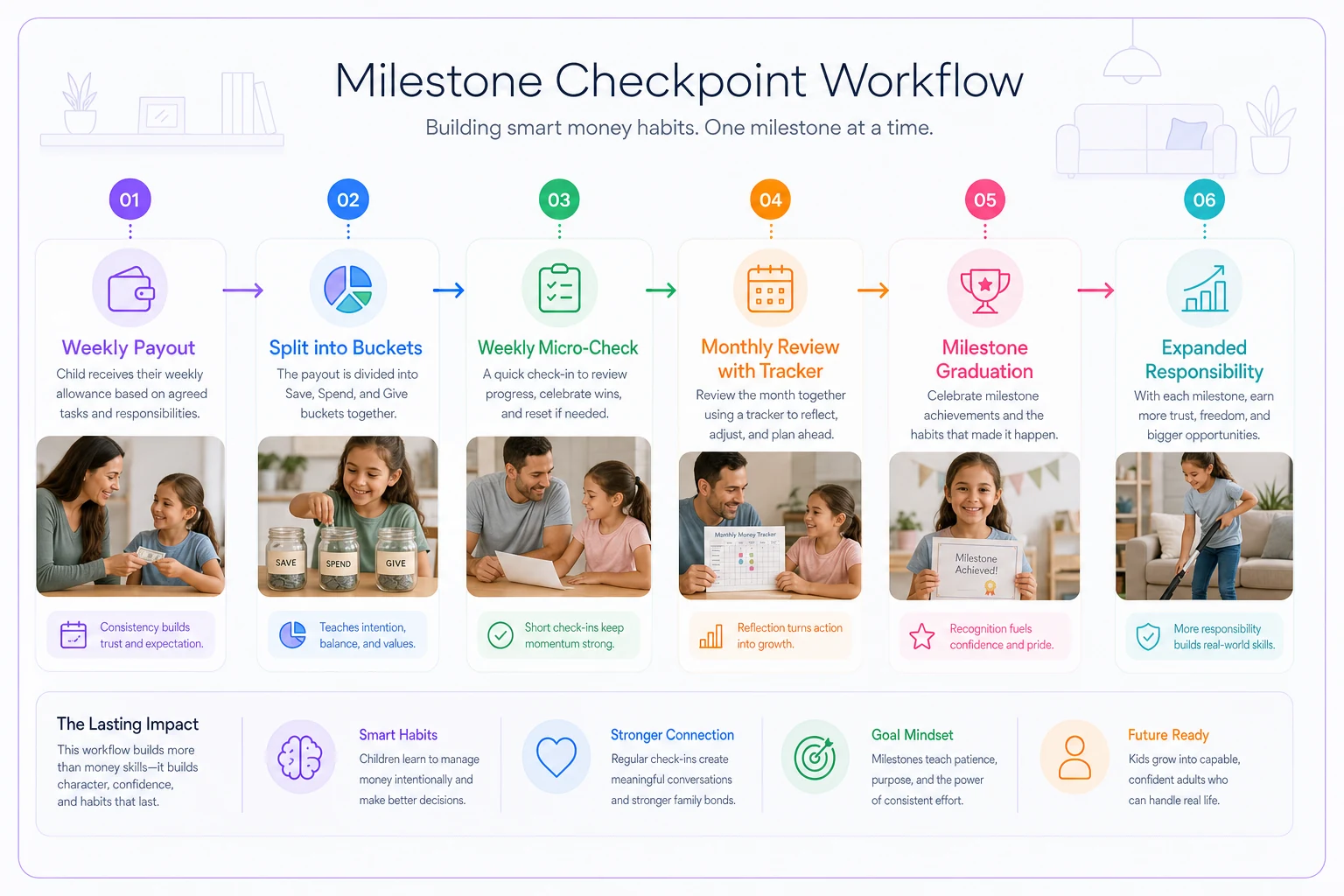
Weekly payout ↓ Split into buckets (same day, every time) ↓ Weekly micro-check (2 min) ↓ Monthly review (10 min, with tracker) ↓ Milestone graduation (skill-based, not age-based) ↓ Expanded responsibility + new financial decision to practice
The cadence is the engine. Everything else just keeps it honest.
## A real scenario: two kids, one broken system, one fixed one
A family with two kids — ages 6 and 10 — ran the classic tangled setup. Allowance was chore-based, paid "whenever," roughly $5 and $8 respectively when it happened at all. The 6-year-old spent everything instantly. The 10-year-old had somehow accumulated about $60 in random cash around her room but had no idea how much she had or what it was for. Every chore request turned into a negotiation.
They switched to a cadence system: fixed Saturday payouts, allowance fully separated from contribution chores, three-bucket split, and a monthly review. Amounts stayed nearly the same — around $5 and $8.
Within about two months, the negotiation-over-chores problem basically disappeared, because chores were no longer a transaction. The 10-year-old, now tracking a running balance, saved toward a $28 art set and bought it herself — the first time she'd ever waited for anything. The 6-year-old still spent most of his money fast, but the give bucket meant he was setting a few coins aside for a cause he picked, and the weekly micro-check meant money was at least on his mind.
Nothing dramatic. No perfect little savers. But the system was now teaching, which the old pile-of-cash approach never did.
## When this makes sense — and when it doesn't
This works well when:
-
Your kids are roughly 5–12 and you want money management to be a repeatable habit, not a one-off lecture.
-
You can commit to a consistent payday. Consistency is the whole engine.
-
You're willing to let small money mistakes happen without rescuing.
This is a bad idea when:
-
You'd use the allowance as a behavior-control lever ("no allowance because you talked back"). Mixing discipline into the payout re-tangles everything you just separated. Handle behavior separately.
-
You can't keep the schedule. An irregular cadence is worse than no cadence, because it teaches that income is unpredictable and unearnable-through-planning.
Skip the elaborate version if your kid is under 5 — at that age, a single jar and "watch it fill up" is plenty. The full three-bucket, tracker, and checkpoint structure is overkill and just frustrates everyone.
## The one thing to get right
If you do nothing else from this whole piece, do this: make the payout predictable and separate it from chores. Everything else — the split ratios, the trackers, the milestone levels — is refinement on top of that foundation.
A kid who can count on money arriving on a schedule, and who has to decide what to do with it every single time, is already learning the two hardest lessons in personal finance: money is finite, and planning beats reacting. The buckets and checkpoints just make those lessons stick.
The allowance isn't really about the dollars. It's about giving a kid a small, low-stakes economy to practice in before the stakes get real. Build the cadence, keep it steady, and let the small mistakes do the teaching.
Ready to simplify your household management?
Join thousands of families using Famioly to save time, reduce home management stress, and keep the household running smoothly.