



Late October brought a wave of warnings from the companies that stock your pantry and your cleaning closet. According to a Reuters report, several major food and household‑goods brands signaled more price increases ahead as commodity and energy costs climb. Around the same time, the USDA's Food Price Outlook nudged its forecasts upward again. For the person actually doing the shopping: the number at the bottom of the receipt is about to move, and it's going to move right as holiday spending ramps up.
That's the news. But the news isn't really the interesting part. What a price warning actually exposes is how most households run their money and their labor — and why the families who absorb these increases quietly aren't the ones with more income. They're the ones who treat their grocery spend and their paid help as a system they can adjust, not a fixed cost they just endure.
The real problem a price hike reveals
Most families don't have a grocery budget problem. They have a visibility problem.
The grocery line is lumpy — some weeks $180, some weeks $320 — and nobody can explain why. Paid help (cleaner, lawn service, occasional babysitter, meal kit subscription) runs on autopilot. Chores are "whoever has time," which usually means one person. So when costs rise 6–9% across the board, there's no lever to pull because nobody knows which parts of the spend are flexible and which are load‑bearing.
A price increase doesn't break a well‑run household. It breaks a vague one. The families that struggle most aren't wildly overspending — they just can't see their own system clearly enough to make a fast adjustment.
So this isn't a "clip coupons harder" article. It's about building enough structure that a 7% cost increase becomes a 20‑minute fix instead of a month of stress.
Start by separating flexible spend from fixed spend
Before you cut anything, figure out what can flex. Pull your last two months of grocery and household‑product spending and sort every recurring cost into three buckets:
Stop losing track of household duties.
Famioly helps you organize, assign & complete family tasks efficiently.
- Centralized task management
- Shared family calendar
- Budget & expense tracking
No credit card required
-
Locked — things you won't touch (prescriptions, baby formula, specific dietary needs, the one brand your kid will actually eat)
-
Flexible — same function, cheaper path available (cleaning supplies, paper goods, snacks, generic staples)
-
Optional — nice‑to‑have that survives only if the budget allows (premium subscriptions, specialty items, convenience foods)
What usually surprises people is how large the Flexible bucket turns out to be. In a typical household grocery run, somewhere between a third and half of the total sits in "same function, cheaper path." That's your absorption capacity. You don't need to touch Locked, and you can defend most of Optional — if you actually get disciplined about Flexible.
The mistake people make is cutting Locked items to feel virtuous — "we'll just stop buying the good coffee." That creates misery without saving much, and the cut never sticks. Go where the volume is, not where the emotion is.
Rework the budget as a trigger, not a target
A budget number sitting in a spreadsheet is useless the moment reality drifts. What works better is a trigger system — rules that tell you when to act, not just how much to spend.
A simple version:
| Trigger | What it means | Action |
|---|---|---|
| Weekly grocery > 15% above your 8‑week average | Prices or habits are drifting | Review the last receipt, swap 3 Flexible items to store brand |
| Two straight weeks over budget | Not a fluke | Pause one Optional subscription for the month |
| Household‑product restock costs jump noticeably | Supplier pricing moved | Buy that category in bulk once, lock a lower per‑unit cost |
| Monthly total holds under target for 4 weeks | You have breathing room | Restore one Optional item you missed |
The point is that the budget responds. You're not staring at a static number feeling guilty — you're reacting to signals. Define the threshold, define the action, stop re‑deciding every week.
Audit paid help before you cut groceries
This is the step most families skip, and it's often where the real money is.
Recurring in‑home services tend to accumulate quietly. A cleaner every two weeks, a lawn service that's technically year‑round, a dog‑walking arrangement, two or three subscription boxes. Individually they feel small. Together they frequently rival or exceed the grocery line — and unlike groceries, they're often locked into pricing you negotiated years ago, or never negotiated at all.
> A two‑income household with two kids pulled their recurring service costs and found roughly $540–$600 a month across a biweekly cleaner, a meal‑kit subscription nobody used half the time, a lawn service billing through winter, and two subscription boxes. They didn't eliminate anything drastic. They moved the cleaner to every three weeks, paused the meal kit for the season, renegotiated the lawn service to a dormant‑season rate, and cut one box. Net: a little over $200/month freed up — more than enough to absorb the grocery increase they were worried about, without changing a single family routine.
When costs rise, the instinct is to squeeze the thing you touch daily (food). But the thing you don't touch daily — the set‑and‑forget services — is usually where the slack hides.
If you want the full renegotiation approach, including the day‑by‑day sequence and ready‑to‑use scripts for vendors and creditors, the Household Rebalance Toolkit covers exactly how to reprice recurring help without burning the relationship or losing the service.
Ask for dormant‑season or frequency discounts — many vendors will offer lower rates if you suggest a concrete, time‑limited change.
If you want the full renegotiation approach, including the day‑by‑day sequence and ready‑to‑use scripts for vendors and creditors, the Household Rebalance Toolkit covers exactly how to reprice recurring help without burning the relationship or losing the service.
When reassigning chores actually makes sense (and when it backfires)
Converting some paid hours back into household hours is one honest way to offset a rising grocery bill. But it only works under specific conditions.
When it makes sense:
-
The task is genuinely teachable to family members (basic cleaning, pet care, simple yard work)
-
You have the capacity to absorb it without pushing one person into overload
-
The savings are meaningful relative to the effort — reclaiming a $120/month service, not a $15 one
When it's a bad idea:
-
You'd be loading it onto the person already carrying the household's mental weight
-
The service exists specifically to buy back time during a chaotic season
-
The "savings" are small and the friction is high — you'll resent it by week three
Who should not do this right now: families already in a stretched period — newborn, eldercare crunch, a move, a health event. During those windows, protect your paid help even at a higher cost. Cutting support during peak chaos to save a bit on groceries is a false economy that usually costs more later in missed work, burnout, or things falling through the cracks.
If you do reassign, the rule that makes it stick is simple: a reassigned chore needs an owner and a checkpoint, not just an announcement. "Kids will handle the kitchen" dies in a week. "Kitchen reset is Jordan's job, checked at the Sunday reset" survives.
A 30/60/90 sequence to absorb the increase without drama
You don't need to do everything this weekend. Spread it out.
First 30 days — see clearly and stop the bleeding
-
1. Pull two months of grocery + household‑product spend and sort into Locked / Flexible / Optional
-
2. List every recurring paid service with its real monthly cost
-
3. Set your three or four budget triggers
-
4. Swap the five highest‑volume Flexible items to cheaper equivalents and see if anyone even notices
Next 30 days — renegotiate and reassign
-
5. Contact your top two recurring services and ask about seasonal rates, frequency changes, or loyalty pricing
-
6. Pause or cancel one Optional subscription you won't miss
-
7. Reassign one paid task to a family owner with a checkpoint
-
8. Tighten pantry planning so you stop the duplicate‑buy leak — buying what you already have is a quiet 5–10% waste in a lot of homes
Days 60–90 — lock it in and recheck
-
9. Compare the new monthly total against your pre‑increase baseline
-
10. Restore anything you cut that turned out to matter more than you expected
-
11. Reset your 8‑week averages so your triggers reflect the new price reality
-
12. Decide what's permanent and what was just for the holiday crunch
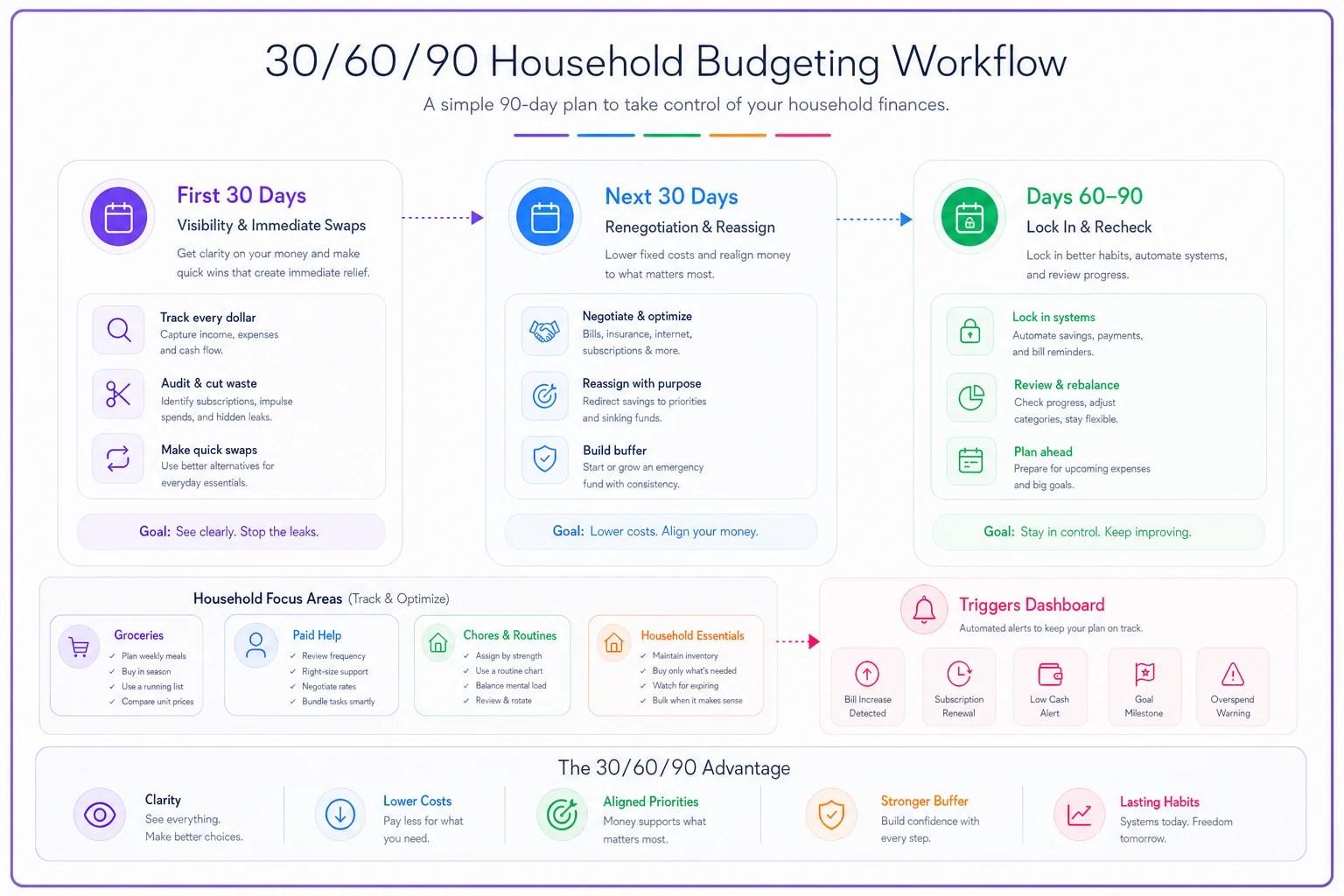
A quick visual of the 30/60/90 workflow helps keep the steps clear.
This sequence works because it doesn't demand a full household overhaul on day one. You're building clarity first, then making moves — which means fewer decisions you'll want to undo two weeks later.
Keep the system visible, or it quietly dies
The reason most household budget resets fail isn't the plan. It's that the plan lives in one person's head and evaporates the moment life gets busy.
What holds it together is keeping the whole thing visible and shared — the spending triggers, the vendor list with renewal dates, the reassigned chores with their owners, the pantry levels that prevent duplicate buys. Whether you run this in a shared spreadsheet, a family‑organizer app, or a simple household management platform, the format matters far less than the fact that more than one person can see it. A system only two eyeballs can access isn't really a system — it's a chore waiting to be dropped.
The households that handle this round of increases well won't be the ones who found some secret coupon. They'll be the ones who already knew which portion of their spend was flexible, which services could adjust, and who owned what — so a 7% bump turned into a short Sunday conversation instead of a slow month of friction.
Price warnings are really just a prompt. They force a question most families never ask on a calm week: do we actually understand how our own household runs? Answer that once, build the structure around it, and the next warning — because there's always a next one — becomes a non‑event.
Ready to simplify your household management?
Join thousands of families using Famioly to save time, reduce home management stress, and keep the household running smoothly.