


The dishwasher starts leaking on a Tuesday night. Someone in the house says "just replace it, it's old." Someone else says "the repair guy quoted $180, that's cheaper than a new one." Now you've got a twenty-minute argument based entirely on gut feeling, with nobody actually checking how old the thing is or whether it's still under warranty.
That's the real problem. Not the broken appliance — the fact that every repair-vs-replace call gets treated like a brand-new philosophical debate. Families burn energy re-deciding the same type of question over and over, and the outcomes are inconsistent because they depend on who's in the room and how tired everyone is.
A repair vs replace decision method fixes this by turning a mushy judgment call into four quick inputs: age, repair-cost percentage, warranty status, and emotional value. You run the numbers, you get an answer, you move on. This post gives you the exact thresholds, decision trees for the categories you'll actually face, and a note on when to write things down so you're not guessing next time.
The four inputs that actually decide it
Most people only look at one variable — usually the repair quote — and that's why the decisions feel arbitrary. A $180 repair on a $600 appliance is very different from a $180 repair on a $220 one, but the dollar figure alone doesn't tell you that.
1. Age relative to expected lifespan. Not "is it old," but how far into its life it actually is. A refrigerator at year 10 of a roughly 13-year lifespan is in a very different spot than a phone at year 3.
2. Repair cost as a percentage of replacement cost. This is the single most useful number. If the repair costs more than half of what a new unit would run you, you're usually throwing good money after bad. The working threshold most people land on is the 50% rule: repair cost above 50% of replacement price leans strongly toward replace.
3. Warranty status. This one flips everything. A covered repair costs you nothing but a phone call, which changes the math instantly. The mistake families make is paying out of pocket for something a warranty would've handled — usually because nobody checked, or nobody could find the paperwork.
4. Emotional value. This isn't filler. A hand-me-down sewing machine or a couch tied to a specific memory can justify a repair the numbers wouldn't. The trick is naming it as emotional before you rationalize it as financial. Be honest about which lever you're actually pulling.
Here's the combined logic in one table:
| Situation | Age vs lifespan | Repair cost % | Warranty | Default call |
|---|---|---|---|---|
| Early failure | Under 40% of lifespan | Any | Likely covered | Repair (usually free) |
| Mid-life, cheap fix | 40–70% | Under 30% | Expired | Repair |
| Mid-life, pricey fix | 40–70% | Over 50% | Expired | Replace |
| Late-life | Over 70% | Over 30% | Expired | Replace |
| Any age, high emotional value | Any | Under ~60% | Any | Repair (override) |
| Any age, safety issue | Any | Any | Any | Replace or professional repair only |
The safety row matters more than the money math. Anything involving gas, high heat, electrical shorts, or brakes doesn't get a "well, it's cheap to patch" answer. You either fix it properly or you replace it.
Quick decision trees for the categories you'll actually hit
Averages are useless when the dryer's broken right now. So here are trees for the common ones, with real thresholds you can act on.
Stop losing track of household duties.
Famioly helps you organize, assign & complete family tasks efficiently.
- Centralized task management
- Shared family calendar
- Budget & expense tracking
No credit card required
Here's a quick visual workflow for the decision trees.
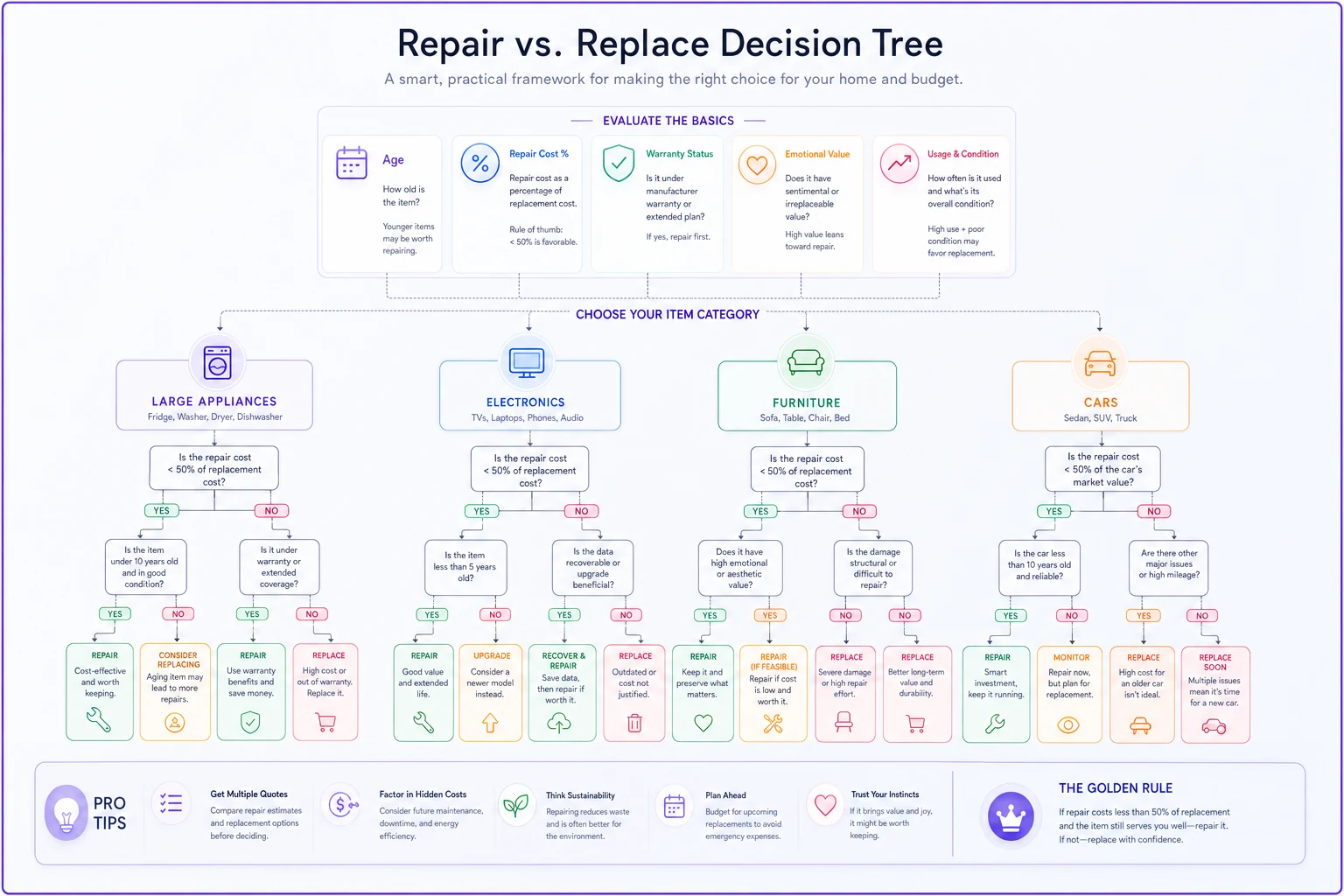
Large appliances (fridge, washer, dryer, dishwasher)
-
Is it under warranty or a service plan? → Yes
file the claim, stop here.
-
Is the repair quote over 50% of a comparable new unit? → Yes
replace.
-
Is it past about 8 years old and this is the second repair in 12 months? → Yes: replace.
-
Otherwise → repair.
Electronics (phones, laptops, tablets)
-
Is it under manufacturer warranty or accidental-damage coverage? → Yes
claim it.
-
Is the repair a screen or battery only? → Usually repair — these are the two cheap, high-value fixes.
-
Is it a logic-board or water-damage repair over 40% of a new device? → Replace.
-
Is the device more than one OS-support cycle from end-of-life? → Lean replace even on a cheap fix.
The mistake here is sinking $200 into a phone that stops getting security updates in eight months. The repair "works," but you've bought yourself less than a year on a device that's already on its way out.
Furniture and household goods
-
Is the frame structurally sound? → If yes, reupholstery or repair is almost always cheaper than replacing.
-
Is the damage cosmetic on a solid-wood or high-quality piece? → Repair.
-
Is it particleboard or flat-pack with structural failure? → Replace — these don't repair well.
-
High emotional value plus a repairable frame? → Repair, and don't over-justify it.
Cars (the big one)
-
Is the repair over the vehicle's current resale value? → Strong replace signal.
-
Is it a single repair under roughly 50% of value on an otherwise reliable car? → Repair.
-
Are you facing a third major repair in a year? → Replace — you're funding a money pit.
The pattern worth noticing: appliances rarely fail once at the end of their life. They fail twice in quick succession. The first repair is almost always worth it. The second repair within a year is the real signal the unit is done, regardless of what the individual quote looks like.
A real scenario with the numbers
A household of four, two working parents. Their washer — about 9 years old — started leaving clothes soaked. The instinct in the room was split: one wanted to replace immediately, the other had already gotten a $210 repair quote and wanted to save money.
Running the method took maybe five minutes:
-
Age 9 years into a roughly 12-year lifespan — around 75% of life used up.
-
Repair cost % $210 against roughly $650 for a comparable new washer = about 32%.
-
Warranty Expired two years earlier.
-
History They'd paid $160 six months earlier for a different issue on the same machine.
On the surface, 32% is under the 50% line, so "repair" looks right. But this was the second repair in under a year on a unit past 70% of its life. The tree flagged replace, and they went with it. The new unit came with a warranty, and when they compared notes with a neighbor whose identical washer kept nickel-and-diming them through two more repairs, the decision had clearly paid for itself.
The point isn't the exact dollars. The history input caught something the single repair quote hid. One number lied; four numbers together told the truth.
When to actually write it down
You don't need to log every decision. But three triggers are worth a two-line note somewhere the household can actually find:
-
You paid for a repair. Log the date, the item, the cost, and what was fixed. This is the only way the "second repair in 12 months" rule works next time.
-
You bought a replacement. Log the purchase date and warranty length. Future-you will thank present-you when something breaks and you can't remember if it's still covered.
-
You made an emotional-value override. Note it honestly. If you keep repairing the same sentimental item three times, that's real information about whether to finally let it go or invest in a proper restoration.
This ties directly into keeping warranty and maintenance records straight. The households who don't lose money on this stuff are the ones who can answer "when did we buy it and is it covered" in under a minute, instead of digging through a junk drawer while the repair tech waits.
Where a simple tracking system helps
The whole method falls apart if the inputs live in three different people's heads. Age and warranty status are only useful if you can actually find them when you need them.
A shared household management tool earns its keep here — something light where each major appliance has a record with its purchase date, warranty expiry, and a running note of past repairs. The value isn't automation for its own sake. It's that when the dishwasher leaks on a Tuesday night, anyone in the house can pull up the record, see it was bought 18 months ago and is still covered, and file a claim instead of arguing.
Put purchase dates and warranty expirations in a shared note so anyone can check coverage in under a minute.
AI-assisted reminders can flag when a warranty is about to lapse or nudge you to log a repair you just paid for, so the history the decision tree depends on actually exists when you need it. The tool doesn't make the decision — it just makes sure you're deciding with real numbers instead of vibes.
When this method is a bad fit
A couple of honest caveats.
Don't use it for cheap consumables. A $25 kettle isn't worth a decision framework. If replacement is under whatever an hour of your time costs, just replace it and move on. The method is for the $200+ decisions.
Don't let the percentage rule override safety. No matter how cheap the fix, anything with a gas leak, electrical scorching, or a compromised brake line goes to a professional or gets replaced. The math is irrelevant when the failure mode is a fire or an accident.
Don't over-engineer emotional value. It's a real input, but it's also the easiest one to abuse. If you find yourself justifying a fourth repair on the same item purely on sentiment, that's usually the sign to either restore it properly once or let it go.
The takeaway
The repair vs replace decision method works because it replaces an emotional argument with four quick inputs anyone in the house can run the same way. Age tells you where you are in the item's life. Repair-cost percentage tells you if the fix is proportional. Warranty status can flip the whole thing to free. And emotional value gets a seat at the table — as long as you name it honestly instead of disguising it as financial logic.
Run the tree, log the three triggers, and the next broken appliance becomes a two-minute call instead of a twenty-minute debate. The households who handle this well aren't smarter about appliances — they just decided how to decide once, so they never have to re-argue it.
The repair vs replace decision method works because it replaces an emotional argument with four quick inputs anyone in the house can run the same way. Age tells you where you are in the item's life. Repair-cost percentage tells you if the fix is proportional. Warranty status can flip the whole thing to free. And emotional value gets a seat at the table — as long as you name it honestly instead of disguising it as financial logic.
Run the tree, log the three triggers, and the next broken appliance becomes a two-minute call instead of a twenty-minute debate. The households who handle this well aren't smarter about appliances — they just decided how to decide once, so they never have to re-argue it.
Ready to simplify your household management?
Join thousands of families using Famioly to save time, reduce home management stress, and keep the household running smoothly.