



Most family trips don't fall apart at the airport. They fall apart three days earlier, when someone realizes the dog sitter was never actually confirmed, the passport for the 9-year-old expired in April, and nobody paused the pool service — so it's been running while you're 2,000 miles away.
Packing is the easy part. What sinks families is the long tail of tasks that don't belong to anyone — the ones that live in the gap between "I thought you were doing that" and "I assumed you had it." A solid family trip pre-flight checklist isn't a packing list. It's a schedule of decisions and handoffs, each one with a name attached and a date it needs to happen.
This is the timeline we're covering: 30 days out, 7 days out, 2 days out, and the day itself. Each phase has different work, and — this is the part everyone skips — different owners. The failure pattern is almost always the same: one person (usually the household manager) silently absorbs 90% of it, forgets three things because they're carrying too much, and the trip starts with a fight in the driveway.
Why the last-minute scramble happens every single time
Trip prep is a mix of two very different kinds of tasks, and most families treat them as one:
-
Long-lead tasks that fail silently if missed early — passports, prescription refills, boarding reservations, house sitter confirmation.
-
Short-fuse tasks that only make sense at the last minute — pulling perishables from the fridge, setting the thermostat, taking out the trash the morning you leave.
When you don't separate these, everything collapses toward the end. The long-lead stuff gets remembered too late, and by then the vet is fully booked or the passport renewal takes six weeks and your flight's in three. Classic example: a family books a spring break trip in January, feels great about being organized, then does zero prep until the week before because it felt far away. "We booked early" is not the same as "we prepared early."
The second problem is ownership fog. In a lot of households, prep defaults to whoever notices the task first. That means the same person catches everything, which sounds fine until they miss one thing — and now there's a cat with no food for a week and nobody to blame but the whole setup.
The real cost, in things that actually go wrong
The consequences aren't abstract. A few patterns that come up over and over:
Stop losing track of household duties.
Famioly helps you organize, assign & complete family tasks efficiently.
- Centralized task management
- Shared family calendar
- Budget & expense tracking
No credit card required
-
The pet care gap. Sitter confirmed verbally, never locked in with actual dates. Sitter thought the trip was the following week. Family lands in Orlando to a text: "Wait, you left already?"
-
The house-comes-home-to-a-disaster problem. Nobody stopped the mail, so a full mailbox advertised an empty house. Or the AC was left running at 74°F through eight days in July — a solid $60–$90 tacked onto the bill for cooling an empty house.
-
The document miss. Expired passport, forgotten prescription, no printed copy of the rental confirmation when the app won't load at the counter.
-
The re-entry crash. No milk, no clean clothes, a pile of mail, and everyone's back at work the next morning. Trip's over, stress lasts another week.
None of these are dramatic. That's exactly why they slip. Each one is a small, boring task that felt like someone else's job.
The 30/7/2/day-of timeline with owners attached
The fix is laying the whole thing out on a timeline where every task has a phase and a person. Below is the structure. Adapt the owners to your household — the point is that "Owner" is never blank.
| Phase | Focus | Example tasks | Suggested owner |
|---|---|---|---|
| 30 days out | Long-lead + anything that fails silently | Check passport/ID expiration, refill prescriptions, book pet care, arrange house/plant sitter, request time off, notify school | Trip lead (adult A) |
| 7 days out | Confirmations + logistics | Reconfirm pet care with dates in writing, hold mail, arrange rides to airport, download offline maps/boarding passes, set out-of-office | Adult B + one older kid |
| 2 days out | Prep + packing | Pack bags, charge devices, print backup confirmations, prep pet supplies + written care sheet, clean out fridge of perishables | Whole family, split by person |
| Day-of | Short-fuse only | Trash out, thermostat set, water off (if needed), lights on timer, lock check, final pet handoff | Adult A does final walkthrough |
The magic isn't the list — it's that each row has a name. The 30-day row is where families win or lose, because everything on it has a slow failure mode. Miss the passport check at 30 days and you might still fix it. Miss it at 7 days and the trip is in real trouble.
One pattern worth calling out: put every confirmation on the 7-day row, not the 30-day row.
Here's a simple visual of the timeline and the handoffs between owners.
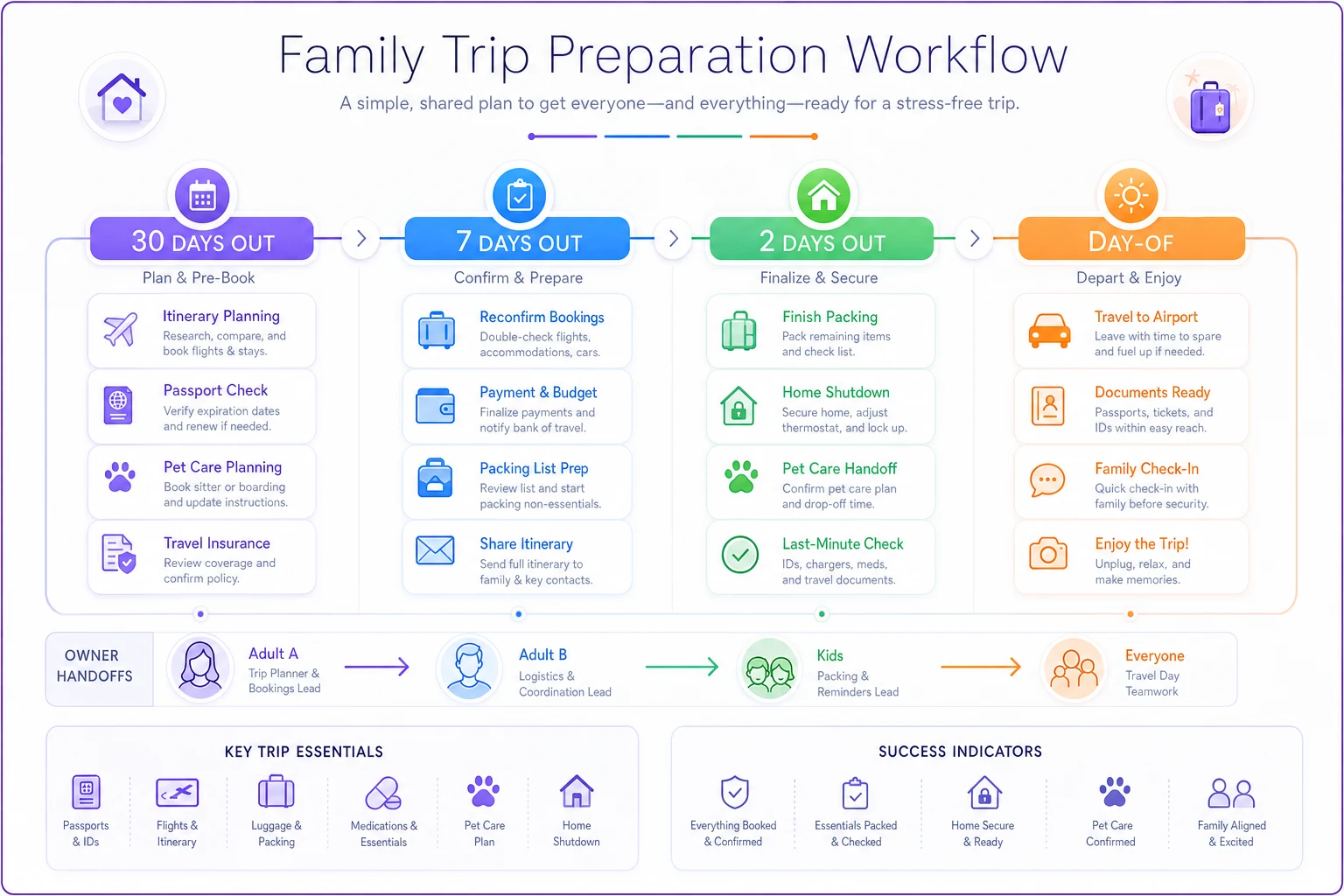
The reconfirm is the load-bearing step.
Pet and home care: the two things that need their own mini-plan
These two areas cause more post-trip regret than anything else.
Pet care. Verbal agreements are where this breaks down. The fix is a one-page care sheet the sitter can follow without calling you, plus a written date confirmation. Your care sheet should include:
-
Feeding amounts and times (be specific — "one scoop" means nothing to a new sitter)
-
Medication with exact timing
-
Vet name, address, and after-hours number
-
Where supplies live (leash, food, litter, meds)
-
What "normal" looks like vs. when to actually call the vet
-
Your contact number plus one backup local contact who can show up in person
Home care. The house needs a shutdown routine and, for longer trips, a check-in arrangement. Core items:
-
Hold mail and packages — or have a neighbor collecting daily
-
Thermostat set to away temp
-
Water main off if you've had any leak history
-
Lights on a timer or smart plug
-
One trusted neighbor who knows you're gone and has a key
The mistake families make is treating pet and home care as day-of tasks. They're not. The arranging is a 30-day task. The written care sheet is a 2-day task. The handoff is day-of. Spread across the timeline, it's calm. Crammed into the last morning, it's chaos.
The contingency layer: what to do when the common failures hit
A checklist assumes everything goes right. It won't. The families who travel smoothly aren't the ones with perfect plans — they're the ones who decided in advance what happens when something breaks. Here's a quick-reference for the failures that actually recur.
-
Sitter cancels last minute. Have a pre-identified backup — a second sitter, a specific neighbor, or a boarding facility you've already checked for availability. Don't scramble to find one at 6 a.m. Have the name written on the care sheet before you leave.
-
Passport or ID expired or missing. For domestic trips, know your acceptable backup IDs. For international, the 30-day check exists specifically so this never becomes a day-of emergency. If it does surface late, expedited renewal is possible but it costs more and eats your buffer — which is the whole argument for checking early.
-
Flight delayed or canceled. Keep the airline app and the phone number saved. The phone line often rebooks faster than the desk line at the gate. Know your hotel's cancellation window before you need it.
-
Kid gets sick the day before. Decide your threshold in advance — what symptoms mean "we still go" vs. "we call the pediatrician" vs. "we push a day." Making that call while packing at midnight is how families make bad decisions.
-
You forgot something important at home. Keep a shared "did we forget" list. Meds and chargers are the usual culprits. For meds specifically, know which pharmacy chain has a location near your destination — a forgotten prescription becomes a 20-minute detour instead of a ruined trip.
A contingency isn't a paragraph of worry. It's a pre-made decision: if X, then Y. Written down, assigned, done. That's the difference between a family that handles a canceled sitter in ten minutes and one that spends the first day of vacation on the phone.
When this level of structure actually makes sense — and when it doesn't
Worth it: longer trips (four-plus days), trips with pets, international travel, anything involving multiple people coordinating (blended families, multigenerational households), or any situation where one parent has historically carried all the prep and it's causing friction. The more moving parts, the more the timeline earns its keep.
Overkill: an overnight to grandma's, a weekend where a neighbor's already handling the cat and there's no flight involved. Don't build a 30-day plan for a two-day trip — you'll abandon it and lose trust in the system for the trips that actually need it.
The household where the same adult always ends up doing 90% of prep is also worth naming directly. If that's you, a better personal checklist isn't the fix. Genuinely splitting the rows is. The point of assigning owners is that no single person is the failure point — a checklist owned by one exhausted person is just a more organized version of the same problem.
A real scenario
A family of four — two working parents, two kids (ages 7 and 11), one dog — does a week-long summer trip most years. Their pattern for a long time: everything landed on the mom around four days out. Last year they nearly lost their sitter (she'd blocked the wrong week), forgot the 11-year-old's asthma inhaler refill, and came home to a fridge situation nobody wants to describe.
This year they ran the 30/7/2/day-of timeline with tasks split between both parents, and small day-of jobs handed to the kids — charging their own devices, packing their own carry-ons off a short list. The 30-day check caught the inhaler refill with three weeks to spare. The 7-day reconfirm caught the sitter's calendar mix-up while there was still time to fix it.
Total prep didn't take less time overall — maybe 20–30 minutes spread across a few weeks instead of one frantic evening — but it stopped landing on one person, and the driveway argument didn't happen. Fewer surprises, fairer split. That's the real win.
Keeping the timeline alive between trips
This only works if the timeline outlives one trip. The families who stop scrambling are the ones who save the template — the owner assignments, the pet care sheet, the shutdown routine — and reuse it each time.
Whether that lives in a shared note, a spreadsheet, or a household app that fires the 30-day and 7-day reminders automatically so nobody has to remember to remember, the format matters less than the habit.
Build it once, tweak it each trip, and the next departure starts from a working plan instead of a blank panic.
The goal was never a perfect vacation. It's a departure morning where the biggest question is "who's driving" — not "wait, did anyone give the sitter the dog's feeding schedule."
Ready to simplify your household management?
Join thousands of families using Famioly to save time, reduce home management stress, and keep the household running smoothly.